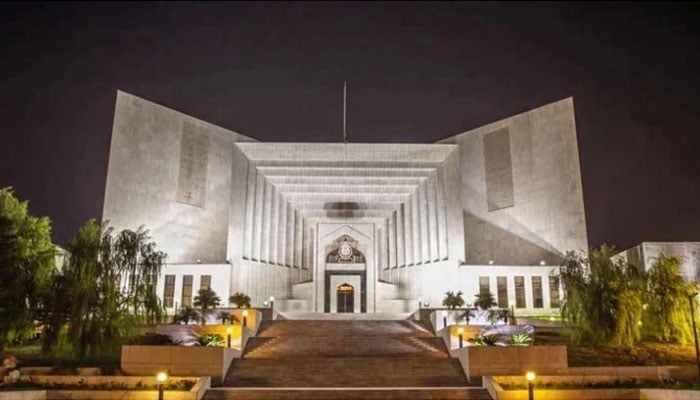
ISLAMABAD: The Supreme Court of Pakistan on Thursday observed that 24 years of imprisonment is insufficient punishment in a case involving the murder of a father (by his son), stressing the need to establish clear legal principles in such matters.
A three-member bench headed by Justice Hashim Kakar heard the case concerning remission of sentence of Muhammad Safdar, who was convicted of killing his father.
During the hearing, counsel for the convict informed the court that a reconciliation had been reached in the case and a report to that effect had already been submitted. He further stated that his client has spent the last 14 years in prison.
At this, Justice Kakar remarked that even 24 years of imprisonment would be inadequate for someone who murders his father, adding that the court must develop a firm and principled approach for dealing with such cases.
Justice Ishtiaq Ibrahim observed that while forgiveness is permissible under the principles of Qisas and Diyat, an accused in such grave offences cannot be granted complete acquittal or a clean slate —particularly when the victim is the father.
The court emphasised that a guiding and significant judgment is necessary to address such cases. Justice Kakar stated that the verdict will be announced on April 8, adding that it will carry exceptional importance.
Meanwhile, the Supreme Court of Pakistan has commuted a death sentence to life imprisonment in a murder case that took place within the premises of a sessions court in Gujrat.
A three-member bench headed by Justice Hashim Kakar heard the case on Thursday.
During the hearing, counsel for the accused submitted that in 2010, the accused’s brother was killed within the premises of sessions court. A year later, the alleged accused was himself killed at the same location.
Justice Kakar inquired about the timing of the incident and the age of the accused at the time and at present. The defence counsel informed the court that the incident occurred in 2011, when the accused was 21 years old, and he is now 36.
The counsel further argued that the accused has already completed a life imprisonment term and, under the Nelson Mandela Rules, a second punishment cannot be imposed after completion of one sentence.
During the proceedings, Justice Ishtiaq Ibrahim questioned the recovery of three bullet casings from the crime scene, noting that while two matched the pistols, the source of the third casing remained unclear.
The court noted that the case was complex and somewhat confusing; however, after reviewing all aspects, it ordered the commutation of death sentence to life imprisonment.