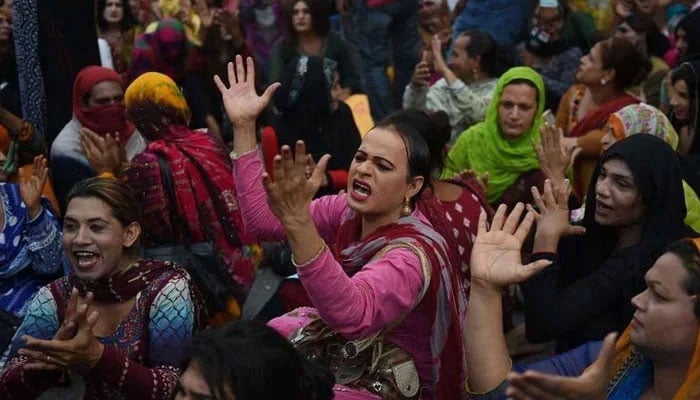
In the cramped alleyways of Rawalpindi and the sprawling slums of Karachi, there exists a population that the state has legally recognised but socially abandoned.
For the transgender community of Pakistan, the passage of the Transgender Persons (Protection of Rights) Act in 2018 was meant to be a turning point-a promise of dignity, employment, and protection. Seven years later, that promise remains largely unfulfilled and the community is paying the price not just with their livelihoods, but with their minds.
Multiple mental health professionals working with trans Pakistanis over the years describe the population as being in crisis. Depression, anxiety, post-traumatic stress disorder and suicidal ideation are not exceptions but near-universal experiences. The causes are not chemical imbalances but structural ones: familial rejection, economic destitution, police brutality and a healthcare system that often inflicts further trauma on those who seek help.
For most trans individuals in Pakistan, the story begins with the family and with a rupture that never fully heals. The moment a young person begins to express a gender identity that does not align with the specific sex assigned at birth, the response from relatives is often swift and brutal. Beatings are common. Conversion therapy, often administered by religious healers who promise to ‘cure’ the individual through exorcism, is widespread. When these methods fail, as they invariably do, the child is cast out.
This expulsion typically occurs during adolescence, a critical period for psychological development. Stripped of education, shelter and the most basic sense of safety, these young people have nowhere to go except the dera system – communal living spaces led by a guru, or an elder. While deras provide a surrogate family and a cultural identity, they are also spaces of profound vulnerability.
Psychologists who have conducted rare mental health surveys within the community report that rates of complex post-traumatic stress disorder (C-PTSD) are extraordinarily high. Unlike single-incident trauma, C-PTSD results from prolonged, repeated exposure to abuse and helplessness – exactly the conditions that define the lives of most trans Pakistanis. Symptoms include emotional dysregulation, a distorted sense of self, difficulty forming trusting relationships and a pervasive sense of hopelessness.
The economic reality of trans life in Pakistan deepens these wounds. With no formal education or family connections, employment options are almost non-existent. A small minority find work as dancers at weddings or birth celebrations, but even this work is precarious. Performers are routinely harassed by audience members for entertainment, cheated by event organisers and extorted by police who view their presence as an opportunity for bribery.
For the majority, survival depends on sex work. This is not a choice but a compulsion. Sex work exposes trans individuals to constant physical danger. Clients are often violent. Police raids are a regular occurrence, and officers routinely demand sexual favours in exchange for release. The psychological toll of this double victimisation, abused by clients and then by the very authorities meant to protect them, is immeasurable.
Yet when trans individuals attempt to seek mental health support, they often encounter the same discrimination that defines their lives. Pakistan’s public healthcare system has no meaningful infrastructure for addressing mental health needs, even for the general population. For trans people, the situation is exponentially worse. Psychiatrists and counsellors frequently lack even basic training in gender identity. Many refuse to treat trans patients altogether, citing personal or religious objections. Others pathologise gender identity itself, treating being trans as a disorder requiring ‘correction’ rather than affirming the patient’s identity.
Community-based organisations have attempted to fill this void, but their resources are severely limited. The Dareecha Male Health Society in Rawalpindi, one of the few organisations offering integrated services, provides basic mental health counselling alongside medical care. But the demand far outstrips the supply. The absence of formal mental health support has led to desperate coping mechanisms. Substance abuse is rampant within the community. Crystal methamphetamine, known locally as ice, is widely used. For such sex workers, it serves a dual purpose: it provides the energy to endure long nights on the streets and offers a temporary escape from the weight of constant degradation. But the drug accelerates psychological deterioration, increasing paranoia, aggression and the risk of psychosis. It also drives risky sexual behaviour, creating a deadly synergy with the HIV epidemic that already disproportionately affects the community.
Self-harm is another grim reality. Community health workers report that cutting and other forms of non-suicidal self-injury are common, particularly among younger individuals in this community who have recently been ejected from their families. These behaviours serve as a way to exert control over a body that society has deemed unacceptable, to transform emotional pain into something physical and therefore manageable.
Suicide is the darkest dimension of this crisis. While no official statistics exist, Pakistan does not collect data on suicide rates disaggregated by gender identity. Anecdotal evidence from community organisations suggests that trans individuals die by suicide at rates dramatically higher than the general population. The causes are almost always external: a brutal encounter with police, a client who went too far, the death of a guru who was the only source of support, or simply the accumulation of years of being told that one’s existence is an abomination.
The 2018 Transgender Persons Act was supposed to change this. It mandated the creation of protection centres, safe houses and anti-discrimination mechanisms. It promised employment quotas and legal recourse for those denied services. Yet successive governments have done little to implement these provisions. The protection centres exist on paper but not in practice. No public hospital has been held accountable for turning away trans patients. No police officer has faced consequences for sexually assaulting a trans individual in custody.
Activists argue that mental health interventions cannot succeed without addressing this structural violence. You cannot counsel away the trauma of police brutality, they say. You cannot treat depression in someone who does not know where their next meal is coming from. The psychological wounds of the trans community are not individual pathologies but symptoms of a society that has refused to accept their humanity.
Some progress has been made, largely through the efforts of community-led organisations operating on shoestring budgets. Peer support networks, where trans individuals counsel other trans individuals, have proven effective in ways that formal therapy often cannot. The shared experience of discrimination creates a foundation of trust that is impossible in a clinical setting with a cisgender, heterosexual provider. These networks operate informally, through WhatsApp groups and gatherings in deras, but they are often the only lifeline available to someone contemplating suicide.
There are also small but significant shifts in the legal landscape. In recent years, a handful of trans activists have won court cases challenging police harassment and employment discrimination. These victories are important symbolically, but they remain isolated. For every trans person who successfully fights a dismissal from work, hundreds more are fired without recourse. For every police officer convicted of abuse, dozens continue to prey on the community with impunity.
The mental health crisis among transgender Pakistanis is not a niche issue. It is a public health emergency that reflects the broader failure of the state to protect its most vulnerable citizens. The cost of this failure is counted not just in depression scores or substance use statistics but in lives lost to suicide, to violence, to the slow erosion of the will to live.
Community leaders are clear about what is needed. First, mandatory training for all healthcare providers on transgender health issues, including mental health. Second, the establishment of dedicated mental health clinics run by and for trans individuals, staffed by providers who understand the specific traumas of the community. Third, meaningful implementation of the 2018 Act, including employment quotas that provide a path out of survival sex work. Fourth, police reform that ends the routine harassment and extortion that define interactions between law enforcement and trans citizens.
None of these changes will come quickly. In a country where mental health services are already severely underfunded and where social conservatism remains deeply entrenched, the trans community will continue to fight for every inch of progress. But the cost of inaction is becoming impossible to ignore. The invisible wounds are becoming visible in the rising number of suicides, in the faces of young people who see no future for themselves, in a community that has been asked to endure more than any community should bear. The alarm has been raised. The question is whether Pakistan will finally listen.
The writer is the co-founder of Virtual Baithak.