It is said that the truth is the first casualty of war, but it won’t be wrong to add that ordinary people of the world face the brunt of conflicts, whether such conflicts erupt in one part of the world or another region of the globe.
This is what is happening during the ongoing conflict in the Middle East that has decimated more than 1400 people in Iran, besides causing the deaths of dozens of Americans, Israelis and Middle Eastern citizens. The conflict has also played havoc with the infrastructure of the invaded country, where more than 10,000 places have been targeted by the brutal Israeli and American attacks. It is asserted that more than 10,000 have also been wounded in Iran, while over 3000 Israelis have sustained injuries of varying degrees.
The ongoing conflict is causing hardships for ordinary people worldwide. Tehran has shut down traffic through the Strait of Hormuz, and with it, 20 per cent of the world’s oil supply and 19 per cent of global liquefied natural gas supply. This is why people in America and Western countries are paying higher energy prices, and the cost of freight has also risen. Aerial traffic has also been disturbed for weeks now, with many ordinary people finding it hard to make it to their destinations. It is the ordinary working-class people, especially in the Middle East, who cannot visit their home town on time or attend a funeral of their loved ones in time because of flight disturbances. Some of these workers might have wanted to be with their dying mother or father. Others might have been saving money to see their kids who have not been able to see their family head owing to their employment abroad.
The conflict seems to be engulfing different parts of the Middle East. The strikes have provided an opportunity to warmongers sitting in power corridors of Tel Aviv, Washington, London and Paris to claim vindication. They have been advocating a united front against the Islamic Republic, asserting that the Iranian strikes indicate that Iran has the capability to target Western states. But any united front would further push the world towards a terrible conflagration. Such a scenario will bring more death and destruction not only to the people of Iran but also to the Middle East and beyond.
It might also destabilise countries like Bahrain, Iraq, Saudi Arabia and Yemen, which have pockets of Iranian support or in the case of Bahrain and Iraq, a large Shia population, which constitutes the majority in the two countries. Pockets of resistance could also emerge in the UAE, Jordan and Kuwait, where Israel is viewed with great suspicion, at least at a public level.
Iran is witnessing one of the largest destructions in its recent history. Its oil facilities have been attacked, while civilian infrastructures were also targeted by ruthless bombardments of Israel and the US. Tehran targeted Qatar, Saudi Arabia, the UAE and other states, hitting their infrastructure in some of the attacks. Some civil and military infrastructure has also been targeted in Israel, while Israeli Prime Minister Netanyahu has wreaked havoc on the lives of millions of Lebanese who witnessed more than 1000 deaths and the displacement of over 1 million people.
Qatar has also been affected, with its gas infrastructure partially destroyed. It is believed that the country will incur a loss of $200 billion over the years. The US has already spent more than $12 billion, and the administration of President Donald Trump is seeking another $200 billion to pump into this insane conflict, creating more hardships in the lives of ordinary Americans who are already reeling under the impacts of rising energy prices.
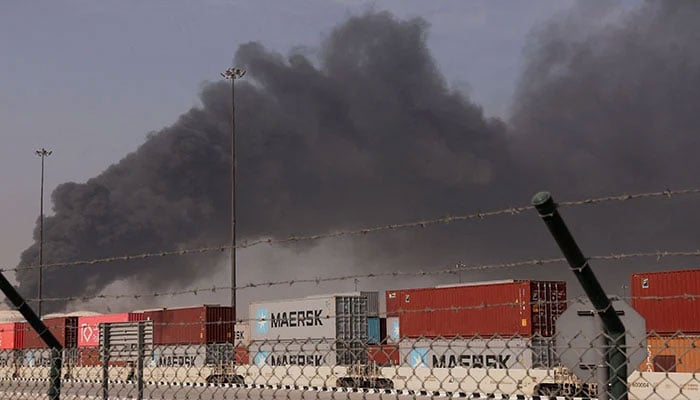
Environmental destruction could also be added to the list of casualties. After reducing Gaza to rubble, Israel seems to be bent on sending Iran into the ‘stone age’. The strategy of the US does not seem to be different from the one adopted by the Zionist state. The targeting of oil refineries and gas installations in the Islamic Republic will leave a deep mark on the environmental landscape of the invaded country. Nine million residents of Tehran recently woke up to truly horrific scenes resembling an apocalypse, with thick black smoke shrouding the capital, blocking out sunlight and the sky.
According to the ‘Guardian’, “Soot and black gunk covered the streets, cars, and people’s houses as toxic air filled their lungs. Those who experienced this nightmare reported waking up with pain in their throat and their eyes burning”. The attack caused huge fires, the newspaper wrote, adding it also led to thick clouds of billowing smoke. “As a result of the strikes, oil spilled onto the sewers, contaminating the water and causing fires to spread catastrophically”.
According to a report by the Climate and Community Institute, an American think tank, the total greenhouse gas emissions from the first 14 days of the assault exceed 5 million tonnes of carbon dioxide, more than Iceland’s total climate pollution in 2024. “This figure is also equivalent to the emissions from 1.1 million gas-powered cars over a year and represents over $1.3 billion in climate damage”.
The international community failed in preventing Israel from wreaking havoc in Gaza. Consequently, the Zionist state’s merciless attacks generated 39 million tonnes of debris besides killing over 36000 civilians. Tel Aviv not only poisoned the lives of those who lost their loved ones during the conflict, but it has also injected a trail of slow death into the landscape of Gaza. According to a United Nations Environment Programme’s report, “Gaza’s five wastewater treatment plants have shut down, with sewage contaminating beaches, coastal waters, soil, and freshwater with a host of pathogens, nutrients, microplastics, and hazardous chemicals. This poses immediate and long-term threats to the health of Gazans, marine life, and arable lands”.
So, it is clear that the Zionist state did not only commit genocide in Gaza, but it also paved the way for ecocide – and this is what it is planning to do in Iran. But what regional states need to remember is that such an environmental disaster would not only affect the Islamic Republic but the entire region too.
Therefore, wealthy monarchies in the Middle East should act, persuading Washington to rein in Israel. It is not Iran that triggered the conflict, but the Zionist regime. Tehran has had missiles for years, but none of them has ever been directed against anyone. One can argue that the Islamic Republic is fighting a war of survival and might go to any extent to protect its sovereignty, including prolonging the conflict. But such a war of attrition would also engulf the rest of the Middle East, causing more terrible environmental destruction. Therefore, they should use their leverage over Trump to let common sense prevail and end the war.
The writer is a freelance journalist who can be reached at: [email protected]