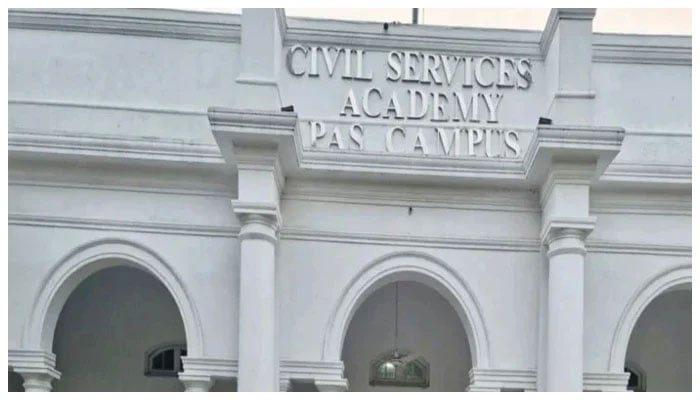
LAHORE: Marking a significant shift in Pakistan’s approach to bureaucratic training, the Pakistan Civil Services Academy (CSA) has formally commenced the 54th Common Training Programme (CTP), unveiling a comprehensive set of reforms designed to modernise the intellectual, professional and ethical foundations of the country’s civil service.
The inaugural ceremony, held at the academy’s Walton Campus, signalled the transition of newly inducted probationary officers selected through the Central Superior Services (CSS) examination into a rigorously structured and immersive training environment. The proceedings opened with a flag hoisting ceremony conducted by two probationers, symbolising unity, discipline and a shared commitment to national service.
In a departure from past practice, the academy has introduced a pre-training engagement phase aimed at developing a deeper understanding of the officers’ personal and psychological profiles. This process includes structured interaction with parents as well as detailed psychological assessments carried out in collaboration with the Health Services Academy and e-ORBIT, an initiative officials say is intended to ensure a more informed and tailored training experience.
Speaking on the occasion, Director General of CSA Farhan Aziz Khawaja outlined the broader vision driving the reforms, describing them as part of a transition towards a modern, evidence based training ecosystem aligned with the evolving demands of governance. He said the academy sought to produce civil servants capable not only of administrative execution but also of functioning as policy advisers and strategic thinkers in an increasingly complex governance landscape.
Officials said the reform architecture rests on three key pillars including standardisation, integration and continuity. These principles are being applied across all tiers of civil service training, including the Common Training Programme, Specialized Training Programmes (STPs), and mid-career and functional courses. The aim is to ensure uniformity in learning outcomes, professional competencies and administrative culture across service groups and career stages.
Within this framework, the 54th CTP has been designed not merely as an orientation course but as a process of intellectual and professional transformation. Probationary officers are being encouraged to approach governance through the lens of social sciences, with particular emphasis on analytical reasoning, data driven decision making and evidence-based policy formulation.