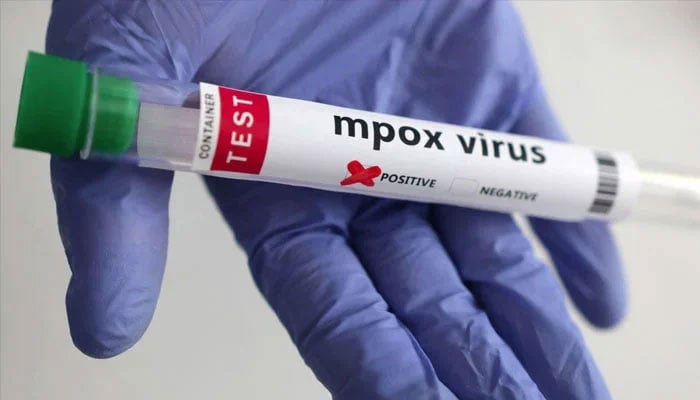
Children with unusual skin lesions are being brought to clinics across parts of upper Sindh, raising fears among doctors of a possible Mpox-like outbreak, even as confusion over testing and lack of coordination between health authorities delay confirmation of the disease.
Pediatricians in Gambat, Khairpur and Larkana say they have been seeing children for the last several days with lesions that do not resemble common infections such as chickenpox or measles, prompting concern that a different viral infection may be circulating in the area.
Following alerts from local physicians, teams of epidemiologists and infectious disease experts visited affected localities and collected samples from suspected cases at the Gambat Institute of Medical Sciences and district headquarters hospitals.
However, uncertainty persists as officials at the Dow University of Health Sciences said they had not received any samples from Gambat or Khairpur for laboratory analysis till late Tuesday. “I have seen at least six cases which clinically resemble Mpox, with clear lesions on children’s bodies. These are neither chickenpox nor measles, but we cannot say anything conclusively without laboratory confirmation,” a senior paediatrician at the Gambat Institute of Medical Sciences said, requesting anonymity.
He added that similar cases were being reported by doctors in Khairpur and Larkana, indicating the situation may be more widespread.
District Health Officer Khairpur Dr Barkat Ali confirmed that multiple children in Kot Diji and Sagio villages had developed suspicious skin infections, after which the district authorities sought intervention from the provincial health department.
“We requested investigation teams after receiving reports from different areas. Samples have been collected, but we cannot determine the nature of the disease until laboratory reports are available. At present, treatment is being provided on clinical grounds,” he said.
There are also unconfirmed reports of child deaths linked to the illness, though no official confirmation is available. Health experts said that in rural Sindh, many deaths remain undocumented due to weak surveillance systems and lack of postmortem examinations, making it difficult to assess the true impact of the disease.
Officials at the National Institute of Health (NIH) Islamabad said they were aware of the suspected outbreak and had seen images of severe lesions on affected children, but expressed concern that provincial authorities had not shared samples or data with the federal institute.
“We have repeatedly asked for samples and information. Without timely sharing, it becomes very difficult to confirm the disease and initiate containment measures,” a senior NIH official said, adding that delays and lack of transparency at lower levels often cost precious time during outbreaks.
Federal health officials also acknowledged that gaps in coordination between provincial departments and national institutions were undermining surveillance and response efforts, making it harder to control emerging infectious diseases.
Health experts warned that districts like Larkana and surrounding areas have previously reported a high burden of HIV among children, which could increase vulnerability to infections such as Mpox.
“When immunity is compromised, children are more susceptible to unusual and severe infections. This makes early detection and coordinated response essential,” an official said.
An official from the Directorate General Health office in Hyderabad said samples had been collected and sent for testing and that results would be shared once available. However, the mismatch between claims of sample dispatch and non-receipt at the laboratory has raised serious concerns about delays in diagnosis.
With suspected cases continuing to emerge and no confirmed diagnosis yet, doctors warned that failure to act swiftly could allow the disease to spread further among vulnerable populations in remote areas.