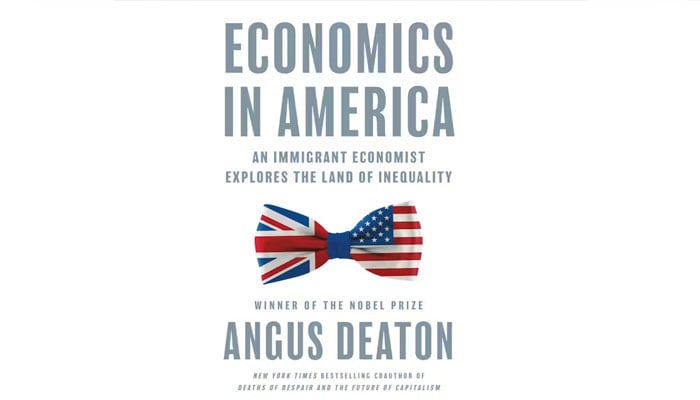
Had I not read Angus Deaton’s Economics in America: An Immigrant Economist Explores the Land of Inequality, I would not have learned that one of the most devastating blows to the economics profession was delivered by the film Inside Job, which won the Oscar for Best Documentary in 2011. The movie directed by Charles Ferguson tried to explain the 2008 global financial crisis in popular terms, and it succeeded, garnering $7 million in revenues against a budget of $2 million.
Not bad for a documentary, but very bad for economics, some of whose leading lights were caught on camera denying their role in framing policies that triggered the crisis, continuing to espouse the deregulation that brought on the crisis, thinking there was nothing wrong in accepting six-figure consulting fees from Wall Street and promoting policies it favored, engaging in selective amnesia, or lying through their teeth.
In one scene, Glenn Hubbard, former chair of George W Bush’s Council of Economic Advisers, then dean of Columbia University’s School of Business, gets upset and threatens to end the interview when asked whether as a researcher or policymaker he has disclosed his multiple links to the financial industry. This display of tantrums was, however, not as bad as the response of John Campbell, head of Harvard University’s Economics Department, when asked the same question; he was simply tongue-tied.
Unlike the meteor that killed the dinosaurs, Inside Job did not destroy economics, though in Angus Deaton’s account, “the movie did great harm to the public image of economists who were seen as benefiting mightily from an economy that they were claiming to research in a neutral, scientific way.”
There is probably no one better qualified to discuss the crisis of mainstream economics than Deaton, one of the leading experts on the economics of health and inequality, a former president of American Economic Association, and a Nobel Prize winner. He is about as mainstream as one can get, though of the center-left variety, probably owing to his training at Cambridge, which apparently not only produced spies for the Soviet Union but also economic iconoclasts like John Maynard Keynes.
A Discipline Captured by Special Interests: Deaton does not beat around the bush. The profession brought the calamity on itself because a great many of its members have been bought by powerful interests to produce the research and policy proposals that would benefit them. Though Deaton would be more measured and courteous in the way he would put it, that is essentially the theme that runs through this book. There may be some who really believe that the untrammeled market is the best way to allocate resources, but for most that belief is sweetened by the financial support, in the form of grants and consultancies, of powerful special interests.
Take the case of the minimum wage. Rigorous experiments by a number of well-regarded researchers have produced results that by now should have yielded no opposition to the fact that raising the minimum wage does not create unemployment. But half the profession still believes it does, and there’s no shaking them from this belief, whose main bankroller is the fast-food industry that sees the false doctrine as useful to keep the wages of its hamburger flippers low.
Excerpted: ‘The Existential Crisis of Mainstream Economics’. Courtesy: Counterpunch.org