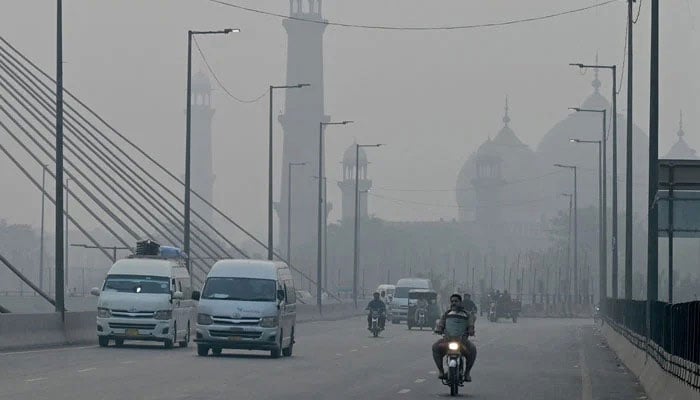
LAHORE:In a landmark environmental success story, Punjab has witnessed a significant improvement in air quality, with 2025 emerging as a turning point year. For the first time since the COVID-19 pandemic, Lahore recorded its lowest average Air Quality Index (AQI) levels, reflecting the effectiveness of sustained policy interventions by the provincial government and the Environment Protection Agency (EPA) Punjab.
According to a detailed assessment based on IQAir data, Pakistan’s average PM2.5 levels declined to 67.3 µg/m³ in 2025, marking an 8.7 per cent reduction compared to 2024.It is pertinent to mention here that during the previous years, the Punjab government termed the air quality data exaggerated and fake and now the Punjab government was relaxing the data of same website as authentic.
The EPD spokesperson said this breaks a four-year upward trend in pollution and establishes 2025 as the cleanest year for air quality in the post-pandemic period.Punjab emerged as the top-performing province, achieving a remarkable 33.2 per cent reduction in PM2.5 levels — from 116.6 µg/m³ in 2024 to 77.9 µg/m³ in 2025. This dramatic improvement underscores the success of coordinated environmental governance and enforcement strategies. The progress is widely attributed to the leadership and policy direction of Senior Minister Marriyum Aurangzeb, whose proactive oversight ensured strict implementation of anti-smog measures across sectors.
Supporting this effort, Secretary Environment Protection and Climate Change Department Silwat Saeed played a pivotal role in institutional coordination and policy execution, enabling a whole-of-government response to the smog crisis.
Punjab EPA Director General Imran Hamid Sheikh led an aggressive, data-driven enforcement regime that transformed environmental compliance across Punjab. Under the leadership of Imran Hamid Sheikh, enforcement actions witnessed an unprecedented scale and consistency over the past three years. From March to December 2024, EPA teams carried out over 62,000 visits, which increased significantly to more than 81,000 in 2025, reflecting an expanded operational footprint. Inspections surged from nearly 76,000 in 2024 to over 113,000 in 2025, while notices issued jumped from under 1,000 to more than 7,900 during the same period. The crackdown translated into tangible enforcement, with thousands of industrial units sealed, over 2,300 FIRs registered in 2025 alone, and environmental fines rising sharply to Rs192 million.
The introduction of water recyclers, numbering over 2,200 installations, alongside hundreds of mist sprinklers at construction sites, significantly reduced fugitive dust emissions — a major contributor to urban smog.
Experts describe this shift as a decisive policy-driven turnaround rather than a temporary environmental relief.A defining feature of the 2025 anti-smog strategy was the large-scale deployment of anti-smog guns across Lahore, which played a critical role in suppressing particulate matter during peak smog months.