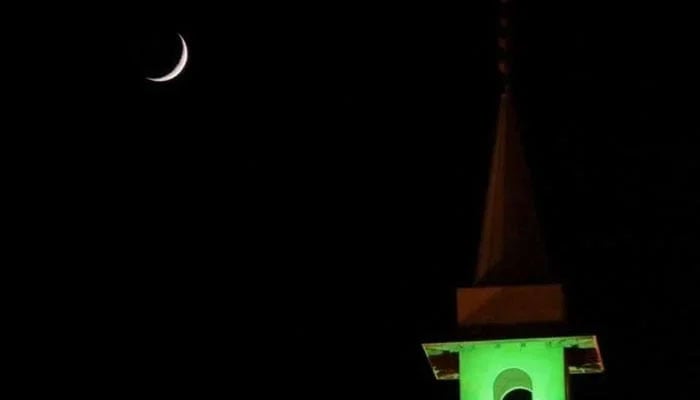
The blessed month of Ramazan has now entered its final phase. While preparations for celebrating Eidul Fitr are in full swing across the country, a common question on everyone’s mind is: when will Eid be celebrated? Will the moon be sighted on the 28th night of Ramazan, leading to Eid today, or will it fall on Saturday? Such questions arise every year with remarkable intensity, reflecting both religious devotion and public curiosity.
In previous years, my predictions regarding the start of Ramazan and the date of Eidul Fitr have consistently proven accurate. I have often stated with confidence whether the moon will be sighted or not, and I maintain that it is possible to determine lunar dates not just for the present year but far into the future. My confidence is actually based on the world’s ancient calendrical systems, the Hindu Vikram Samvat calendar.
In my view, ancient Hindu astronomers, long before the start of the Common Era, carefully studied the movements of the sun, moon, stars and planets. At a time when much of the world was immersed in ignorance, they developed an advanced system for measuring time, dividing day and night, determining months, predicting solar and lunar eclipses, and understanding seasonal cycles in such an accurate way that continues to astonish modern science.
Historically, the Hindu Vikrami calendar was introduced in 57 BCE during the reign of the Indian king Vikramaditya. Before the arrival of British colonial rule, this calendar remained in official use for centuries in royal courts across the Subcontinent. Hindu astrologers were hired to prepare horoscopes to determine auspicious timings for important events and even in the Mughal courts, this calendar held special significance.
According to the Vikrami calendar, a lunar month, consisting of approximately 29.5 days, is divided into phases based on the waxing and waning of the moon. The night of Amavasya (new moon), when darkness prevails, and Purnima (full moon), when the sky is illuminated, are central to this system. Similarly, the sun’s transition from one zodiac sign to another indicates seasonal changes. Occasionally, an additional thirteenth month is added to reconcile differences between the solar and lunar cycles.
Traditionally, the Hindu calendar plays a vital role in determining religious and cultural festivals. Diwali is observed on the new moon of Kartik, while Holi falls on the full moon of Phalguna. These celebrations are not only expressions of faith but also strengthen social cohesion and cultural identity. Its alignment with seasonal cycles has also made it valuable in agricultural planning, particularly in rural societies.
Both the Islamic and Hindu calendars rely on the moon. The Islamic calendar is purely lunar, causing its months and festivals to shift across seasons over time. However, the Hindu calendar incorporates a solar component, ensuring that festivals remain tied to specific seasons. While the Hindu system relies on mathematical and astronomical calculations, the Islamic calendar emphasises the physical sighting of the moon to start a new month.
Interestingly, this month will also bring New Year celebrations for the Hindu community in Pakistan. While Eidul Fitr will be celebrated across the country, the Vikram Samvat year 2083 will also begin at the same time, bringing messages of hope, prosperity and spiritual renewal. According to Hindu belief, the day marks the creation of the universe, making it a symbolic start of time and the cosmic cycle.
Based on Hindu astronomical calculations, I can confidently predict that the new moon is expected on March 20, suggesting that Eidul Fitr is likely to fall on March 21. However, in Islam, the celebration of Eid is dependent on the physical sighting of the moon. Therefore, the final decision to celebrate Eid in Pakistan must be in accordance with the official announcement by the Ruet-e-Hilal Committee.
I pray to God Almighty that both Eidul Fitr and the Hindu New Year bring happiness, mercy and blessings to all living in my beloved country.
The writer is a member of the National Assembly and patron-in-chief of the Pakistan Hindu Council. He tweets/posts @RVankwani