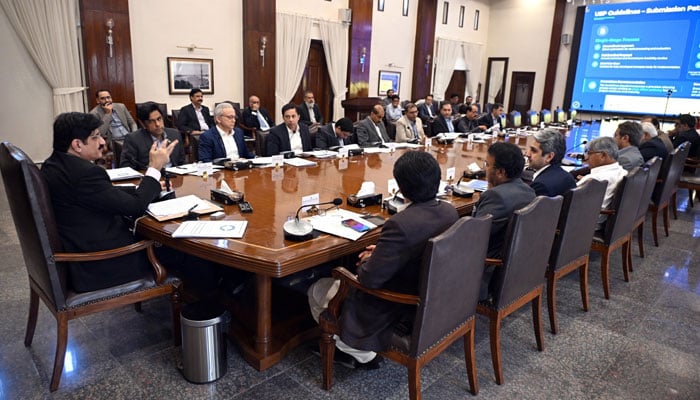
Sindh Chief Minister Syed Murad Ali Shah, presiding over the 51st Public-Private Partnership (PPP) Policy Board on Wednesday, approved the construction of a new bridge over the Indus River to provide a new link between Sukkur-Rohri and adjoining towns, which would decompress the traffic on the existing links
The meeting held at the CM House was attended by provincial ministers Nasir Hussain Shah and Ziaul Hassan Lanjar, Special Assistant to CM Syed Qasim Naveed, Chief Secretary Asif Hyder Shah, Principal Secretary to CM Agha Wasif, Planning & Development Board Chairman Najam Shah, Board of Revenue Senior Member Khalid Hyder Shah, Local Government Secretary Waseem Shamshad, Finance Secretary Fayaz Jatoi, Transport Secretary Asad Zamin and others.
The CM also approved major infrastructure projects and critical regulatory reforms aimed at fostering private sector investment. Local Government Minister Syed Nasir Shah informed the meeting that the Sukkur and Rohri formed a closely integrated urban and economic corridor, with 70 per cent of the residents of Rohri, Saleh Pat and Pano Aqil routinely using Sukkur–Rohri link to travel to Sukkur for employment, education, health services and commercial activities
The main crossing was the Lansdowne Bridge, which was further supported by the Sukkur Barrage, the meeting was told. However, due to the maintenance, the Sukkur Barrage was closed for public movement until at least 2027, Nasir said.
To this, the CM said a study conducted by his team had revealed that more than 30,000 vehicles (cars, motorbikes, public transport, etc.) used the Lansdowne Bridge every day. Due to its historic nature and ageing infrastructure, heavy traffic bound for adjoining cities and major corridors, such as the N-5 and M-5, was barred from using the bridge.
To address frequent bottlenecks and ensure safe transport, the CM approved the Project Development Facility (PDF) to engage transaction advisors for the construction of the New Sukkur–Rohri Bridge Project, to be undertaken by the Sindh local government department under the public-private partnership modality, aimed at improving regional connectivity and facilitating economic activity in the Sukkur–Rohri corridor.
The CM said the bridge would be an approximately 1.5-kilometre-long multi-lane structure north of Bukkur Island designed to support heavy commercial vehicles and would include dedicated pedestrian walkways.
The local government minister thanked the CM on behalf of the people of Sukkur for approving the construction of a new bridge over the Indus River. “Our people are facing serious difficulties, and with this project, a major traffic problem and connectivity issues will be resolved,” he said.
The Public-Private Partnership Board also reviewed progress on the Shahrah-e-Bhutto Expressway in Karachi, a 39km high-speed corridor that is currently 88.2 per cent complete. The CM directed the local government department to ensure that the expressway was fully operational by April 2026.
The CM also approved the installation and 25-year maintenance of solar-powered streetlights along a 4.5km elevated section at Sammo Goth to enhance public security and operational safety.
The board also approved awarding the contract for the feasibility study and detailed design of the Kathore Interchange, aimed at ensuring seamless connectivity at the expressway’s termination point. Beyond specific projects, Murad led the approval of several strategic decisions to enhance the transparency and bankability of Sindh’s public-private partnership framework.
To strengthen the procurement framework, the board approved the Procedures for Determination and Treatment of Abnormal Bids in Infrastructure-Related PPP Projects (2026). Under the procedures, bids exceeding or falling below the estimated bid value by more than 15 per cent would be treated as abnormal and rejected by the technical and financial evaluation committee to ensure financial discipline and prevent unsustainable bidding practices.
The board approved the Procedures and Guidelines for Managing Unsolicited Proposals under the public-private partnership framework, introducing a structured mechanism for submission and evaluation of privately initiated infrastructure proposals. The framework formalises the Right of First Refusal (ROFR) mechanism, whereby if the initiator does not emerge as the best-evaluated bidder but its bid value does not exceed the winning bidder’s bid value by more than 20 per cent, the initiator may either match the winning bid by exercising the ROFR or opt for reimbursement of project development costs, subject to a maximum of Rs100 million or one per cent of the estimated project cost, whichever is lower, which would be reimbursed by the winning bidder.