Every few months, another breathless announcement: Pakistan is getting its own super app. The pitch is always the same – one app combining payments, shopping, entertainment and services.
The reference point is always WeChat in China, Grab in Southeast Asia & Gojek in Indonesia. And the outcome is always the same: nothing that actually changes how Pakistanis live their digital lives.
Here’s the uncomfortable truth: the SuperApp model won’t work in Pakistan. But something better might. The UltraApp model, vertical utilities built on shared rails, is designed to complement rather than replace existing habits. The opportunities are hiding in plain sight.
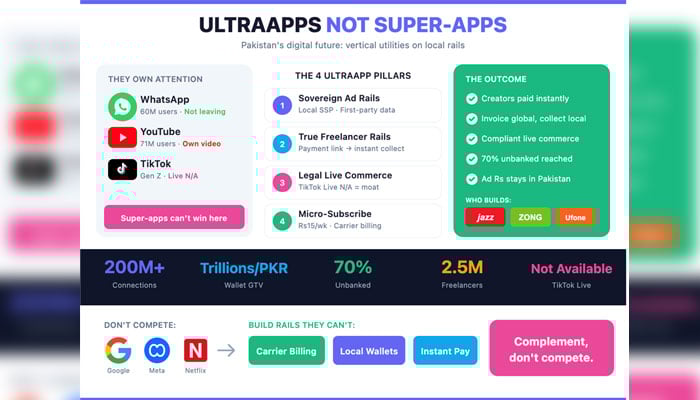
WeChat succeeded because China banned WhatsApp, Facebook and Google. Pakistan hasn’t. WhatsApp has 60 million users here who aren’t switching. YouTube has 71 million. TikTok owns Gen Z’s attention. Any strategy that requires Pakistanis to abandon these platforms is fantasy.
The telcos know this. Jazz, Zong and Ufone have each tried a version of the lifestyle super app. None has cracked it. The PTCL & Telenor merger will create another giant asking the same question: how do we stay relevant when voice revenue is dying and data is a commodity? With 5G coming to our shores, the pressure on shareholder value will also increase significantly, which is great for consumers.
The answer isn’t another SuperApp. It’s UltraApps that solve problems no global platform can touch unless they localise, something we shouldn’t hold our breath for.
An UltraApp does one thing brilliantly, connected to other services through shared identity and payment rails. Here are four that don’t exist but should:
Sovereign ad rails: Pakistani advertisers spend billions annually, but most of it flows to Google and Meta, with targeting data leaving the country. Pakistan has no local supply-side platform or domestic ad exchange. An UltraApp that aggregates local publisher inventory, enables first-party data targeting with user consent, and keeps ad rupees circulating domestically would be strategic infrastructure. Start with telco-owned properties, expand to news and entertainment publishers, and slowly build the stack that makes Pakistan’s digital advertising self-sufficient. It takes a leap of faith to build.
True freelancer rails: Let’s be clear: linking to Payoneer isn’t freelancer infrastructure, it’s a band-aid. Pakistan has 1.5 million freelancers but no sovereign payment rails. True freelancer rails mean a Pakistani creative can send a payment link to a client in New York, collect in USD and see it in their mobile wallet near real time, not days. Virtual IBANs issued locally. Market rate FX conversion. Tax documentation auto-generated. Until a freelancer can invoice and collect without leaving Pakistani infrastructure, we don’t have freelancer rails. We have workarounds.
Legal live commerce: Here’s a regulatory gift no one is exploiting: TikTok Live gifting is banned in Pakistan due to concerns over currency outflows and content moderation. This creates a protected opening for a domestic, legally compliant alternative. Imagine live streaming &/or live commerce where creators sell products, accept tips and run auctions, all settled through local mobile wallets, fully compliant with SBP and PTA regulations. The creator gets an instant payout. The platform gets transaction fees. The regulators get compliance. TikTok can’t compete because it’s not allowed to. Also, telcos have a huge user base moat they have not yet monetised fully.
Micro-subscribe: Netflix premium costs Rs1,100 per month + (about 200 in transaction fees, taxes and charges). Most Pakistanis can’t afford that. But they can afford Rs15 per week charged to airtime. An UltraApp aggregating entertainment, education and utility subscriptions at micro price points enabled by carrier billing would create a market that doesn’t exist today.
This is the infrastructure moat: Google can’t charge for airtime directly without carriers. Only local players can, and it (Google) also can’t zero-rate YouTube, local carriers can either zero-rate their entertainment plays to promote BTS/clips/VOD & apply freemium models to it to add a monetisation layer.
Pakistan’s creator economy is a half-billion-dollar opportunity that local platforms are ignoring. We have 71 million YouTube users, but homegrown streaming platforms pay creators nothing. They licence cricket rights for billions, then wonder why users leave when the tournament ends.
The winning play isn’t competing with YouTube for eyeballs. It’s becoming the monetisation layer creators depend on. Instant payouts via mobile wallet, something YouTube + Payoneer pipeline can’t match. Live commerce integration, where the creator earns commission on every sale. Brand deal facilitation with local advertisers through the sovereign/local ad network. A creator who monetises faster through local rails will use both platforms, but depend on yours for consistent payments.
Pakistan sits between Chinese investment and American platforms (YouTube, WhatsApp). We can’t ban our way to a local champion like China did. But we can build infrastructure that makes local rails indispensable. You message on WhatsApp, but pay through Pakistani wallets. You watch YouTube, but the creator gets paid through local rails. You browse TikTok, but when you want to tip a creator live, you do it on a compliant local platform.
Meanwhile, Easypaisa, now a stand-alone entity following its separation from Telenor the Telco, is also SIM-agnostic, raising the stakes across the industry. The response shouldn’t be walled gardens. It should be rails so fast, so useful and so sovereign that they become essential infrastructure.
The winner in Pakistan’s digital economy won’t be whoever builds the best WeChat clone. It will be whoever builds UltraApps, solving problems that global platforms can’t touch, connected through shared identity and payment rails, only local players’ control, whilst being compliant with domestic regulations.
The building blocks exist: 200+ million mobile connections, carrier billing infrastructure, trillions in wallet transactions. What’s missing is imagination and the courage to stop chasing super app mirages. At some level, use the telco leverage but act like a startup.
Pakistan doesn’t need another super app announcement. It needs UltraApps that actually work.
The writer is a strategist focused on digital transformation in emerging markets. He tweets/posts@faizansiddiqi and blogs at: blog.chinookstrategy.com