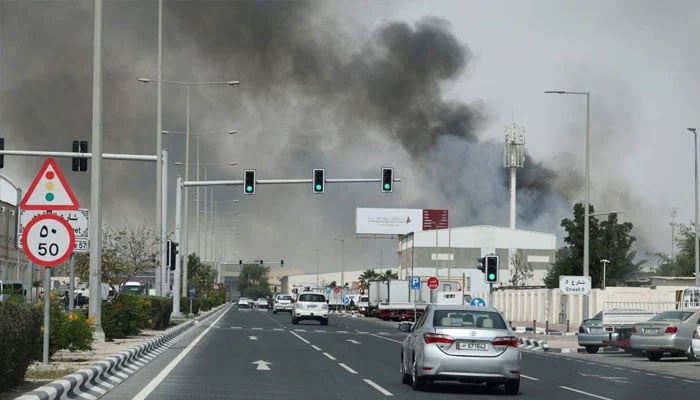
On February 28, I had just joined a Zoom meeting after landing and settling in a lounge at Doha airport, when phones around me began beeping and flashing emergency alerts, warning people to stay indoors.
At first, many of us assumed it was a temporary disruption. That illusion did not last long. The messages kept coming: airport screens initially filled with delays, then cancellations and soon thousands of stranded passengers gathered around Qatar Airways transfer desks, trying to learn the fate of their journeys. What followed was a visible chaos; children crying, travellers queueing for hotel vouchers, non-Arabic and non-English speakers struggling to seek help, and passengers on regular medication anxious about medicines packed away in the hold luggage.
The airline arranged decent apartment hotels for all. However, life seemed on hold. Comfort itself had lost its meaning, giving way to waiting and uncertainty. The roads were nearly empty except for food delivery riders. The mood among locals was visibly strained and the night sky kept erupting with blasts and fireworks as interceptors struck incoming missiles.
On the fourth day, after the night when Doha was heavily attacked by missiles, I was assisted by the Pakistan Embassy in Doha to leave for Saudi Arabia by road, only to discover that flights from Dammam had also been cancelled that day. Then came a fifteen-hour drive to Makkah. The journey was long and uncertain, yet it offered an unexpected spiritual solace in the chance to perform Umrah, followed by two days in Madinah and, on the ninth day, my eventual return to Islamabad. Throughout the journey, Ernest Hemingway’s ‘A Farewell to Arms’ kept coming to mind.
I was nowhere near the battlefield. That is precisely why the experience lingers. War does not need to arrive at one’s doorstep before it begins to alter ordinary life. It unsettles movement, erodes routine and brings uncertainties. Even at a distance, it changes the mood of public spaces and the measure of time itself.
That is what Hemingway understood with such force in his novel. He did not define war only by offensives and front lines, but by confusion, waiting, fatigue and the slow unravelling of normal life. The novel very powerfully shows how conflict enters everyday life long before it is fully grasped as history.
One can relate it to the current Gulf crisis. The war on Iran and its response is already being narrated in the official vocabulary of modern statecraft. Terms like ‘deterrence, ‘retaliation’, ‘preemption’, ‘strategic assets’ and ‘red ‘lines’, etc are meant to make war sound measured, even rational. Yet war is rarely lived in such terms by ordinary people. It is lived as uncertainty, separation, fear and the shrinking of private choices. The vocabulary of power rises into abstraction. The experience of war moves in the opposite direction, down into daily existence.
Hemingway revealed another cruelty as well. The words that justify war often outlast the lives they rupture. In one of the novel’s best-known passages, words such as glory, honour and sacrifice are stripped of grandeur when set beside the plain reality of places, bodies and dates. His point was that war does not destroy rhetoric. It leaves it standing, polished and available for reuse, long after homes, certainties and lives have been broken.”
His rationale to say farewell to war is still valid, a century after he wrote his novel. A regional war does not remain confined to the battlefield. It travels through oil prices, disrupted routes, anxious households and suspended plans. It enters daily life in the form of rising costs, broken schedules and a nagging sense that events far away have begun to rearrange the terms of ordinary existence. Even those who are nowhere near the front find that war has already reached them.
That wider spread was visible even on the edge of the crisis. In Doha, what struck me was the speed with which ordinary systems lost their solidity within hours of the first alerts. Flights, hotel bookings, onward plans, access to medicine, even the simple possibility of leaving the airport, all became uncertain at once. The war had not reached us directly, yet it had already begun to reorder our lives. Travel was no longer simply about where one was going. It had become about whether movement itself remained possible.
That same uncertainty followed me from Dammam to Makkah, though it took a different form there. The Holy cities carried their own calm, devotional rhythm, sense of continuity. Yet the wider region pressed in nonetheless. Routes had changed. Plans had been abandoned. Journeys had lengthened, stays shortened (even I had to rush out for fear of airspace closure). The atmosphere was not chaotic but rather conditional. Everything seemed to depend on what might happen next.
Wars often arrive in this manner. They narrow the future before they destroy the present, unsettling not only movement and routine but also the private spaces in which people try to remain human. Hemingway saw this clearly. Throughout his novel, the deepest struggle is not for territory but for refuge from the machinery of conflict. Love, companionship and private life grow fragile under war’s pressure. War not only destroys bodies. It enters intimacy, forcing people to live between interruptions and to make plans they know may not hold.
That is one reason the conflict matters so much to countries such as Pakistan. Much of the discussion at home is quite properly focused on supply and prices of imported fuel, remittances and the balance of payments. These concerns are real and urgent. Yet to stop there would be to miss the larger point. This is not only an economic story. It is also a human one. War exposes the false comfort of distance. A missile may be launched in one place, but the aftershocks travel along air routes, shipping lanes, family networks and market expectations. They arrive in airport lounges, on desert roads, in hotel lobbies, at petrol pumps and in the minds of people trying to decide whether they will make it home for Eid.
Seen in that light, Pakistan’s position is not simply that of an economic bystander caught in the turbulence of someone else’s war. Pakistan knows, perhaps better than many countries do, how prolonged conflict in the neighbourhood can unsettle borders, societies and everyday life. That history gives it a clear interest in restraint and regional stability. It also lends weight to the steady efforts of Pakistan’s civilian and military leadership, which has remained in continuous contact with key actors in the region to encourage de-escalation and avoid a wider conflagration. In such moments, the effort to preserve peace is not a retreat from resolve. It is a responsible use of it, a refusal to hand judgment over to the momentum of force.
My own journey ended after nine days, in Islamabad. For many others, the disruptions caused by this war will be harsher and more lasting. The point of recalling those delays is not to dramatise inconvenience. I mention those days only because they taught me how quickly conflict reaches into ordinary life.
Hemingway saw that long ago. He does not tell us who will win such a war. He tells us that before war is counted as a military gain, it is felt as a loss to humanity, and that this is its first victory. That is precisely why one must say farewell to wars.
The writer heads SDPI, chairs the board of the National Disaster Risk Management Fund, and serves on the ADBI’s Advisory Board. He posts on LinkedIn @Abidsuleri