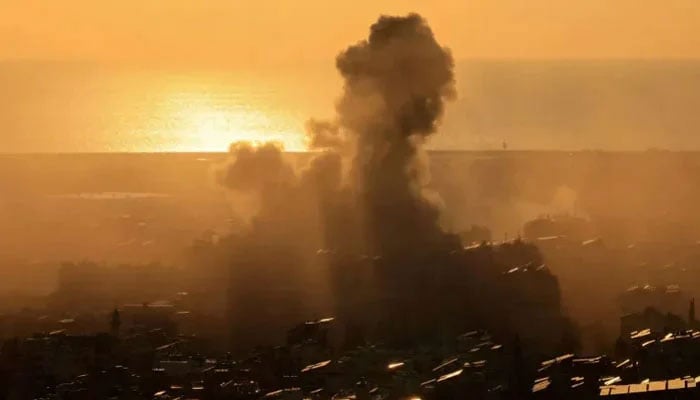
Beyond the deeply sobering reality that a man as impulsive and strategically superficial as Donald Trump wields extraordinary power – and has now used it not merely to widen destruction against one country but to trigger instability across an already fractured region and send tremors through the global economy – several new strategic facts have surfaced, each carrying consequences far beyond the battlefield.
Within the US itself, the military, political and institutional landscape has received an exceptional shock. First, this war has reopened the question of presidential war powers. A president who escalated militarily while brushing aside caution within sections of the military establishment has forced Washington back into a debate unresolved since Iraq and Afghanistan: how much unchecked authority should reside in one individual when the consequences extend across continents?
This war was unpopular from the outset. It was not sold to the American public as a national necessity but increasingly perceived as a war entered under Israeli strategic pressure and political framing. That perception matters because once a war begins without domestic legitimacy, every setback magnifies scrutiny. Second, this conflict has exposed not merely policy failure but strategic ignorance at the highest level. Iran was approached as though it were a conventional target that could be rapidly degraded through superior firepower, technological dominance and intimidation. Yet Iran is not Iraq of 2003, nor Libya of 2011. It is a state shaped by four decades of sanctions, war conditioning, asymmetric doctrine and layered deterrence. Washington appears once again to have underestimated how a heavily pressured nation develops strategic patience, dispersed command structures and resilience under sustained attack.
Third, the American media landscape is under renewed pressure because this war has collided with domestic dissent. When senior officials suggest that sections of the media suffer from anti-presidential bias because they are not singing a victory chorus, the language itself reveals insecurity in wartime narrative control. Trump’s repeated attacks on major outlets form part of an attempt to delegitimise scrutiny during war. The larger democratic question is unavoidable: can a country wage external war while narrowing internal dissent without weakening its own institutional credibility?
Fourth, the war has reopened the larger question of American identity: what now constitutes ‘Make America Great Again’? Many within Trump’s own political base, including conservative isolationists, increasingly see this war as the opposite of strategic prudence. Diplomacy was abandoned with remarkable speed. For many Americans, fatigued by decades of intervention, this does not look like strength; it looks like overreach.
The second major strategic front concerns Israel’s long-standing hold over American political decision-making. First, there are early indications that Israel’s once-near-unquestioned political stranglehold over Washington may be entering a more contested phase. Recent polling trends show something historically significant: support for unconditional US backing of Israel is no longer politically automatic across broad segments of the electorate, especially among younger Americans and increasingly within parts of both major parties. For the first time in decades, criticism of military support to Israel is no longer confined to activist margins. Second, this war has intensified a perception already sharpened after Gaza: that Washington is increasingly fighting not solely for stated American interests but for Israeli strategic priorities. When a war is seen domestically as serving another state’s agenda, political friction grows in ways previous administrations tried carefully to avoid.
On the military front, another reality has emerged. First, the war has exposed limits in the mythology surrounding overwhelming technological superiority. The US entered this confrontation with the world’s most advanced military architecture: stealth aircraft, strategic bombers, carrier strike groups, missile defence networks, forward bases, intelligence fusion and electronic warfare dominance. Israel entered with layered missile defence systems, including Iron Dome, David’s Sling and Arrow interceptors.
Yet, Iran has continued to absorb punishment and retaliate.
Second, Iranian missile systems have repeatedly demonstrated that even highly sophisticated interception systems cannot guarantee impermeability. Penetrations matter politically, even when militarily limited, because they puncture deterrence psychology. The strategic image of invulnerability has been damaged. Third, the war has therefore become a test not only of weapons but of doctrine. Iran’s doctrine of dispersed command, layered launch systems, mobility and delegated crisis authority has shown operational durability. Unlike heavily centralised systems vulnerable to decapitation, Iran’s military design was built precisely for continuity under attack.
Iran’s internal strategic posture has been central to this outcome. First, geography has been converted into strategic depth. Mountain terrain, hardened underground systems, dispersed military infrastructure and geographic scale continue to complicate rapid coercion. Second, four decades of sanctions have not merely weakened Iran but also forged self-reliance in critical sectors of military production and crisis management.
Third, nationalism has emerged as a decisive battlefield factor. Far from collapsing internally, Iranian society has displayed a level of cohesion under attack that many external planners appear to have discounted. The repeated assumption that pressure automatically fractures morale has once again proved false. Fourth, despite extensive targeting of senior leadership, commanders, scientists and strategic infrastructure, the political centre has not fractured. Even after the killing of senior figures and severe attacks on state-linked assets, the anticipated internal collapse has not materialised. Regime change remains what it largely always was: a projection detached from political sociology.
Israel and the US also underestimated the strategic significance of the Strait of Hormuz. Here lies another critical fact. First, Iran has converted geography into leverage without full closure. The mere credible threat to energy movement through Hormuz immediately internationalised the conflict beyond missile exchanges. Nearly one-fifth of the oil traded globally passes through that corridor. Markets do not wait for actual closure; they react to risk. Second, Iran has used Hormuz simultaneously as coercive leverage and calibrated diplomacy. It has signalled pressure without indiscriminate escalation, preserving channels with China, Russia and neighbouring states while keeping strategic ambiguity alive. Third, Washington’s own appeals to Beijing for restraint reveal how quickly military escalation can turn into diplomatic dependence when global energy arteries are threatened.
Europe, meanwhile, has remained an unwilling strategic partner. First, major European powers have avoided full ownership of this war because they recognise both its legal fragility and strategic unpredictability. Second, unlike earlier interventions, Iran’s demonstrated ability to retaliate has made European governments cautious about openly aligning with an expanding confrontation. Third, Trump’s visible frustration with hesitant allies reflects a broader reality: even Western alignment now has limits when escalation lacks a credible end state.
A further decisive development has been Iran’s rapid expansion of the battlefield. First, within less than forty-eight hours, Iranian-linked retaliation moved towards US-linked military infrastructure across the region. That altered the psychological map immediately. Second, American bases, once designed as pressure architecture around Iran, suddenly became exposed liabilities. The ring meant to constrain Iran also became vulnerable to counter-pressure.
Third, Gulf states now face a dual anxiety: they remain under the American security umbrella, yet that umbrella has not prevented regional exposure. At the same time, critical American air-defence resources continue flowing primarily towards Israel. This produces a strategic paradox for Gulf capitals. They still require American security guarantees, but they now also see more sharply that US regional prioritisation remains heavily Israel-centred.
What follows in the immediate and medium term? First, no dramatic collapse of US-Gulf security ties is likely. These ties are too deeply embedded in oil, arms, finance, military basing and elite political architecture. Second, confidence erosion has nonetheless accelerated.
Third, China and Russia will gain somewhat greater strategic space – not as replacements for the US, but as additional balancing actors. Fourth, debate around a more organic regional security structure will intensify. Former Qatari prime minister Hamad bin Jassim bin Jaber Al Thani’s remarks about a Muslim security arrangement reflect a discussion no longer confined to theory.
Fifth, Pakistan’s relevance rises in this altered environment. Pakistan remains uniquely placed: a nuclear-capable Muslim state with deep ties across the Gulf, stable relations with Iran, a longstanding defence credibility and no image of hostility towards Tehran. That gives Islamabad unusual strategic utility – as a deterrent presence, a quiet stabiliser and a potential bridge-builder. Sixth, Turkey also remains relevant, though its role will depend on wider regional alignments and the pace at which Gulf capitals reassess long-held assumptions.
The larger conclusion is stark: this war has not dismantled the old regional order overnight, but it has unmistakably stressed its foundations. The US-Israel security architecture built over five decades has entered a phase of visible strain.
Yet strategic systems of this depth do not unravel suddenly. Nations move slowly even when history turns sharply. What has changed is direction: the old order survives, but with diminished certainty; the path of gradual reconfiguration has begun and once such shifts begin, they rarely reverse fully.
X/Twitter: @nasimzehra
Email: [email protected]
The writer is a foreign policy & international security expert.