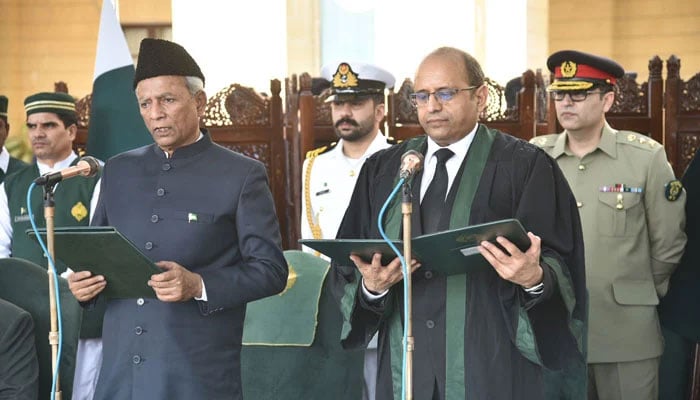
In Pakistan, provincial governorships are often treated as ornamental posts: elegant houses, formal oaths and constitutional dignity without much executive muscle. Yet in Sindh, the office has rarely been merely decorative. Because the province sits at the intersection of old political tensions, the governor is never simply a ceremonial figure.
He becomes a signal. He may lower or raise the temperature. He may reassure competing constituencies that the federation has sent a constitutional custodian, or he may behave like a partisan actor with a flair for provocation. That is why the appointment of Nihal Hashmi deserves a welcome. Sindh today needs a governor inclined towards reconciliation rather than agitation. This is not because one office-holder can transform the province’s fortunes – Sindh’s troubles are too old and structural for that – but because the appointment suggests a correction in political style.
The governorship in Sindh should not function as a parallel chief ministership, a campaign platform, or a theatre of confrontation. It ought instead to serve as a constitutional bridge between the centre and a politically sensitive province. In a place where rhetoric can inflame old insecurities much faster than policy can calm them, tone matters. Kamran Tessori, to be fair, was not an idle governor. He brought energy to the office. Governor’s House became visible, public-facing and active in ways many predecessors had failed to achieve.
In Karachi, where public frustration often springs from the belief that institutions do little unless forced into action, such activism was bound to attract admiration. Tessori understood the politics of visibility. That counted for something. Karachi is a city of impatience and disappointment. It is not naturally drawn to understated constitutionalism. It responds to spectacle, motion and visible patronage. Tessori’s immense wealth gave him a scale of public generosity and projection that few politicians could rival. Yet, visibility is not the same as suitability. A governor can be energetic and still misjudge the burden of the office he holds.
In Sindh, where the line between urban and rural politics has long been sharpened by grievance, memory and manipulation, a governor must be more than active. He must be careful. That was the central weakness of Tessori’s tenure. Whatever good he may have done through public outreach, there was no need for the governor of Sindh to slip into antagonism with the PPP.
Nor was there any wisdom in allowing the office to become associated with rhetoric that seemed to widen the divide between urban and rural Sindh. In a province with such a long history of tension between Karachi and the rest, even the impression that the governor is speaking for one Sindh against another is politically damaging. This rises above party preference. One need not be a partisan of the PPP to recognise that Sindh has repeatedly suffered whenever its internal divisions are turned into political currency.
Karachi’s grievances are real. Urban Sindh has legitimate complaints about governance, representation and municipal neglect. But there is a profound difference between articulating grievances and romanticising estrangement. The language of division has damaged Sindh for decades. A governor should be the last person to give that language fresh respectability. The history of Sindh’s governorship offers sobering lessons. Perhaps the bleakest phase came between 1978 and 1987, when two generals held the office in succession. Lt-General S M. Abbasi governed during some of the hardest years in Sindh’s political life: the consolidation of General Ziaul Haq’s rule, the execution of Zulfikar Ali Bhutto, and the suppression of the Movement for the Restoration of Democracy, especially during the Sindh uprising of 1983.
Under Abbasi, the office became associated not with constitutional balance but with repression. Sindh felt not merely administered but disciplined. The Governor House stood less as a symbol of federal reassurance than as one of the visible instruments of military domination. That period left a deep scar. It reinforced the belief, still alive in parts of Sindh, that democratic dissent there would be met not by dialogue but by force. Once an institution becomes associated with coercion, it does not easily recover moral neutrality.
Abbasi’s successor, Lt-General Jahan Dad Khan, presided over a different but equally consequential phase. If the earlier years were marked by repression, the later ones were shaped by political engineering. These were the years in which urban Sindh’s politics was being reorganised in ways that would transform the province. The Zia regime needed a counterweight to the PPP in Sindh, and Karachi’s politics offered fertile ground for such a design. Whether one calls it facilitation, encouragement or cultivation, the broad effect is clear enough: the rise of MQM took place in a climate in which the state found advantage in the fragmentation of Sindh’s political field.
Under Jahan Dad Khan, the office became less associated with naked force and more with the strategic management of division. Between these darker phases came a different chapter in the 1990s. Mahmood Haroon served two substantial terms as governor, first from 1990 to 1993 and then again from 1994 to 1995, with a brief interregnum under Hakim Muhammad Saeed. Haroon represented a more patrician and establishment-compatible Karachi. He came from one of the city’s most prominent political and media families and had already held important public offices. His style was neither military nor populist in the later televised sense. His governorship belonged to a phase when family standing, business influence and establishment respectability still gave the office civic gravitas.
The brief tenure of Hakim Muhammad Saeed sharpened that contrast. Scholar, physician, philanthropist and public intellectual, he brought intellectual dignity and moral seriousness, if only briefly, to the Governor House. Together, the Haroon-Saeed phase suggested that the office could be associated with civic stature rather than repression or ethnic mobilisation.
Then came another long era. Ishrat-ul-Ibad, governor from 2002 to 2016, was the longest-serving governor in Sindh’s history. He was a master survivor. He adapted across regimes, outlasted transitions and remained embedded in Karachi’s changing power arrangements for well over a decade. Yet survival is not the same as distinction. His tenure overlapped with some of Karachi’s ugliest years, including the violence of May 12, 2007, when dozens were killed amid chaos surrounding the suspended chief justice’s visit. Ibad’s long years in office came to symbolise an order built on selective accommodation, bargaining and the uneasy management of Karachi through political deals and coercive balance.
Seen against these precedents, the case for Nihal Hashmi becomes clearer. He comes from a different political tradition. He is not a military proconsul. He is not a master of administrative survival in the mould of Ibad. Nor is he a man of vast wealth who can convert the Governor House into a permanent public spectacle. He is something older and, at this moment, more useful: a party worker shaped by struggle, loyalty and organisational life. That distinction matters. Pakistan’s politics is crowded with men who enter prominence through wealth, branding or tactical convenience. Hashmi comes from a middle-class background and from the harder school of party politics. Whatever else may be said about him, he has remained loyal to the PML-N through difficult years.
In an age of ideological opportunism, loyalty retains some value. It makes a politician legible. It suggests that office, for him, is tied to a longer political story rather than to an instant personal project. There is also an important symbolic point. Nihal Hashmi is Urdu-speaking and rooted in Karachi’s politics. Yet unlike many who have flourished by keeping those anxieties permanently inflamed, he has not made the division of Sindh his politics. That is perhaps his greatest strength for this office. Sindh has too often been trapped by the false assumption that an Urdu-speaking leader proves authenticity only by dramatising estrangement from the rest of the province.
Hashmi offers a healthier possibility: An Urdu-speaking politician loyal to his party and rooted in Karachi, while still affirming Sindh as one province rather than a negotiable arrangement. This is why, despite his past controversies and rhetorical excesses, he still looks the better choice. Politics is not a contest among immaculate men. It is usually a choice among imperfect ones whose instincts suit some offices better than others. Hashmi has baggage. But his temperament appears more compatible with what Sindh now requires from its governor than the temperament of a flamboyant populist forever edging towards confrontation.
The writer is dean of the faculty of liberal arts at a private university in Karachi. He tweets/posts @NaazirMahmood and can be reached at: [email protected]