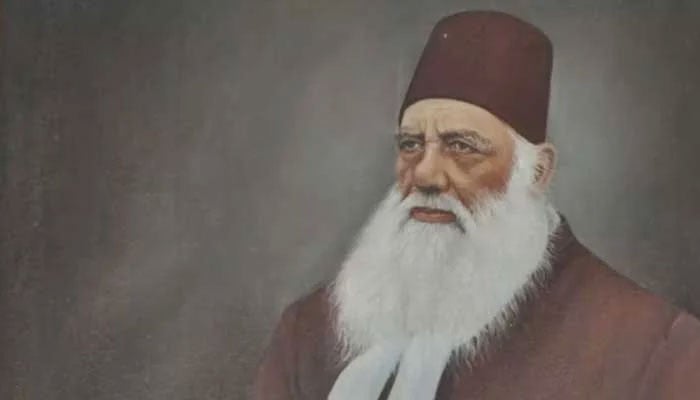
This is the second part of my discussion of 'Sir Syed Ahmad Khan: A Private Life by Iftikhar Alam Khan', translated and edited by Athar Farooqui and published by Oxford University Press. In the first part (published last week), I lingered in Sir Syed’s drawing room – amid genealogies, bereavements and the moral wreckage of 1857.
This concluding reflection moves into narrower, darker corridors: of intrigue, succession and institutional anxiety. Reading the latter half of this book, I was struck less by triumph than by tension. It reads almost like a ledger of turbulence: “Love-Hate Relationship with Samiullah Khan”, “Embezzlement in College”, “Opposition from Mr Beck”, “Syed Mahmood’s Married Life Falls Apart”, “Sir Syed’s Office SHIFTED”. Even the typography, with its abrupt capitalisation and clipped headings, seems to register friction. Most biographies of Sir Syed, the author notes, echo Altaf Hussain Hali’s 'Hayat-i-Javid', a work that Shibli Nomani once described as "mudallal middahi" (praise fortified with argument).
Hali’s biography was written in the immediate aftermath of Sir Syed’s death, when the community needed reassurance, perhaps even myth. Iftikhar Alam Khan’s project is different. He seeks, in his own words, an “ecology”to – place Sir Syed within the living environment of relatives and rivals, officers and subordinates, successes and failures. That ecological ambition becomes especially vivid in the book’s second half. By the time one reaches the chapters covering the “Period of Versatility, 1876–1890”, Sir Syed is no longer merely a reformer; he is an institution-builder navigating imperial power with practised tact.
The foundation ceremony of the Muhammadan Anglo-Oriental College, described with almost theatrical care, is shown as choreography. The naming of workers involved, the description of the compound of Sir Syed House, the mention of British guests such as Lord Ripon and Sir Alfred Lyall reveal how hospitality functioned as political language. Sir Syed understood, a century earlier, that institutions are built not only on syllabi but on symbolism.
To bring British officials into Aligarh was to tell Empire that Muslim modernity would not be peripheral. It would be visible, respectable, unavoidable. Yet the narrative resists any easy arc of ascent. The very next chapters catalogue administrative fragility: membership of the Viceroy’s Council, participation in the Education Commission, debates over trustees’ law,and even the first strike in the college. Modern education requires modern governance. Still, governance breeds rivalry. The book’s candour about internal dissent is one of its strengths. The so-called 'love-hate relationship' with Samiullah Khan reads almost like a Shakespearean subplot: collaboration curdled by suspicion, loyalty tempered by ego. Principal Beck appears not as a villain but as a personality – assertive, occasionally patronising, frequently at odds with Syed Mahmood. Mohsin-ul-Mulk and Viqar-ul-Mulk enter as mediators, sometimes as antagonists. One chapter – “Embezzlement in College” – is almost jarring in its bluntness.
The book’s most poignant strand concerns Syed Mahmood, Sir Syed’s son. As I read the pages devoted to him – his early retirement as district judge, his deteriorating health, his encirclement by opponents, his contemplated legal action against Morrison – I felt a quiet ache. The father who had laboured to create a modern Muslim elite found himself grappling with the vulnerabilities of his own heir. It conveys the descent: “Syed Mahmood’s Married Life Falls Apart”, “Syed Mahmood’s Intention to Initiate Legal Action”, “Syed Mahmood Moves to Sitapur”, “Syed Mahmood’s Demise”. The repetition of his name across chapters becomes almost liturgical, as though the institution cannot disentangle itself from his fate.
There is something deeply human in this portrayal. Public stature offers no immunity from private turmoil. Sir Syed’s anxieties over his son’s conduct, his illness and the controversies that swirled around him puncture the marble of heroism. The reformer who counselled rationality and discipline could not command destiny at home. “Sir Syed Moves Out of the House for a Second Time". “Ownership of Sir Syed House Transferred". Property becomes biography. The movement of rooms mirrors the movement of authority.
When Sir Syed moves out of his own residence, the act feels more than logistical. It is symbolic displacement. The founder yields to the institution he created. The language controversy over the Nagari script, treated earlier in the narrative, resurfaces in this phase as a reminder that cultural fault lines were widening. Sir Syed’s defence of Urdu was not merely an aesthetic preference; it was a demographic strategy. In a polity where numbers mattered, language became arithmetic. His suspicion of early Congress agitation, so often caricatured, appears here less as reactionary obstinacy than as anxiety over minority vulnerability.
As a reader in the present, I cannot avoid recognising the resonance. Educational reform in South Asia is still entangled with identity, demography and political calculus. Sir Syed’s caution about majoritarian democracy may not sit easily with modern liberal sensibilities, but the book compels us to understand the context from which it sprang. The final chapters, covering the period after Sir Syed’s death in 1898, are unexpectedly affecting. Claimed contributions for his interment, the construction of his mausoleum, the appointment of Mr Beck as registrar, the opposition to Syed Mahmood – these details form a quiet coda.
What moved me most was the absence of melodrama. There is no sentimental crescendo. Sir Syed's death is narrated with restraint. The administrative reshuffles that follow are recorded with the same measured tone as earlier triumphs. The English translation retains a faint cadence of Urdu scholarship – measured, occasionally formal, never flamboyant. There is gravitas without grandiosity. The editorial apparatus of notes, index and careful cross-referencing signals archival seriousness. At nearly 350 pages of main text, the book demands patience. It is not a brisk narrative for casual consumption. Names proliferate; dates accumulate; administrative minutiae crowd the margins.
Yet therein lies its value. For scholars of 19th-century India, Muslim reform movements or colonial institutional history, this granularity allows the reconstruction of an entire ecosystem. These are invitations to further scholarship. What lingers with me is the paradox that frames the entire work. Sir Syed has been alternately sanctified and vilified – father of Muslim separatism to some, loyalist apologist to others. This biography refuses both caricatures. It presents a grieving son who lost his mother amid the wreckage of 1857; a meticulous administrator obsessed with accounts and ceremonies; a cautious liberal wary of mass politics; an anxious father confronting the frailties of succession.
In our age of binary judgment, such complexity feels almost radical. We prefer heroes unblemished or villains unredeemed. Iftikhar Alam Khan offers neither. He offers ecology: life embedded in context, praise tempered by proximity, criticism softened by empathy. Oxford University Press’s decision to publish this translation is itself a cultural intervention. It allows Anglophone readers to engage with a strand of Urdu historiography that has too often remained confined to regional audiences. In doing so, it broadens debate beyond nationalist simplifications. As I closed the final page, I found myself thinking less about Aligarh as a monument and more about Sir Syed as a man.
Institutions endure in stone and statute; private lives dissolve into anecdote. Yet it is in those anecdotes – about attire, about household tensions, about office shifts – that the texture of history resides. This second half of the biography, with its catalogue of intrigue and introspection, persuades me that the private is not peripheral to the political. It is its crucible. Sir Syed’s legacy cannot be understood without acknowledging the domestic anxieties and administrative skirmishes that shaped it. To encounter him in these pages is to step away from the statue and into the study.
One sees the ledgers, the correspondence, the arguments over trustees’ law, the strained conversations with Syed Mahmood. One sees, above all, the cost of reform. In the end, perhaps that is the book’s quiet achievement. It restores proportion. Sir Syed Ahmad Khan emerges not as a marble effigy but as a mortal reformer – strategic yet vulnerable, visionary yet anxious. And in that restoration lies a more durable tribute than any monument.
Concluded
The writer is dean of the faculty of liberal arts at a private university in Karachi. He tweets/posts @NaazirMahmood and can be reached at: [email protected]