LAHORE: As the long-running confrontation between the United States and Iran heats up with every passing hour, eminent American media houses, academia and think-tanks have started focusing on the war’s financial toll on American taxpayers.
“Forbes,” an internationally-recognized American business magazine in publication for almost 109 years, has viewed: “President Trump’s strikes in Iran have likely cost American taxpayers over $1 billion using cursory estimates.”
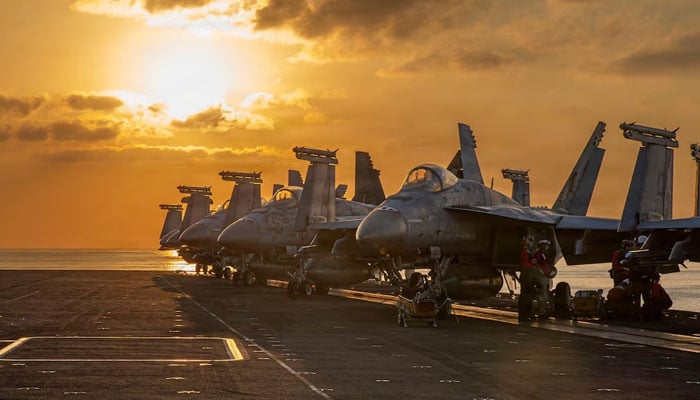
The magazine’s March 3, 2026 report reads: “Three US jets were also struck down in Kuwait on Sunday, costing nearly $300 million at a minimum, if each jet costs an estimated $90 million. Even before the strikes properly began, transporting troops, ships and aircraft to the region had likely cost the military an estimated $630 million, Elaine McCusker, a senior fellow at the “American Enterprise Institute” think tank and former Pentagon budget official, told the “Wall Street Journal.”
“Forbes” added that while the full scope of the military’s operation in Iran was still unclear, the cost of approximately 1,250 “kamikaze” drones fired on Iran was $43.8 million, as each drone costs $35,000.
The magazine held: “Higher-end bombers cost much more to operate than the one-way drones, with the “New York Times” reporting B-2 bombers that have been used in strikes, cost $130,000 to $150,000 per flight hour to operate alone. Reports suggest the military has been using Tomahawk missiles to carry out strikes, which the newspaper estimates cost $2 million each.”
“Forbes” asserted the THAAD Anti-Ballistic Missile Interceptors, which US military uses to intercept enemy strikes, cost approximately $12.8 million each, according to Pentagon documents.
Meanwhile, the Providence-based Brown University’s widely-cited “Costs of War” project estimates the American military operations in Iran had cost between $2 billion and $2.25 billion in 2025, which includes the strikes during the “12-Day War” last June.
In the Middle East, as the Brown University has estimated, the United States has spent between $31.5 billion and $33.7 billion between October 2023 and September 2025, which includes $21.7billion military aid to Israel and operations in Iran, Yemen and the broader Middle East region.
Researchers at Brown University further calculated that in 2021, the United States had spent $5.8 trillion on wars in the wake of the September 11 attacks, though the amount included spending for veterans’ medical care and counterterrorism efforts inside America also.
The “Fortune,” a 97-year-old American business magazine headquartered in New York, quoted Kent Smetters, director of the “Penn Wharton Budget Model” and a foremost fiscal analyst.
The journal chipped in: “According to Kent Smetters, the total economic cost of the strikes could reach as high as $210 billion. On top of direct military expenditures, he projected an additional economic loss of approximately $115 billion, with a wide band of uncertainty stretching from $50 billion all the way to $210 billion. The figures do not include the cost of the administration’s International Emergency Economic Powers Act (IEEPA) tariff regime, which may rest at a separate $179 billion, an amount that will have to be refunded to American companies, if not taxpayers, after the Supreme Court ruling.”
The Washington DC-based “Center for American Progress,” an independent policy institute has noted: “The Trump administration has launched a reckless war of choice in the Middle East, which has already imposed an estimated cost of more than $5 billion on the American taxpayer.
In a March 2 press conference, Chairman of the Joint Chiefs of Staff General Dan Caine described the deployment of more than 100 aircraft, the use of Tomahawk missiles and attacks on more than 1,000 targets in just the first day of operations. It is hence likely that these costs would cross the $4 billion mark. But these are not the only costs.
Elaine McCusker, a former Pentagon official in the first Trump administration, estimated the costs of repositioning forces in the Middle East to hover around $630 million even prior to the start of hostilities. On March 2, Kuwait accidentally shot down three fighter jets in a friendly-fire, costing $351million.”
As far as the military comparison between the United States and Iran is concerned, the “Global Firepower Index 2025,” has revealed the United States possesses 13,032 aircraft, 465 naval vessels, 11 carriers, 66 submarines, 4,666 tanks, and over 409,000 armored vehicles in in its arsenal, while Iran operates about 551 aircraft, roughly 109 naval vessels, 25 submarines and 2,675 tanks with zero aircraft carriers.