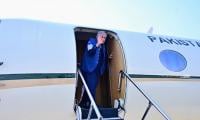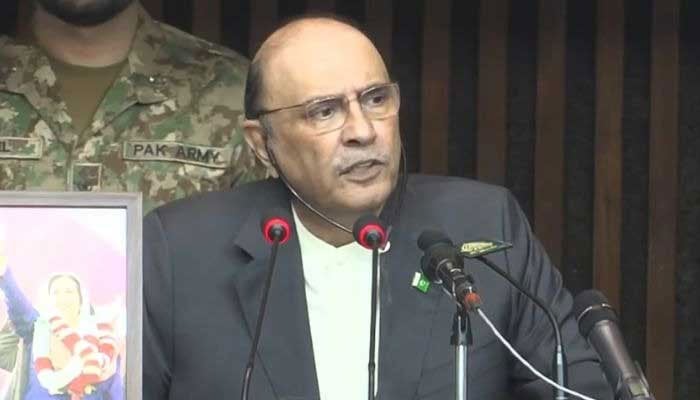
ISLAMABAD/KABUL: President Asif Ali Zardari made it clear that Pakistan will not allow any entity either domestic or foreign to use neighbouring territory to destabilise its peace.
“Our action spelt out the limits to our tolerance for attacks from Afghanistan, particularly by Indian-sponsored TTP and BLA and their affiliates. Let me be clear: the soil of Pakistan is sacred. We will not allow any entity—domestic or foreign—to use neighbouring territory to destabilise our peace,” he said while addressing a Joint Session of Parliament on Monday to kick-off the new Parliamentary Year.
The president warned that Pakistan has already shown India and Afghanistan merely a glimpse of its capabilities. He made it clear that no one should be under any misapprehension. “We are ready for you. My message to them is to step away from the battlefields and come to the table for meaningful dialogue, because that is the only path to regional security.”
The president said the recent report of the United Nations Security Council’s monitoring team has described the presence of terrorist groups in Afghanistan as an extra-regional threat. “This report warns that any other country could fall victim to another catastrophic attack if the issue is ignored,” he said.
Amid protest and slogans of opposition, President Zardari in his 9th address to the joint session of the Parliament deliberated on all national, regional and international matters, including the Kashmir and Palestine, ongoing tension in the Gulf region, Maarka-e-Haq and Ghazab Lil Haq operations, Indian violation of the Indus Waters Treaty, economy, provincial autonomy and poverty.
The opposition backed by the Pakistan Tehreek-e-Insaf (PTI) raised the slogans of “Go Zardari Go” and made a protest during the presidential address.
At the outset of the joint session, fateha was offered for Supreme Leader of Iran Ayatollah Seyyed Ali Khamenei and other innocents martyred in Iran, for victims in other brotherly countries, and for Pakistanis martyred during recent aggressive actions by the Afghan Taliban regime.
Addressing the Parliament, the president said, “It is my singular privilege, as your twice-elected president, to address this august House for the ninth time at the beginning of a new parliamentary year. Each such address is a reminder of the continuity of our democratic system and of the responsibility we carry as representatives of the people of Pakistan,” he said.
He said nations are tested not only in times of crisis but at key crossroads. He said the past year has reminded us that the strength of our republic lies in its Constitution, in the resilience of our people, the responsibilities of parliament and government, and the courage of our armed forces. “As we begin a new parliamentary year, we must build upon that resilience — safeguarding sovereignty, strengthening constitutional governance and advancing economic transformation so that stability becomes growth to generate prosperity, progress and peace for every citizen,” he said.
The president said the past 10 months tested our nation in profound and complex ways…when our sovereignty was challenged on either front, Pakistan responded with strategic restraint, and firm resolve. “When confronted with unprovoked attacks on both our borders, one after another, our armed forces acted with outstanding professionalism and discipline. In the case of Maarka-e-Haq, they turned India’s attack on our motherland into a landmark strategic victory,” he said.
On the western border, he said when the Taliban regime ramped up a long line of attacks on the night of February 26, our security forces acted decisively to signal zero tolerance for any incursions on our sovereign territory. “The political leadership stood united. The people stood resolute. At the outset, I want to express the nation’s undying gratitude to the heroic defenders of our borders. It is because of their vigilance, bravery and service that we are all sitting here, secure in our workplaces and homes,” he said, adding that by the Grace of Allah, this was not just a military victory; it was an expression of our national resolve in crisis.
The president said as united as one proud nation, we bravely repulsed India’s aggression and emerged victorious, both militarily and diplomatically. “Our decisive and principled response was acknowledged by world capitals, beyond a shadow of any doubt. Let me take this opportunity to say that India must listen to us attentively: Pakistan will continue to give its fullest diplomatic and moral support to the just cause of the people of Jammu and Kashmir.”
However, he said, it is a sad fact that despite multiple diplomatic engagements by Pakistan and our friendly brother countries, the Afghan de facto regime continues to provide safe sanctuaries to a variety of terrorist groups including Al-Qaeda, BLA and TTP. “All promises they made in Doha, not to allow these terror groups to operate from Afghan soil, have been conveniently forgotten,” he said.
He said they must choose to dismantle the terror groups that survive on conflict and its war economy. “None of this will feed Afghanistan’s children or create opportunities for national cohesion,” he said.
“On our end, we have never treated the Afghan people as anything but kith and kin. We have never walked away from dialogue,” he said. The president said the Afghan people need a break from endless wars. Don’t take away their choice for a future of prosperity connected to peace. “I would urge them to stop being used by another country as a battlefield for their ambitions,” he said.
Expressing concern at the recent grave developments in the region, President Asif Ali Zardari said Pakistan remains deeply concerned at the recent grave developments and has always sought to prevent unilateral attacks on any country. “In this spirit we strongly condemn the war being waged on Iran while negotiations were under way. We have reaffirmed our support for the sovereignty and territorial integrity of our brotherly nation. I join all Pakistanis in condoling the martyrdom of Iran’s supreme leader Ayatollah Ali Khamenei. May Allah grant him the highest place in Jannah,” he said.
At the same time, he said we also condemn subsequent attacks launched on our brotherly countries in the Gulf region, UAE, Bahrain, Jordan, Kuwait, Qatar and Saudi Arabia.
He wished that the sooner stability returns to the region, the sooner the world can go back to the business of rebuilding lives and fractured trust. “I urge the need to exercise maximum restraint, to uphold international law, and to respect the territorial integrity of all brotherly nations,” he said, adding that to save the region from a deepening crisis, we urge negotiated solutions that choose peace and restraint.
The president said that to this end we appreciate the efforts of all those countries that sought to de-escalate a conflict between two nuclear neighbours in South Asia, particularly those who took the lead in brokering a ceasefire to end a devastating war that could have engulfed the entire globe. “I note with satisfaction that in the past year, Pakistan and the US have opened new avenues for strategic cooperation, investment and economic partnerships. The coming year will be even more productive,” he said.
On ;Maarka-e-Haq;, the president said that Pakistan initially showed restraint amid Indian violation of Pakistan’s sovereignty, but later its armed forces acted with outstanding professionalism and discipline, turning India’s attack into a landmark strategic victory.
Similarly, responding to the attacks by the Afghan Taliban regime on the night of February 26, the armed forces acted decisively.
He said the political leadership stood united and the people stood resolute, and expressed gratitude to the security forces, including army, air force, navy, Rangers, Frontier Corps, police services and intelligence agencies for both the successful military encounters.
He said that while visiting the families of the martyred soldiers, he felt the same pain as he did at the time of the martyrdom of his wife Shaheed Mohtarma Benazir Bhutto. “This was not just a military victory; it was an expression of our national resolve in crisis... We bravely repulsed India’s aggression and emerged victorious, both militarily and diplomatically. Our decisive and principled response was acknowledged by world capitals, beyond a shadow of any doubt.”
Responding to the statements by Indian leaders of preparing for another war, he said that, being a lifelong advocate for regional peace, he would not recommend that.
Besides appreciating the deepened ties with the Gulf countries, Azerbaijan and Turkiye, the president said that the Pakistan-Saudi Strategic Mutual Defence Agreement was a new milestone in the region.
Similarly, he said the ironclad relationship with China had ascended to new heights in all areas as CPEC 2.0 would revolutionise Pakistan’s infrastructure.
He said the entire nation was thankful to China for its solidarity with Pakistan during ‘Maarka-e-Haq’ and President Xi Jinping for advancing the shared objectives of security and connectivity.
Highlighting the sufferings of the Palestinian people and the destruction of Gaza, Zardari reiterated Pakistan’s unchanged principled stance of supporting the creation of an independent and undivided state of Palestine with borders as before 1967 and with Al-Quds Al Sharif as its capital.
He congratulated the people of Bangladesh on holding elections and forming a new government, saying that the bilateral relations were poised to become steadier and stronger.
The president said sustainable regional peace requires dialogue and respect for international law.
On the issue of water security having emerged as a strategic concern, he said India’s attempts to manipulate river flows and engage in what amounts to water aggression requires careful, long-term policy planning.
He said India’s illegal actions that place the Indus Waters Treaty in abeyance is plain and simple hydro-terrorism—a weaponisation of vital water flows to exert political leverage. “This blatant disregard for international and humanitarian law not only jeopardises Pakistan’s agricultural economy but signals a dangerous escalation in India’s strategy to destabilise the region,” he said.
President Zardari said rivers symbolise life and international law does not permit the unilateral blockage of water. “This is not merely a bilateral issue,” he said adding that the stability of the region also depends on a web of trans-boundary water-sharing practices. If one treaty is flouted, many others across other borders may also suffer the same fate. We will defend our water rights with unity, resolve, strength and legal clarity,” he said.
Zardari said as president elected by both Houses of Parliament and all provincial assemblies, he was constitutionally bound to safeguard the unity of the federation and Parliament.
He said provincial autonomy under the Constitution has strengthened participatory governance and a strong federation does not require centralisation but it requires coordination and constitutional forums such as the Council of Common Interests (CII) must function effectively.
Speaking on the issues relating to natural resources, fiscal distribution, energy coordination and water management, the president said these must be resolved through consultation. “A functioning and harmonious federation also requires an efficient and equitable distribution of resources. I look forward to a just and equitable National Finance Commission Award in the coming year,” he said.
Emphasising special attention for Balochistan province, he said that amidst efforts to dismantle insurgencies fueled by foreign proxies, the genuine social and economic grievances of the Baloch people were also being addressed. The people of Balochistan are and must remain full partners in Pakistan’s progress, he added.
Highlighting the country’s economic outlook, he commended the government for steering the economy out of a virtual collapse, citing improved indicators.
“But this is a first step on a journey to sustained, people-centric growth. Our salaried classes, pensioners, labourers and small traders have endured a long night of hardship. The next phase must therefore focus on inclusive growth, jobs and direct relief,” he said, calling for transparency in taxation and expenditure, widening of tax base and adoption of technology and innovation to reshape the economy.
Emphasising the energy reforms as a precondition for industrial revival, he said the climate-resilient agriculture, water management and coordinated policy were strategic imperatives.
President Zardari also stressed the need to grow the Benazir Income Support Programme to empower the poor, besides dismantling barriers to women’s progress, ensuring their safety, digital access and financial independence.
He said that Quaid-i-Azam Muhammad Ali Jinnah envisioned a democratic state rooted in constitutionalism and the rule of law while Shaheed Zulfikar Ali Bhutto gave this nation its unanimous Constitution and Shaheed Mohtarma Benazir Bhutto strengthened the democratic process through sacrifice and exemplary leadership.
He also highlighted that while being the president, he unilaterally returned the Presidency’s powers to the Houses of Parliament as envisioned in the 1973 Constitution.
“Through the historic 18th Amendment, today the Presidency stands as the symbol of the unity of the federation—a bridge between the federating units and a guardian of the constitutional laws that bind us all,” he added.
He said that with the start of the new parliamentary year, our priorities must be to protect sovereignty, eliminate terrorism, build on economic stability. “Let us preserve the unity displayed in moments of trial. Let us institutionalise reform. Let us ensure that macro-economic gains translate into household relief. Let us safeguard our borders while creating opportunities within,” President Zardari urged.
The session was attended by Prime Minister Shehbaz Sharif and members of the National Assembly and Senate, while in the galleries were provincial governors and chief ministers and diplomats.
Meanwhile, Federal Minister for Information and Broadcasting Attaullah Tarar said that Pakistani security forces killed 435 Afghan Taliban combatants and destroyed 188 posts during ‘Operation Ghazab Lil Haq’ (Righteous Fury), launched in response to “unprovoked action” from across the border.
Sharing a summary of the Afghan Taliban regime’s losses at 3:00 pm on Monday, Tarar said that more than 630 Afghan operatives were injured during ‘Operation Ghazab Lil Haq’.
The minister stated that 188 tanks and armored vehicles were destroyed during the operation, 31 Afghan posts were captured, and 51 locations across Afghanistan were successfully targeted in air strikes.
Tarar described the operation as a decisive response to aggression, underscoring the scale of losses inflicted on the Afghan Taliban regime.
Meanwhile, Pak Armed Forces destroyed an ammunition depot belonging to Fitna al-Khwarij and the Afghan Taliban in Khost during the ongoing ‘Operation Ghazab Lil Haq’ in response to the Afghan Taliban’’s unprovoked aggression.
Security sources said that the Pakistani Armed Forces launched strong and effective retaliatory actions in response to aggression by the Afghan Taliban.
Following unprovoked aggression along the Pak-Afghanistan border, Fitna al-Khwarij and the Afghan Taliban regime are facing a comprehensive setback on all fronts, they said.
Meanwhile, in Landikotal, two mortar shells fired from Afghan territory struck a residential area, injuring four members of a family, local sources said.
They said that the mortars were fired from the Afghanistan side at around 6:17pm and struck Malik Jahangir Kallay in Khyber Sadukhel.
They said Ajmal Khan Afridi, his brother Luqman, Romania and Taimur were injured in the incident.
The injured were rushed to the District Headquarters Hospital in Landikotal, where they were provided urgent medical treatment.
Authorities in Khyber Pukhtunkhwa condemned the mortar attack and called for heightened security measures to protect civilians living near the volatile frontier.
Meanwhile, a blast was heard from the direction of a military base in Afghanistan´s key city Kandahar on Monday, an AFP journalist said, as Afghan and Pakistani forces clashed at the border.
A jet flew over the southern city, which is home to Afghanistan´s supreme leader, before the explosion and subsequent gunfire.
Pakistan has acknowledged bombing Kandahar and the capital Kabul since Afghan forces launched a border offensive on Thursday, but did not immediately comment on the latest blast.
Anti-aircraft guns and small arms fire were also heard by AFP journalists in Kabul before dawn on Monday. City police reported the situation “remains normal”.
According to Reuters, Afghan police said late Sunday that Pakistani jets had targeted Bagram air base outside Kabul, claiming there were no casualties or financial losses, they said.
Bagram air base, located north of Kabul, was the largest US military base in Afghanistan and once the centrepiece of US and NATO military operations during the 20-year war. At the Torkham border crossing, the information department said “both sides have been engaged in fighting” with “light and heavy weapons”.
Meanwhile, Pakistan Peoples Party (PPP) Vice President and Parliamentary Leader in the Senate Senator Sherry Rehman paid tribute to President Zardari for his ninth address to the joint session of Parliament, describing it as a powerful reflection of national dignity, unity, and democratic continuity.
“The president’s address was a symbol of national confidence and institutional strength. She commended his unwavering commitment to safeguarding Pakistan’s sovereignty and national security, noting that his clear and firm stance on key security challenges demonstrated principled leadership at a critical time,” she said in a statement on Monday.
PPP Chairman Bilawal Bhutto Zardari and Punjab Chief Minister Maryam Nawaz Sharif exchanged a cordial greeting in the corridors of Parliament House on Monday, drawing attention amid the evolving political landscape.
Bilawal greeted Maryam with the words, “Hello, madam chief minister,” and exchanged pleasantries. The Punjab CM responded warmly, and the two leaders exchanged pleasantries before proceeding in different directions.