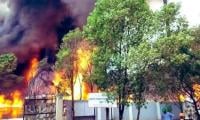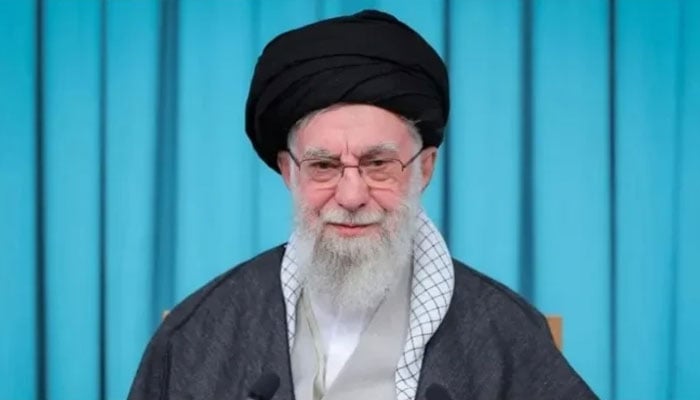
KARACHI: Saturday’s Israeli/US strikes on Iran were definitely not merely about degrading missile sites or naval assets. By most estimates, they appeared to have been aimed at the symbolic and operational core of the Islamic Republic — the Ayatollah.
Ayatollah Ali Khamenei has occupied that core since 1989. Born in 1939 into a cleric family, he trained in Mashhad, Najaf and Qom, studying under senior religious scholars including Ayatollah Ruhollah Khomeini, the revolutionary figure who led the overthrow of Mohammad Reza Pahlavi in 1979. As a young cleric, Khamenei was arrested and tortured multiple times by the Shah’s secret police for his activism. In 1981, he survived an assassination attempt that left his right arm paralysed.
After serving as president during the turbulent 1980s, he was chosen by the Assembly of Experts (Majles-e Khobragan Rahbari) to succeed Khomeini as Supreme Leader. Under Iran’s constitutional order, that position holds ultimate authority over the armed forces, judiciary and key state institutions. It is both political and spiritual, embedding clerical oversight at the summit of governance.
Over nearly four decades, Khamenei has steered Iran through war, sanctions, covert operations and repeated domestic unrest. He has also faced waves of domestic protest -- from the disputed 2009 election to demonstrations over economic hardship and the 2022 unrest following Mahsa Amini’s death to the more recent protests this year. Each episode tested the system; none dislodged it.
Central to that resilience has been the loyalty of the Islamic Revolutionary Guard Corps (IRGC) and the Basij paramilitary forces. Under Khamenei’s leadership, the IRGC expanded beyond a conventional military body into a powerful political and economic actor, deeply embedded in Iran’s security architecture. His office, often referred to as the ‘Bayt’, functions through a tightly controlled network of loyalists across the military, intelligence and political establishment.
Regionally, Khamenei positioned Iran as the hub of what officials describe as an ‘Axis of Resistance’, aligning Tehran with allied state and non-state actors. Support for the Palestinian cause has been a consistent pillar of his foreign policy rhetoric and tensions with Israel have evolved into a prolonged shadow war marked by targeted strikes and reprisals.
On the nuclear question, Khamenei has long maintained that Iran’s programme is for civilian purposes and that the country would not build an atomic weapon. Neither US intelligence nor the UN nuclear watchdog has publicly concluded that Iran was actively pursuing one. Nonetheless, Israeli leaders and some in Washington have consistently framed Iran’s capabilities as an existential threat.
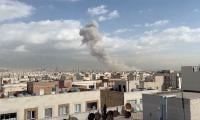
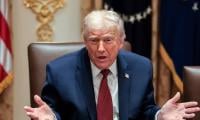
In recent weeks, rhetoric escalated sharply. Israeli officials declared that Khamenei “cannot continue to exist”. Meanwhile, US President Donald Trump has publicly described him as an “easy target” and urged Iranians to overthrow their government, also openly speaking of ‘regime change’. Against that backdrop, strikes near his compound on Saturday carried a significance beyond battlefield calculations.
If Khamenei were to be killed, the impact would be historic -- the most consequential decapitation of Iranian leadership since the 1979 revolution. Yet, many would argue that the system he shaped was built to endure shocks. In fact, US intelligence assessments reportedly examined scenarios in which hardline figures from the IRGC could assume leadership if he were eliminated. In a nutshell: the institutional machinery surrounding the Supreme Leader does not disappear with one individual.
His removal could trigger a tightly managed succession process dominated by security elites. And it could also ignite nationalist backlash, reinforcing hostility towards Washington and Tel Aviv. Alternatively, it is also quite possible it opens a period of internal contestation over Iran’s political future. None of these outcomes, however, guarantees the collapse of the Islamic Republic.
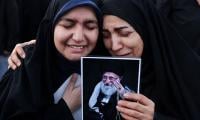
For his supporters, Khamenei has represented continuity -- the guardian of revolutionary identity and national sovereignty in the face of external pressure. For his adversaries, he has embodied the ideological and strategic barrier to a different Iran.
As rumours swirled on Saturday night, one reality stood out: Israeli and American missiles may have struck concrete and command centres, but their deeper target was the authority and symbolism concentrated in a single office -- one that has shaped Iran’s trajectory for nearly four decades.