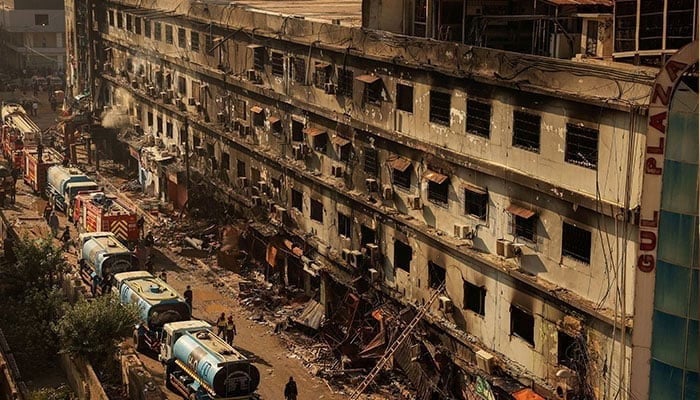
The fire department and Rescue 1122 were equipped with advance machinery and specialised SOP to handle emergencies like the Gul Plaza shopping centre fire, but they failed to extinguish the fire effectively and rescue the trapped individuals, a civil defence technical instructor claimed on Saturday.
Recording his statement before a single-member inquiry commission headed by Justice Agha Faisal, Mirza Mursaleen Baig said the civil defence department had conducted a fire audit of the Gul Plaza in 2024 and 2025, during which it had been observed that fire safety measures were inadequate.
Baig said the Gul Plaza management had been directed to comply with the safety regulations. A challan as regards non-compliance of fire safety measures could not be submitted before the special court concerned due to the unavailability of the court’s presiding officer, he added. He said that the relevant court became functional in July 2025 but the challan had not been submitted until the fire incident.
He also said electricity should not have been cut off immediately after the fire broke out. “Based on my information, the fire was a class B fire involving multiple types of highly flammable materials/fuel spread all over the floors such as plastic, rubber, melamine crockery, electronic appliances, perfumes, nylons, etc.”
Baig said electricity is usually cut off when the fire originates from a short circuit, class C, while in class B fires, the immediate disconnection of electricity is not necessarily mandated unless there is direct electrical hazard.
He said that premature shutdown of electricity contributed to the darkness inside the premises and panic among the people. The exit doors should have remained open to facilitate the evacuation of the trapped people, he added.
He explained that due to the accumulation of excessive smoke, which typically intensifies within 7 to 10 minutes in closed environments, many individuals were unable to exit on time, while the closure of doors, combined with the darkness and smoke, significantly impaired the evacuation efforts.
The fire instructor, whose department’s core responsibility is to inspect fire prevention measures in the commercial and industrial sector, said that according to the July 2025 inspection of the building, the management had 62 dry chemical powder (DCP) fire extinguishers, 18 carbon dioxide ones and 32 fire balls inside the premises, which were sufficient to sustain an extinguishing attempt for 30 to 40 minutes, had they been used properly and been readily available in the accessible area.
He said the building management is usually required to maintain firefighting capacity sufficient for approximately 15 minutes of initial extinguishing efforts before the arrival of emergency services.
He also said that there were no separate emergency lighting arrangements installed in the corridors, which are normally required to function in the event of an electricity shutdown during a fire emergency.
The absence of such emergency lighting further exacerbated panic among the occupants, particularly in the condition of darkness combined with dense smoke, he added.
Baig said the fire department and Rescue 1122 were equipped with advance machinery such as special oxygen masks with tanks, tools and specialised SOP to handle such emergencies.
But the fire and rescue departments failed to extinguish the fire effectively and rescue the trapped individuals either due to a lack of awareness or negligence, he added.
He said that according to the initial report, the fire originated at a flower shop where polypropylene chemicals were likely involved, and in such cases, the appropriate extinguishing agent is aqueous film forming foam or DCP.
However, the fire team did not utilise it, and despite rescue tools, the rescue department failed to deploy them effectively, he added. He pointed out that his department has also submitted the incident report highlighting these shortcomings.
The commission said that the chief fire officer and the Rescue 1122 director general have the right to cross-examine the fire instructor until March 5, adding that failing to respond by then would be construed as a waiver of that right.