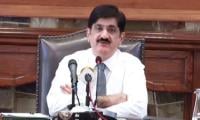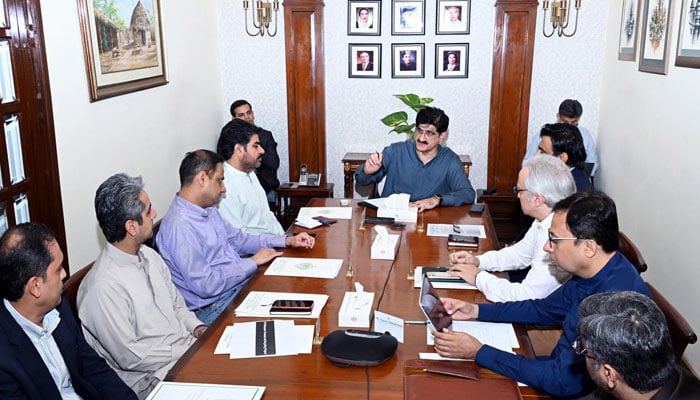
Sindh Chief Minister Syed Murad Ali Shah on Saturday chaired a high-level meeting to review progress in Karachi’s wastewater treatment projects, approving Rs 5 billion for the secondary treatment of 100 million gallons per day (MGD) at the TP-1 and setting firm timelines for improved performance.
The CM set an interim target of treating between 30 and 35 MGD of wastewater by June 30 and directed that the TP-1 be made fully operational by December 31, 2026. He expressed confidence that Karachi would witness noticeable improvement within the current year as a result of the accelerated efforts.
Describing the TP-4 project as a revolutionary step for the city’s water management system, Shah instructed the Karachi mayor, Karachi Water & Sewerage Corporation (KWSC) and planning & development department to ensure immediate coordination and seamless collaboration for its timely execution.
The TP-4 scheme has been undertaken under a public-private partnership mode, and a government-to-government memorandum of understanding has been signed between the KWSC and Enertic Holding Company.
The project has secured substantial international financial backing. The World Bank has committed $100 million in viability gap funding, while the Asian Development Bank has assured $50 million for the same purpose.
The Sindh government has separately approved capital expenditure funding equivalent to $80 million. The TP-4 project is being structured under the DBFOMT model, covering design, build, finance, operate, maintain and transfer components.
Under the plan, a 22-kilometre-long interceptor with a capacity of 200 to 250 million imperial gallons per day would be constructed alongside a 100 MGD wastewater treatment plant and a 40 MGD recycling plant.
Reclaimed water is expected to be supplied to Korangi Industrial Area and Korangi Creek Industrial Park, a move the CM said would significantly reduce pressure on the city’s potable water supplies.
A total of 140 acres has been declared available at the TP-4 site for construction, and the deputy commissioner concerned has been directed to immediately complete the survey and demarcation process.
The technical feasibility study was submitted on February 18 and the CM briefed accordingly. The financial feasibility is expected by mid-March 2026. Financial close has been targeted for October 2027, with commercial operations scheduled to commence by the end of 2030.
Reiterating that wastewater treatment remained among the top priorities of his government, Shah emphasised that the initiative represented a decisive step towards addressing Karachi’s long-standing environmental and infrastructure challenges.
Sukkur Barrage
On Thursday, the CM presided over a meeting to review the third-year progress on the Sukkur Barrage Rehabilitation and Modernisation Project (SBIP), calling it critical to Sindh’s irrigation security and agricultural economy.
The meeting, held at CM House, was attended by Irrigation Minister Jam Khan Shoro and Irrigation Secretary Zarif Khero. It focused on major civil, structural and mechanical upgrades, particularly the large-scale replacement of the barrage’s historic gates.
The irrigation secretary briefed the CM on the ongoing inspections and progress at the site, including work on the cofferdam, barrage pavement and allied structural components. The CM was informed that the Year-3 cofferdam (Phases II & III) had successfully enabled heavy construction activities across three major zones of the barrage.
Reviewing mechanical works, Shah noted substantial progress in gate replacement. Of the 27 new gates planned in the current phase (gates 15 to 43), 25 had been fully fabricated, achieving over 96 per cent completion. Painting and sandblasting for corrosion protection had been completed on 19 gates, while dismantling of old hoisting systems and cutting of existing gates in the targeted sections had also been finalised.
Rehabilitation of the left bank canals had reached 100 per cent completion, except for the Nara Canal, which remained under execution. At this, the CM directed the irrigation department to speed up the Nara Canal rehabilitation works.
On the civil side, the CM was told that dredging at the Right Pocket had been completed, while dredging at the ‘Approach Channel’ was under way to ensure uninterrupted water flow.
Zone-wise progress showed that in Zone-1, dewatering, de-silting, and GPR surveys of floors and piers had been completed with concrete overlay work in progress. In Zones 2 and 3, sheet piling and backfilling were largely complete, and dewatering and de-silting activities continued to prepare for further structural repairs.
Emphasising the strategic importance of the Sukkur Barrage, the CM directed the irrigation department to maintain the momentum of Year-3 activities and ensure strict adherence to timelines.
“This barrage is the backbone of Sindh’s irrigation system. Precision in installing the new gates is vital for smooth irrigation flows and the long-term safety of this century-old structure,” Shah said.
He instructed the irrigation department to resolve all remaining punch-list items from Phase I, including minor rectification works on the gates 44 to 59, without delay.
The meeting concluded with the CM reiterating that the timely and quality completion of the modernisation project was essential to safeguard Sindh’s water security, agriculture and livelihoods dependent on the irrigation network.