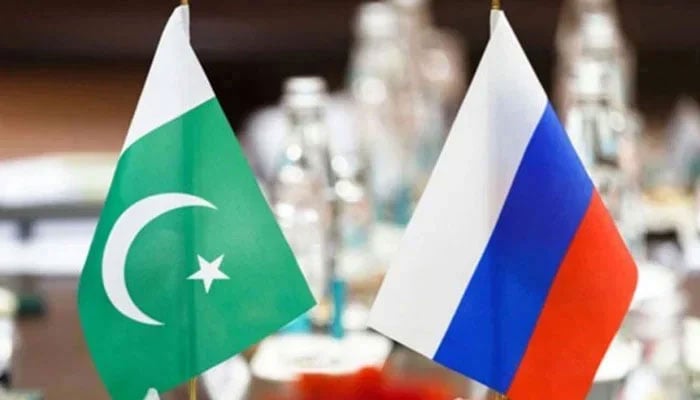
ISLAMABAD: Pakistan is seeking to sign a preferential trade agreement (PTA) with Russia to boost bilateral trade volume during Prime Minister Shehbaz Sharif’s upcoming visit to Moscow, Pakistan’s ambassador to Moscow has said, ‘Arab News’ reported.
Pakistani Ambassador Faisal Niaz Tirmizi said this during the Moscow-Islamabad media forum, which was hosted by Sputnik ahead of Sharif’s scheduled visit to Moscow next month.
Pakistan and Russia, once cold war rivals, have strengthened ties in recent years. In 2023, Islamabad began purchasing discounted Russian crude oil banned from European markets over Ukraine war, and also received first shipment of liquefied petroleum gas from Moscow.
The volume of Russia-Pakistan trade rose more than 100 per cent to $1.81 billion from July 2023 till June 2024, though it experienced slight contraction in the last fiscal year, according to officials.
“Once the prime minister is here, we will start the process of signing PTA with the Eurasian Economic Union and the Russian Federation,” Tirmizi said at the forum.
PM Sharif plans to visit Russia on March 3-5, Russian state news agency RIA reported this month, citing a Pakistani official.
During the event, speaking at the session titled ‘Perspectives on Bilateral Relations Development Between Russia and Pakistan’ geopolitical analyst and head of the Scientific Centre of International and Strategic Studies at the University of World Civilization Dr Roxolana Zigon said that Pakistan and Russia should address emerging challenges, strengthen mutual understanding and explore new avenues for collaboration to promote sustainable bilateral relations.
She said global power shifts influenced both nations to recognise shared strategic and geopolitical objectives. Dr Zigon added that the forum aims to strengthen strategic collaboration ahead of Prime Minister Shehbaz Sharif’s visit to Moscow, emphasising Pakistan’s efforts to combat terrorism, manage tensions with India responsibly, and assert its role as a middle power through active global engagement.
She emphasised that Pakistan’s diplomatic and military responses, including the management of heightened tensions with India, reflect strategic restraint and responsibility as a nuclear state.
Former foreign secretary Aizaz Ahmad Chaudhry observed that Pakistan-Russia relations have witnessed a steady upward trajectory since the early 2000s, with both countries gradually building mutual trust and expanding cooperation across multiple sectors including defence, energy and regional connectivity.
Sarwat Rauf, head of the department of international relations at NUML, noted a visible thaw in bilateral relations, describing the current phase as an opportune moment to consolidate gains and move forward despite geopolitical challenges. She stressed the importance of academic and intellectual exchanges in strengthening long-term cooperation.
Dr Syed Muhammad Ali, chairperson of the Council of Complaints, deliberated on emerging sectors of potential cooperation and the importance of fostering mutual trust. He identified 14 key challenges and proposed measures to address them, highlighting Pakistan’s stance on various issues while expressing optimism about stronger ties in the future. Senior journalist Almas Haider Naqvi highlighted collaboration in multinational forums such as the SCO as a reflection of mutual recognition and forward-looking partnerships.
News analyst and anchor Shaukat Piracha termed the PM’s upcoming visit to Moscow as highly significant for advancing strategic engagement, adding that Russian President Vladimir Putin condemned blasphemous content that hurt the sentiments of Muslims and recalled instances where Russia supported Pakistan’s principled positions on key international issues.
During the third session tilted ‘New Trends in International Journalism’, Executive Content Producer of Rossiya Segodyna Dmitry Leontiev stressed that media organisations must uphold their national interests while reporting. “We are here following our national interest, and Pakistani media should also follow their national interest,” he said, emphasising that no external body can better judge a country’s interests than the country itself.
Adviser to Pakistan’s Ministry of Defence and Chairperson of the South Asian Strategic Stability Institute University Dr Maria Sultan underscored the central role of communication and journalism in bridging trust gaps. She stressed that sustainable cooperation cannot be achieved without accurate and balanced media representation. “If there are no voices reflecting the truth on either side, the communication bridge will not hold,” she said.