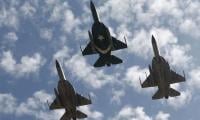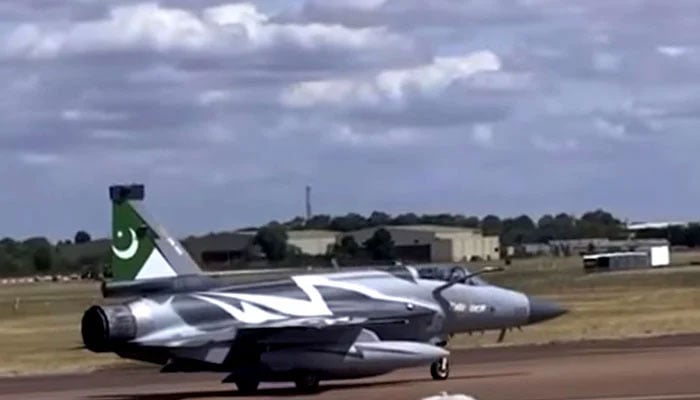
A sudden surge recently in prospects for exports of Pakistan-produced JF-17 ‘Thunder’ fighter planes has presented the country with an unprecedented opportunity to turn its technological advancement into an economic gain. But beyond a short-term success story, the emerging gains on this front must be seen as evidence of Pakistan’s repeated ability to beat the odds.
With almost a dozen customers, from prospective ones to those that have placed orders, Pakistan’s JF-17 programme has emerged as a success story. Information in the public domain suggests a growing number of international customers lining up to purchase batches of the JF-17, following last summer’s aerial encounters in the four-day conflict between India and Pakistan.
The skies above Pakistan and India were then dominated by the Chinese J-10CE fighters, the JF-17s produced by Pakistan with China’s assistance and older US-produced F-16 fighter planes. Together, their success in targeting at least three French-manufactured ‘Rafale’ fighter planes has subsequently raised the profile of the Pakistan Air Force while prompting questions over the performance of the Indian Air Force.
The JF-17s, however, stood out with a vital edge based on affordable costs, alongside its top-of-the-line performance at par with modern front-line fighter planes. Unlike Western-supplied military hardware, there are no political strings attached to Pakistan’s JF-17 exports for global customers. This is a lesson that Pakistan learnt the hard way from the 1980s onwards. The past supply of US-manufactured F-16s to Pakistan from 1981 onwards gave the country a significant boost to its aerial defence.
Earlier US sanctions slapped on Pakistan from the days following the 1965 Indo-Pakistan war and onwards were reversed literally overnight as Washington sought to empower a frontline ally. But soon after the 1989 withdrawal of Soviet military forces from Afghanistan, Pakistan’s relationship with the US simply crumbled. In October 1990, the US sanctioned Pakistan on the pretext of the country’s progress towards producing nuclear weapons.
The US decision disregarded Pakistan’s need to nuclearise as an essential step in response to India’s journey as a nuclear-armed state, beginning with Delhi’s maiden nuclear tests of 1974. It is noteworthy that the US-led global effort to force Pakistan away from becoming a nuclear-armed state simply failed in May 1998 when Pakistan carried out its maiden nuclear tests, three weeks after a series of nuclear tests by India. Today, Pakistan’s nuclear and missile programmes present not only the surest guarantee of a credible deterrence against India. This status has reinforced peace in South Asia time and again, with the conflict in May last year standing out as the latest evidence of this trend.
Going forward, Pakistan’s successful entry into global markets with the sale of its fighter planes creates an essential guarantee for the future. The sales present Pakistan with a guarantee for the sustenance and future growth of the JF-17 and other defence-related systems.
As Pakistan's revenue from international sales of its JF-17s grows, global experience offers a vital lesson in securing the skies above the country. The expansion and continuous modernisation of the JF-17 fleets in the Pakistan Air Force will inevitably fulfill the needs of the country’s defence. Meanwhile, growing international sales of the JF-17s promise to bring in valuable foreign exchange that will support plans for future modernisation of the Pakistan Air Force.
Going forward, on a related front, Pakistan is set to gain additional benefits for its defence preparedness as the country modernises its naval force to defend its maritime boundary along the Arabian Sea and the Indian Ocean. The year ahead may see Pakistan's unprecedented entry of up to 4 submarines purchased from China.
At home in Karachi, work is ongoing on the production of another four submarines with Chinese assistance at the Karachi Shipyard and Engineering Works (KSEW). Together, these eight submarines will elevate Pakistan’s maritime defence to unprecedented levels.
While the successful exports of the JF-17s and the expansion of Pakistan’s submarine fleet bear witness to advances in the country's national defence, Pakistan’s history of successfully developing its nuclear program deserves to be remembered.
Along this journey, Pakistan has paid a heavy price while continuing its march towards attaining nuclear weapons. Pakistan’s emergence as the Islamic world’s only country armed with nuclear weapons became possible through the contributions of a large number of individuals in the public service.
Notable among them stands Dr Abdul Qadeer Khan, who is widely remembered as a prominent pioneer in this area. Yet, keeping Pakistan’s nuclear programme consistent under successive governments helped the team of the country’s nuclear scientists to continue their work without interruption.
Ultimately, these achievements have guaranteed Pakistan’s national defence more than the reliance on the widely publicised ties with foreign powers. Going forward, Pakistan’s security and independence remain closely tied to the country’s resilience, as repeatedly demonstrated over time.
The writer is an Islamabad-based journalist who writes on political and economic affairs. He can be reached at: [email protected]