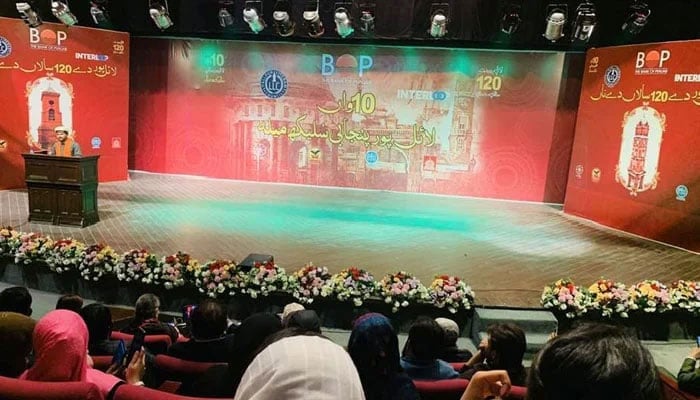
Recently, we went through a glut of literary festivals, with major cities contributing to the sustenance of the (nostalgic) cultural capital.
This, in many ways, is a commendable venture, given the post-literate society we live in, the extreme religiosity and hostility we inhabit, and the ways in which dialogue is stifled through legal mousetraps (and at times, outright state’s brutality). Yet, we occasionally see critiques of these events, both in print and on social media, pointing out how exclusive these literary spaces are, and thereby denying a valuable platform to indigenous voices.
This leads to the absence of discussions around major, novel ideas, including those of dissent in the face of a regressive status quo. Resultantly, it is really important, for the proliferation of the literary current in this country, to analyse and undertake a gap analysis around these festivals.
First, these festivals lack institutional governance and infrastructure. There is no institutional continuity: these events are more like an annual ritual, with no permanent establishment, which should ideally work actively whole year on the stated objectives. Further, the language equity and translation habitat are in oblivion: there is limited structured translation between Urdu, regional languages and English, leading to siloed regional literature discussion as well as low populace’s attendance from every walk of life. Especially those belonging to the working and middle classes, who are mostly subject to socio-economic bloodbath, and also not well versed in eloquent English or even Urdu.
Commercial transparency is also lacking. One cannot ascertain the funding details or the disaggregation of expenditures of these flamboyant events. Given the absence of institutional governance, audited accounts are also not publicly available.
Literary festivals should not be co-opted by the publishers, making this more like a marketing event for book selling and signing. In the words of Zulfikar Ghose, while penning his views about literary festivals, “the model for such indiscriminate inclusiveness is the capitalist notion of letting the market decide what holds the most value; and the occasion – instead of being a festival that celebrates literature – becomes a promotional fair given the rather grand title of ‘Literary Festival’ that prompts in the mind of the public making its annual pilgrimage the charming illusion that it is privileged to be among the elect.”
Apart from publishers, they can become protege of big corporates’ CSR initiatives –which, of course, is not in itself wrong but which carry consequences, as palatability is required for their annual reports, showcasing the ‘great work’ they have done. This can shape both the language of the sessions and the language of the milieu: extravagant venues, triggering elite cultural signalling, effectively making the general audience shilly-shallied, while for the elite the ambiance becomes a networking space and a source for Instagram posts.
Also, urban centricity is visible with no significant footprint in secondary cities and rural districts. Youth, the asset we all talk about, is also missing in the dialogue, with long-in-the-tooth authors as speakers overlapping in every festival and selling the same books – mostly anglophone – which doesn’t even need that much spotlight, especially at the expense of indigenous writers and voices.
On the ecosystem side, we see multiple problems as well. These include: first, little or no inter-festival collaboration; second, the soft power strategy is almost entirely missing: literature, culture and intellectual exchange could be used to shape how Pakistan is perceived internationally. Festivals could bring global attention, boost the economy, entertain the population and make our cities feel part of the international scene; third, in most cases, data on audiences, with proper disaggregation, is not published, muddling transparency for such public events; fourth, the interaction between these events and national cultural policy remains unclear: do they influence the state’s outlook toward art and culture, or do they remain confined to their own space without a broader national effect? Plus, structural bottlenecks in the publishing industry are rarely discussed, which seems like a missed opportunity.
The focus should also not be solely on talks and interviews; the pedagogical role should be emphasized as well. Workshops for new writers, where experienced authors can teach and innovative sessions to nudge audiences to become writers, or to engage with authors’ work more comprehensively, should be emphasised. For instance, I came across a talk by Anjum Altaf, named ‘Gen Z, Gen Alpha & Faiz’, at this year’s Faiz Festival that exemplified this approach. Other festivals should also strive to become more out-of-the-box.
The remedies for this predicament are imperative if these festivals are to truly revive and proliferate literature, while evolving into cosmopolitan intellectual platforms, heritage-centered institutions and grassroots civic spaces.
The first and foremost priority should be to make these public festivals genuinely public, where everyone, especially pauper labourers and students from all backgrounds and levels, can mingle freely and develop a literary sensibility. Ergo, venues should be public universities or other accessible spaces, rather than ones that friendly cater only to the well-off. The speakers should ideally include the full spectrum of writers: from audience-pullers to emerging and yet-to-be-acknowledged voices, and even the completely fledgling.
Some other enhancements (non-exhaustive) include: creating a Pakistan LitFest Network for coordination; establishing an annual translation fund and partnering with universities and publishers, and creating a ‘Festival Translation Prize’; developing traveling lit-fest caravans; launching provincial outreach programs; creating structured Youth Literary Fellowships under all festivals; hosting Cultural Policy Roundtables with relevant ministries; and publishing audited accounts along with audience’s statistics.
With these steps and more, we may curate events that savour the rich flavors of literature and culture throughout the year on the one hand, while projecting a soft, culturally rich image of Pakistan to the world on the other.
The writer is a Peshawar-based researcher who works in the financial sector. He can be reached at: [email protected]