Pakistan stands at a decisive moment in its history. With one of the youngest populations in the world, it possesses a demographic profile that could either become its greatest asset or its most destabilising liability.
To understand the scale of the challenge, it is important to recognise the extent of Pakistan’s educational underinvestment. Pakistan has been consistently spending about 1.7-1.9 per cent of its budget on education, which is far lower than India, which spends 4.1 per centof its much larger GDP on education. Unesco has advised a minimum of 4-6 per cent expenditure for education, which our leaders have constantly ignored.
The result is that over the last three decades, India has forged well ahead of Pakistan with its exports now reaching $ 820 billion while those of Pakistan stagnate at a dismal $ 30 billion. This is a shameful reality and emphasises the lack of vision of our leadership and the urgent need for a change of direction.
The rapid transformation of Korea, a poor country in the 1960s, into one of the world’s strongest economies was also based on its emphasis on quality education and its allocation of appropriate resources to it. South Korea spends around 5.0 per cent of GDP on education and maintains one of the highest R&D expenditures in the world at nearly 5.0 per cent of GDP. Singapore too consistently invests about 3.0 per cent of GDP in education, but couples it with highly targeted workforce development and innovation programmes. Vietnam, despite having a per capita income historically comparable to or lower than Pakistan’s, has steadily invested in school quality and teacher development, producing learning outcomes that outperform those of many wealthier nations. There are lessons to be learned from these successes, but we need visionary leadership to emulate these transformations.
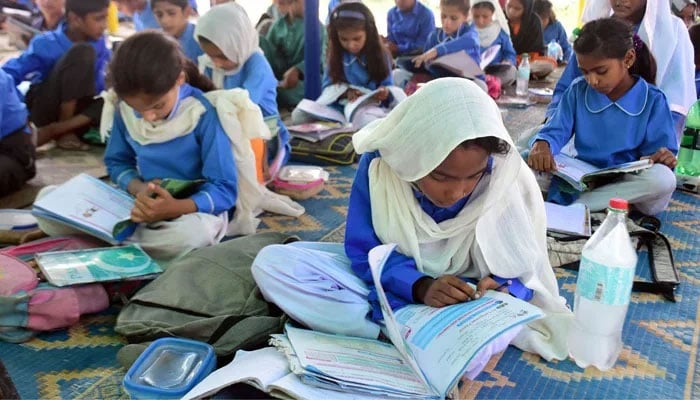
At the school level, Pakistan’s foundational learning crisis is acute. There are some 27 million out-of-school children with no opportunities for education. Many children complete primary school without achieving functional literacy or numeracy. This is not merely a statistical problem but a structural barrier to scientific advancement. A child who cannot read fluently by Grade 3 will struggle to comprehend scientific texts in Grade 6. A student who does not master fractions and algebraic thinking by middle school cannot meaningfully engage with physics or computer science in later years.
Pakistan can tackle the out-of-school crisis through a focused, low-cost national mobilisation strategy that combines governance reform with scalable delivery models: immediately introduce double-shift schooling in all government facilities to maximise existing infrastructure; expand public-private partnerships through performance-based funding (as demonstrated by the Punjab Education Foundation model); strengthen conditional cash transfers under the BISP to keep poor children – especially girls – in school; establish community-based non-formal schools in underserved rural areas; and digitise teacher attendance and school monitoring to eliminate ghost schools and leakages.
Even within limited fiscal space, reallocating resources to address inefficiencies and prioritising foundational literacy as economic infrastructure can rapidly bring millions of children into classrooms while laying the groundwork for a technology-driven knowledge economy.
Teacher quality lies at the heart of educational transformation. In Singapore, teacher recruitment is highly selective, training is systematic and professional development is continuous. Teachers receive structured mentoring early in their careers and leadership pathways later. Pakistan’s system, in contrast, often emphasises seniority and credentials over demonstrated teaching effectiveness. Political interference in appointments undermines meritocracy.
Curriculum reform itself must shift from memorisation to inquiry. Pakistan’s textbooks frequently prioritise factual recall over reasoning. Board examinations often reward students who reproduce expected answers rather than those who demonstrate conceptual understanding. This culture of rote learning discourages experimentation, curiosity and intellectual risk-taking. Pakistan has periodically launched laptop distribution schemes and ICT initiatives, but without systemic teacher training and curriculum integration, such efforts yield limited long-term impact.
Mathematics deserves particular emphasis because it is the language of modern technology. Nations that industrialised successfully invested heavily in mathematics education. South Korea’s rapid ascent in electronics and manufacturing was supported by strong math performance among students. Ireland, which transitioned from an agriculture-dominated economy to a high-tech hub, invested in STEM pathways and higher education expansion to attract multinational technology companies.
Technical and vocational education and training (TVET) is another neglected pillar. A technology economy does not rely solely on PhDs and engineers; it requires skilled technicians, machinists, laboratory technologists, renewable energy installers and network operators. Singapore’s Institute of Technical Education and polytechnic system exemplify how vocational training can be high-status, well-resourced, and aligned with industry demand. Germany’s dual apprenticeship model integrates classroom learning with paid industry training, creating a steady pipeline of skilled workers.
Pakistan’s vocational institutions often suffer from outdated equipment, weak industry linkages, and social stigma. Modernising TVET, aligning curricula with emerging sectors such as solar energy, automation and advanced manufacturing, and creating apprenticeship incentives for private firms could dramatically enhance productivity.
Universities represent the apex of the knowledge ecosystem. Yet Pakistan’s universities struggle with governance challenges, funding instability, and research fragmentation. The operational budgets of our public sector universities have been frozen at Rs66 billion for almost a decade due to shameful, myopic government policies, resulting in most of our universities being degraded into low-level colleges with few opportunities for research and development.
The tenure-track system of higher salaries based on performance, introduced by me when I was the HEC chairman in 2005, led the brightest children to opt for careers in education and research and was responsible for the phenomenal increase in the quality of research. The dramatic transformation of the higher education sector that occurred under my stewardship of this sector and led to warning bells ringing in India.
Unfortunately, the momentum created during my tenure was not sustained by the governments that followed and the higher education sector unravelled, with the tenure-track system of faculty appointments eroding over time. A book by Fred Hayward, published by Palgrave Macmillan in 2022, accurately and in detail describes the rise and fall of the higher education sector during my leadership and in subsequent years.
Pakistan’s underinvestment in education, the politicisation of the sector and the fragmentation of the education system through the 18th amendment have destroyed our future, leaving the nation struggling in a rapidly advancing technological world. Lip service will not do. The time to act is now, before the youth bulge becomes a huge liability.
The writer is a former federal minister, Unesco science laureate and founding chairperson of the Higher Education Commission (HEC). He can be reached at: [email protected]