The new penal codes issued by the Afghan Taliban, aimed at further subjugating women and establishing a brutal social hierarchy, have vindicated those who had claimed that this group of militants would never be amenable to the idea of reforming itself.
The audacity with which such obscurantist laws were introduced clearly indicates that the regime does not fear any backlash nor does it pay any attention to the pleas of the international community that has been appealing to Kabul to form an inclusive government and respect the rights of women, ethnic minorities and sectarian entities.
According to the British newspaper, The Independent, these penal codes enshrine some of the Taliban’s most backward practices into the law of the land in Afghanistan, with women in particular set to suffer at the hands of the courts. “Signed by the hardline Islamist group’s supreme leader Hibatullah Akhundzada, the 90-page criminal code includes anachronistic stipulations harking back to Islamic scripture, such as different levels of punishment depending on whether the offender is f’ree’ or ‘a slave’”.
Following the footsteps of their archrival, the Islamic State, the codes seem to be introducing slavery in the 21st century, relegating women to the status of slaves in one or another way. The paper notes, “Perhaps most alarmingly, the code effectively appears to put women on a par with ‘slaves’, with clauses stating that either ‘slave masters’ or husbands can mete out discretionary punishment in the form of beatings to their wives or subordinates. It encourages less serious misdemeanours to be dealt with through a ‘ta’zir’ (discretionary punishment) – in other words, in cases where the ‘offender’ is a wife, a beating by her husband”. Many say it amounts to encouraging domestic violence and beating of women would become normal as long as it does not cause any fracture or visible wounds.
Under the new laws, the female victims will have to go through another ordeal while seeking justice against the perpetrators. The British publication wrote, “The code does provide a route to justice for women who are assaulted, but they are required to prove they have suffered serious bodily harm by showing their wounds to the judge, while at the same time being required to remain fully covered. They are also required to be accompanied to the court by their husband or male chaperone (mahram) – even though the majority of offenders in such cases are the husbands themselves”.
Imagine the amount of trauma a woman experiences while appearing before the court, accompanied by the perpetrator who subjected her to torture. Then how can women show their wounds to the judge while remaining completely covered? The Afghan Taliban do not have any clue about modern scientific methods that can be helpful in establishing the assaults and proving the guilt of the violent men.
By sheer luck, if a woman gets through all the legal and social hurdles to prove she has been the subject of a serious assault by her spouse, the husband will be given a maximum sentence of 15 days. It means that after 15 days, he might be in a position to vent his anger against the victim, which could be death in some cases, because such a complaint, in the mind of the perpetrator, might amount to disgracing him.
The Taliban seem to have closed all doors of relief for victims of domestic violence. In countries like Pakistan, India, Afghanistan and Bangladesh, women rush towards their fathers’ homes to seek refuge from domestic violence. But the Taliban’s callous approach has also shut this door. Article 34 of the penal codes reportedly states that if a woman repeatedly goes to her father’s house or that of other relatives without her husband’s permission and does not return home despite her husband’s request, the woman and any member of her family and relatives who has prevented her from going to her husband’s house are deemed criminal and will be sentenced to three months’ imprisonment.
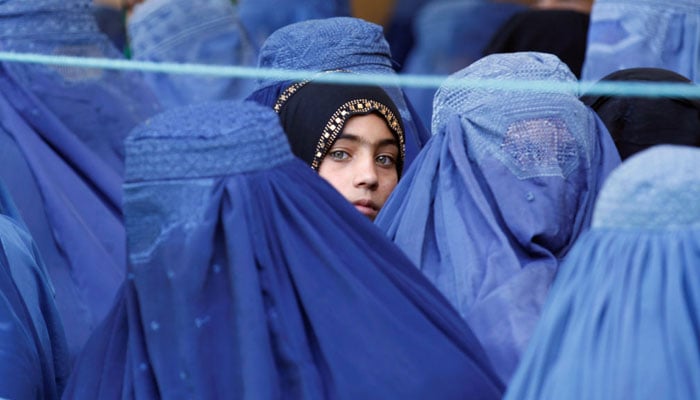
It seems the Afghan Taliban have been emboldened by the lacklustre response of the international community that failed in protecting Afghan women, who have been deprived of higher education, political representation, access to many government and private jobs and freedom of movement. Some of the women have also been meted out inhuman punishments. Tens of thousands had to flee because of these policies, which are effectively a gender apartheid in the war-torn country.
According to Amnesty International, women are banned from going to school, studying, working, leaving the house without a male chaperone, showing their skin in public, accessing healthcare delivered by men or being involved in politics or speaking publicly. According to UNWOMEN, nearly 80 per cent of young Afghan women are not in education, employment or training. “Not a single woman has a position in the de facto cabinet or local offices. A complex patchwork of more than 80 edicts, directives and decrees introduced by the Taliban has directly and systematically targeted women’s rights and autonomy. They ban women from education after Grade Six; most professions; and from public spaces, including parks, gyms, and sports clubs”.
The US seems to be completely indifferent to the plight of Afghan women. Contrary to popular beliefs, Afghan women were given the right to vote in 1919, which was revoked in 1929 and they were again enfranchised in 1964. During the 1950s, 1960s, 1970s and even the early 1980s, their participation in public affairs could be seen in all major urban centres, with women serving in government, the medical professions, academia and other fields.
Instead of punishing the Afghan Taliban, Washington has been lavishing aid on Kabul. The special inspector general for Afghanistan reconstruction (SIGAR) revealed that since the withdrawal of its troops from Kabul in the summer of 2021, the US has spent almost $21 billion on aid for Afghanistan. Many critics claim that part of this sum has kept the Taliban regime afloat. Other Western countries and international bodies have also extended various forms of assistance to Kabul.
No one with a modicum of common sense would advise the US or the international community to invade the country in a bid to topple the gender apartheid, but the US can use the leverage of aid. Qatar, Saudi Arabia and the UAE should also exert their influence. Pakistan has a historic opportunity to undo the mistakes of the past by highlighting the barbarities. At least it could grant asylum to those female activists who are fleeing or have sought shelter in Pakistan.
Some women’s organisations supported by the Afghan diaspora have been lobbying to designate the Afghan Taliban regime as a gender-apartheid regime. The US, EU and Islamic countries should second such moves and let the regime in Afghanistan know that Afghan women are not heirless. The entire international community is with them and will not leave any stone unturned to ensure they have all the rights enshrined in the Universal Declaration of Human Rights. Challenging the gender-apartheid might be the first step towards that goal.
The writer is a freelance journalist who can be reached at:[email protected]