LAHORE: Pakistan, already grappling with its highest unemployment levels, faces the looming demographic wave that threatens to turn today’s crisis into a historic catastrophe. We should either quickly build a productive economy or surrender the domestic market to others.
According to World Bank estimates, 1.2 billion job seekers will be in the job market over the next 10-15 years, but on current trajectories, only about 400 million jobs will materialize. The gap is staggering — and Pakistan is among the most vulnerable.
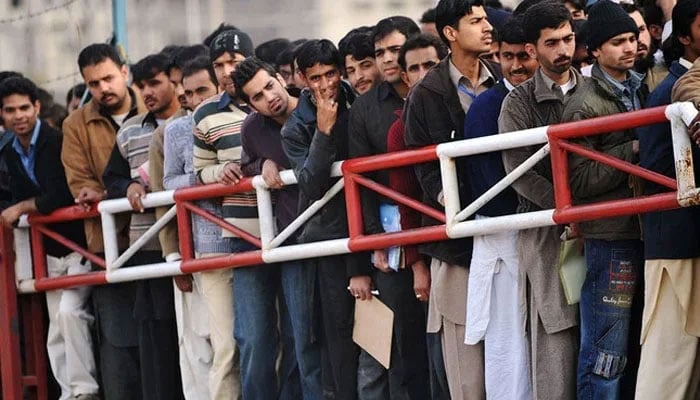
With a young and rapidly expanding population, Pakistan should have been positioned to reap a demographic dividend. Instead, the country is edging toward a demographic disaster. Each year, millions of young Pakistanis enter the labour force, but the economy is generating too few productive jobs. The result is rising unemployment, underemployment, informality, and a growing pool of frustrated youth.
The fundamental deficits are well known but persistently ignored. Power shortages, poor transportation infrastructure, weak education and healthcare systems, and policy uncertainty deter private investment. Without reliable electricity, efficient logistics, skilled workers, and predictable regulations, firms do not expand, and new businesses do not emerge. Jobs, therefore, remain scarce.
Besides infrastructure equally critical is investment in people — skills, health, and education. India’s Bhubaneswar skills centre for example trains nearly 38,000 people annually in market-aligned skills and places most graduates in jobs or entrepreneurship, underscores what is possible. Pakistan has vocational institutes, but they remain poorly funded, disconnected from industry needs, and often focused on outdated curricula.
Equally damaging is the regulatory unpredictability that plagues Pakistan. Sudden tax changes, arbitrary import restrictions, shifting tariffs, and inconsistent enforcement create uncertainty. Entrepreneurs hesitate to invest when policies change overnight. Capital flows to safer destinations, while Pakistan remains trapped in low-value activities. Clear rules and predictable regulation are prerequisites for job creation.
Access to finance is another major bottleneck. Small and medium enterprises are the backbone of employment globally, yet Pakistan’s SMEs struggle to obtain affordable credit. Brazil through innovative trade finance guarantees, equity financing, and risk insurance unlocked billions in private capital. Pakistan’s financial system remains risk-averse and heavily tilted toward government borrowing, crowding out productive enterprises.
By 2050, more than 85 per cent of the world’s population will live in developing countries, representing the largest expansion of labour, consumers, and markets in history. If Pakistan fails to build its productive capacity, its vast population will become primarily consumers of foreign goods, not producers. Domestic markets will increasingly be supplied by imports — from food and consumer electronics to machinery and even basic manufactured goods.
This is already happening. Pakistan imports a growing share of its machinery, electronics, chemicals, and even agricultural inputs. Domestic manufacturing is stagnating, and local firms are losing competitiveness. Without urgent reforms, Pakistan risks becoming a market economy — a nation that consumes but does not produce.
Persistent trade deficits will worsen, foreign exchange reserves will remain under pressure, and dependency on external borrowing will deepen. More importantly, millions of young Pakistanis will be denied dignified livelihoods, fuelling social unrest, migration, and political instability.
The solution requires a decisive shift in policy priorities. First, human capital must be treated as core infrastructure, not a residual budget item. Education, vocational training, and healthcare spending should be expanded and targeted toward market-relevant skills.
Regulatory stability and rule of law must be restored. Investors need confidence that policies will not be reversed arbitrarily. Transparent taxation, consistent tariffs, and fair enforcement are essential. The financial sector reforms should channel credit to SMEs and manufacturing rather than government deficits. Industrial and export policies should focus on value addition, technology upgrading, and integration into global value chains. Without upgrading, Pakistan will remain stuck in low-value segments while others capture higher margins.
If Pakistan invests early in people and connects them to productive work, its young population can build a foundation for growth and stability. Otherwise we will be a captive market for foreign suppliers and a cautionary tale of squandered potential.