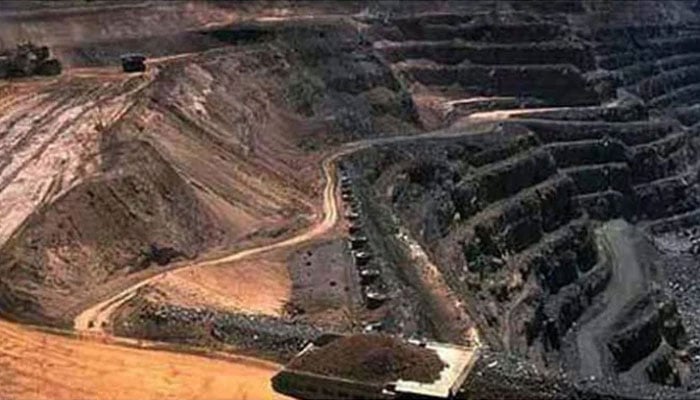
Pakistan sits on an estimated six billion tonnes of copper-bearing ore. This ore has an average copper grade of around 0.41 per cent, meaning it contains copper-bearing minerals (hence ‘copper-bearing ore’). That’s worth around $300 billion at today’s prices.
Pakistan sits on an estimated six billion tonnes of copper-bearing ore. It also includes significant gold — around 0.22g per tonne on average — with total gold reserves estimated at 41.5 million ounces. At $5,050 per ounce, that’s worth around $200 billion.
Chile has a strategic copper export policy. Chile’s Codelco, Antofagasta Minerals, and Minera Escondida have secured offtake contracts with Chinese buyers such as Jinchuan Group and Jiangxi Copper. In 2025 negotiations for 2026 deliveries, Codelco proposed record-high premiums of up to $350 per metric tonne over the LME benchmark (compared to $89 per tonne for 2025).
Does Pakistan have a single, unified national strategic policy for copper? The Democratic Republic of Congo (DRC) has a copper export policy. The Kamoa-Kakula copper project in the DRC has signed long-term copper off-take agreements with major CITIC Metal (China) and Zijin Mining Group (China).
Argentina has a policy. In early 2026, Argentina and the United States finalized a critical minerals trade deal. Australia has a strategic framework. In October 2025, Australian rare earth producers Lynas signed supply partnerships to feed U.S. downstream magnet manufacturing.
Zambia has an export policy. Guinea has an export policy. In 2026, DFC (US) committed a $553 million loan to upgrade the Lobito Atlantic Railway and port. State-owned copper producers in Zambia and Guinea have teamed up with international traders like Mercuria to reallocate supply into US-aligned chains and allied markets of Saudi Arabia and the UAE.
Chile has a formal mining code, a published export strategy and a transparent royalty framework. Australia has a Critical Minerals Strategy (a federal document). The United States has a Critical Minerals List, an Industrial Base Strategy and Defense Production Act Title III funding.
Pakistan has no roadmap. Pakistan has no timeline. Pakistan has no quantified export target. Pakistan must have a publicly released ‘National Copper Strategy’ approved by the cabinet. Remember, absence of a federal document means absence of strategy.
Chile negotiates benchmark premiums annually. Pakistan has no benchmark premium framework. Pakistan has no sovereign negotiation template. Pakistan has no published long-term pricing architecture.
Chile and DRC have structured long-term offtake arrangements. Pakistan has no sovereign-backed offtake framework. Pakistan has no state-negotiated long-term copper allocation. Pakistan has no allocation priority for strategic partners.
Yes, Pakistan has an overlapping federal-provincial authority. Pakistan has no defined permitting timeline. Pakistan has no legislated stability window. That’s a high degree of uncertainty – and capital hates uncertainty.
Red alert: A strategic copper policy is not a speech. It is a document — with five hard elements in it: One — a pricing framework. Two — a permitting clock. Three — a smelter mandate. Four — an offtake architecture. Five — a fiscal stability guarantee. Chile has one. Australia has one. The DRC has one. Pakistan does not. All that we have is God-given geology.
The writer is an Islamabad-based columnist.