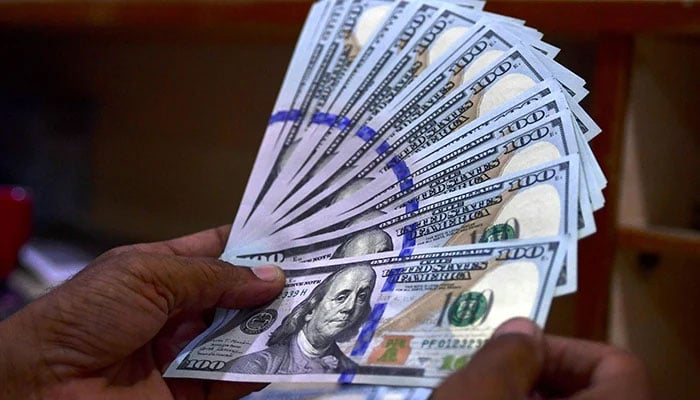
KARACHI: Pakistan’s central bank bought $620 million from the interbank market in November, a decrease from $1.03 billion the month before, according to data from the State Bank of Pakistan.
Over the past 12 months, from December 2024 to November 2025, the central bank’s total purchases from the market reached $6.4 billion. This was part of its efforts to build foreign exchange reserves and make repayments on external debt.
Awais Ashraf, director of research at AKD Securities Limited, said that the SBP used its purchases to cover interest and dividend repatriation. However, during the reported month, the central bank reduced its dollar purchases due to improved financial inflows.
The SBP’s latest FX intervention numbers come ahead of the visit of the International Monetary Fund (IMF) team to conduct the third review of Pakistan’s $7 billion Extended Fund Facility and the second review of the Resilience and Sustainability Facility. The IMF review will take place from February 25 to March 11.
The SBP interventions show a fairly deliberate reserve-building approach, said Saad Hanif, head of research at Ismail Iqbal Securities Limited.“Instead of letting incoming dollars fully pass through to the market, the SBP has been actively absorbing FX liquidity which has helped gradually rebuild reserves from very stressed levels,” Hanif said.
“This kind of intervention usually reflects tighter control over external flows, better timing in market operations, and an effort to strengthen buffers without creating unnecessary exchange rate volatility,” he added. “It is not a sign of excess reserves, but it does show policy intent to steadily improve the external position and maintain a more stable FX environment.”
In January, Pakistan recorded a current account surplus of $121 million, primarily driven by strong remittances and reduced imports. For the first seven months of fiscal year 2026, the current account posted a deficit of $1.07 billion, in contrast to a surplus of $564 million during the same period last year.
The SBP expects the current account deficit to stay within 0–1 per cent of GDP, as strong remittances offset the wider trade gap. The bank anticipates that its forex reserves will rise to $18 billion by June 2026, with further increases expected in FY27, potentially covering nearly three months of imports. The SBP’s reserves stood at $16.2 billion as of February 13.
According to the SBP, debt repayments for FY26 amount to $25.7 billion. Of this, $12.5 billion is subject to rollover, while $2.2 billion is expected to be refinanced by Chinese commercial banks. Consequently, the net amount that needs to be repaid for FY26 is $11 billion, of which $5.7 billion has already been repaid. Therefore, the total outstanding repayments for the remainder of FY26 are $5.3 billion, and these will be made on time.
Reports indicate that Pakistan is preparing to repay approximately $1.3 billion in foreign debt in April. This amount includes both the principal and interest on an international Eurobond. To raise funds, the Ministry of Finance plans to issue Panda bonds shortly after the Chinese holidays, aiming for an initial tranche of $250 million.