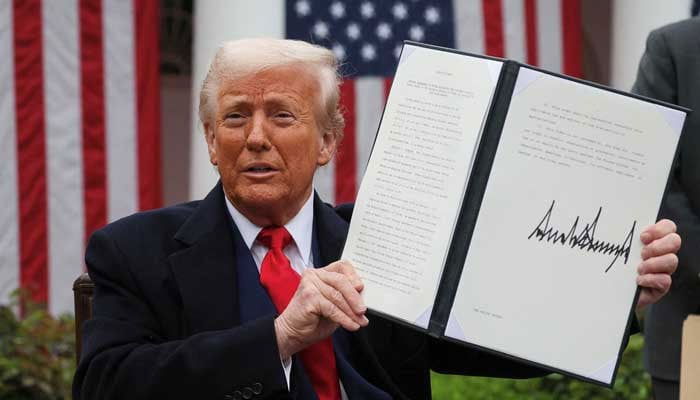
US President Donald Trump has just suffered his first major setback and, ironically, it has come at the hands of those seen as aligned with his agenda. The US Supreme Court, which includes two justices handpicked by Trump, struck down the ‘reciprocal tariffs’ he imposed on countries across the world last year, ruling that the president exceeded his authority in imposing them. The tariffs imposed rates ranging from 10 per cent to 50 per cent. The move comes at a time when Trump’s approval rating is sinking as the American people grow increasingly weary of the trade and immigration turmoil he has unleashed. Opposition to Trump’s policies is also growing in both houses of the US Congress, including from lawmakers within his own Republican Party, as crucial midterm elections loom, painting a picture of an increasingly embattled president. Trump, for his part, struck his typically defiant and furious tone in response to the ruling, calling the justices disloyal and unpatriotic. So, has the world just been liberated from President Donald Trump’s ‘Liberation Day’ tariffs? Not quite. While the US Supreme Court might have struck down Trump’s signature economic policy, he is already working on alternatives. This includes a potential 10 per cent global tariff under Section 122 authority, but even that imposes limits on both the duration of any potential levies and where they can be imposed. There is also the fact that many countries do not want to alienate Washington by seeking new deals.
As such, countries like Pakistan that are seeking lower US tariff rates do not exactly have cause to celebrate, at least not yet. Prolonged uncertainty appears to be the safest bet for now, with Trump fighting legal and political battles at home to keep his tariffs alive while also likely renegotiating trade deals he has struck with various countries, on the basis that those tariffs would actually last. The problem is not exactly whether tariffs will be higher or lower, though analysts argue the latter seems more likely, but the ambiguity surrounding them. No one knows exactly what the rates will be, how long they will last, what they will be applied to and how they will affect existing agreements going forward. So much uncertainty is never good for business and it is particularly harsh for a heavily indebted country seeking to build foreign exchange reserves by boosting exports. The tariff rate on Pakistan before this ruling was 19 per cent, higher than the 18 per cent on India, courtesy of its trade deal with the US and only slightly lower than Bangladesh’s 20 per cent. Bangladesh also enjoys an exemption for garment exports made with US cotton imports.
Officials have been trying to get Pakistan lower rates and, given that the US is still our top export destination, doing so is very important. But with all the chaos and confusion this ruling is likely to unleash, securing a better long-term deal seems just as hard if not even harder than before. All this just goes to show how hard it has become to reach any kind of trade or economic deal with what is still the world’s largest economy and used to be its open and most pro-business one too. However, the political impact of this decision might be even more important for Pakistan, which has enjoyed an exceptionally warm relationship with Trump. But with his rule becoming increasingly precarious and the Democrats seeming increasingly likely to retain power in 2028, where does that leave us?