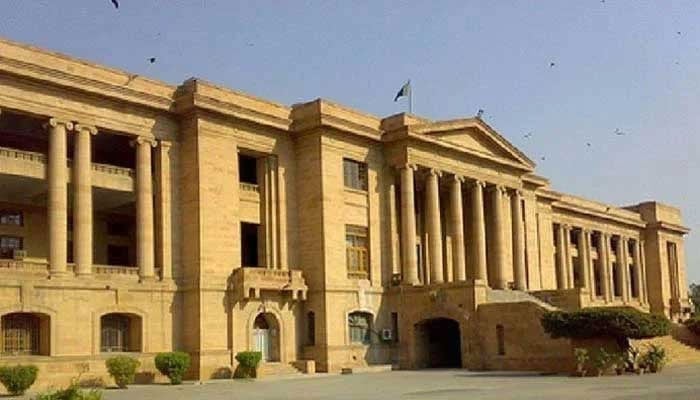
The Sindh High Court has observed that courts derive only those powers granted under law and must refrain from delving into areas beyond, as any deviation from the same would result in dangerous consequences.
The observation came in a judgment of the court while dismissing a petition challenging the speaker the National Assembly’s power to appoint a member of the Judicial Commission Pakistan (JCP), who could be either a woman or a non-Muslim or a technocrat other than a member of Majlis-e-Shoora (Parliament).
Petitioner Maria Ahmed had sought declaration and direction against the appointment of a member of the JCP under Article 175A 2(viii) which relates to appointment as a member to JCP of a woman or non-Muslim or a technocrat other than a member of parliament, who is qualified to be member of the parliament, to be appointed by the Speaker of the National Assembly.
She submitted that Article 175A(2)(viii) of the Constitution does not provide any proper criterion for the term “technocrat.” She submitted that the scheme of the said article provides that an appointment made under Article 175A(2)(viii) of the Constitution would have to be representative of women and/or Non-Muslims in the commission, and that the same has to be done by virtue of promulgation of transparent rules and procedures, disclosing the reasoning behind such appointment.
The petitioner submitted that the appointment cannot be left at the sole discretion of the Speaker of the National Assembly without such proper reasoning. An SHC’s division bench comprising Justice Yousuf Ali Sayeed and Justice Osman Ali Hadi observed in the judgment that the petition has not directly challenged the vires of Article 175A(2)(viii) of the Constitution, but rather the petitioner is seeking that an adequate process be initiated, whereby there is a transparent mechanism for appointment(s) being made under Article 175A(2)(viii).
The court observed that courts have repeatedly held that where the law is clear, it is not the prerogative of the court to interpret the same in a manner which would have the effect of altering/ amending such law. It observed that since the wordings of Article 175A(2)(viii) is clear, the same does not require interference by the court to supply and/or read any further words into the subject Article, as that is a topic for the Legislature.
The court observed that courts derive only those powers granted under law, and must refrain from delving into areas beyond as any deviation from the same would result in dangerous consequences.
The SHC said prayers sought by the petitioner is effectively indirectly inviting court to legislate and supply words/meaning into the said Article 175A(2)(viii), which is beyond the court’s mandate, as legislation undisputedly falls within the domain of Parliament.
The court observed that any interference, as has been sought by the petitioner under Article 175A(2)(viii) of the Constitution is beyond the scope of judicial interference, as the same has been promulgated by the parliament in their wisdom, for which they are empowered under the Constitution. The court observed that interference in the same would not only be judicial overreach, it would also distort the trichotomy of powers provided under the scheme of the Constitution.