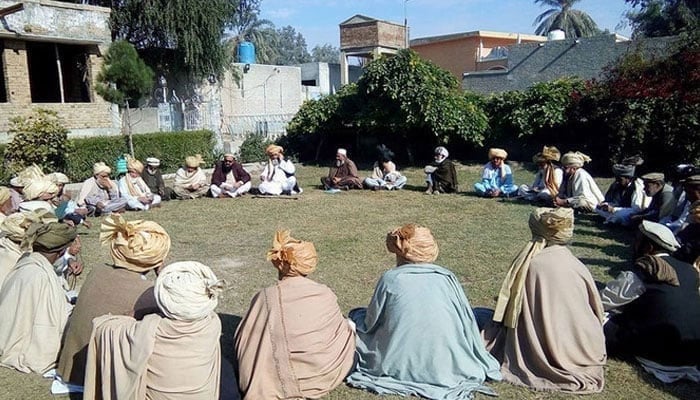
TIMERGARA: Area elders and political leaders on Sunday underscored the importance of jirgas in resolving local disputes swiftly, saying that sincere and impartial forums could help reduce the growing burden on courts. They were speaking at the oath-taking ceremony of the office-bearers of the Qaumi Islahi Jirga Talash Dushkhel. The ceremony was attended by political, social and tribal elders from Talash, Timergara and Adenzai.
Former MNA and head of the Dir Qaumi Jirga, Sahibzada Mohammad Yaqoob Khan, administered the oath to the newly elected office-bearers. Addressing the gathering, he said that jirgas had long been an integral part of Pakhtun society and played a key role in resolving disputes through reconciliation.
Former senator and PPP leader Ahmad Hassan Khan, jirga president Mohammad Israr, general secretary Dr Noor Mohammad, former presidents Mohammad Ibrahim Khan and Malik Taj Mohammad Khan, former Tehsil Nazim Riaz Muhammad, District Bar Timergara president Mohammad Saleem Khan Advocate, Adenzai Jirga president Khurshid Ali Khan, Malik Abdul Sattar Khan, Jehan Bahadar and Syed Latif Bacha also spoke on the occasion. Leaders and workers from different political parties were present. The speakers highlighted the historical role of jirgas in Pakhtun society and said that delays in the formal justice system had enhanced the need for alternative dispute resolution (ADR) mechanisms. They added that even courts encouraged parties to settle disputes amicably in the presence of elders.
District Bar Timergara president Mohammad Saleem Khan Advocate said that following amendments to the Khyber Pakhtunkhwa Code of Civil Procedure (Amendment) Act, 2020 courts were empowered to refer cases to Alternative Dispute Resolution (ADR), allowing parties to appoint a jirga for settlement if they so desired. He said that if both parties accepted the jirga’s decision, courts generally raised no objection.
Israr said the Qaumi Islahi Jirga Talash Dushkhel had been active since 1998 and operated under a constitution, with office-bearers elected annually. He claimed that the jirga had resolved hundreds of disputes over the years through reconciliation rather than adjudication, adding that its members rendered services voluntarily and without any financial incentive.