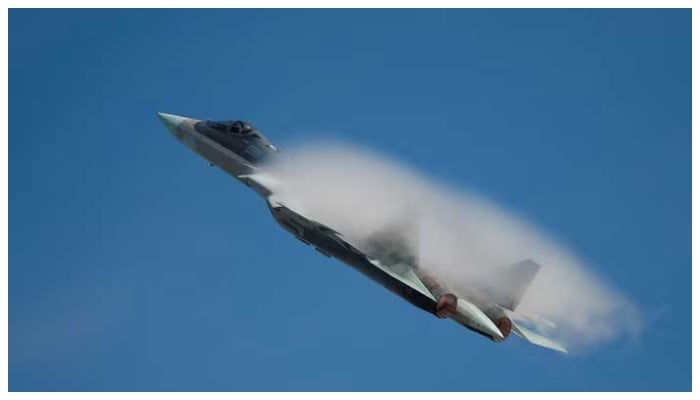
Recent reports suggest that after signing of an agreement on the joint production of the Sukhoi Superjet 100, a transport aircraft capable of carrying up to 100 passengers, India and Russia are engaged in active discussions for India’s re-entry into SU-57 fifth-generation fighter aircraft (FGFA) development programme.
Citing official sources, the reports claim that the talks are focused on a framework that can involve Hindustan Aeronautical Limited (HAL) in domestic production at level beyond existing collaborations on programmes such as SU-30 and Brahmos. Analysts have also noted that Indian Air Force (IAF) is carefully evaluating the operational capabilities, platform performance, lifecycle support and strategic implications of integrating SU-57 into existing fleet, rather than simply committing to an acquisition deal.
Russia and India’s defence partnership dates back to the cold-war era, when India co-produced platforms such as MiG-21 and MiG-27. The licensed production model, providing gradual indigenisation, shaped the appetite for technology transfer and industrial participation in technology-intensive programmes. SU-30MKI programme initiated during late 1990s, is probably the India’s most successful model of production under-license. Based on decades of experience, in 2007 India joined Russia for SU-57 co-development programme, tailored to meet specific Indian requirements. By the mid-2010s New Delhi, however, began to highlight concerns over cost escalations, limited workshare, expected stealth performance of the platform, and insufficient access to critical technologies, paving way for the formal Indian withdrawal from the programme in 2018.
Many reasons are cited for India’s pull out of SU-57 programme. The IAF appeared increasingly dissatisfied with the overall capability of the platform. Highlighting issues with the stealth characteristics, sensor fusion and avionics integration, a sense developed that the platform did not meet the 5-Gen benchmarks. Indian government was also not happy with the workshare and technology transfer on offer.
Cost escalation was another major factor behind New Delhi’s increasing frustration. The projected cost of the intended package and its life cycle support was highlighted as disproportionate to promised operational capability, especially once combined with uncertainties over timelines and the final configuration of the platform. Most importantly, the pull-out reflected a strategic recalibration. Some analysts noted that the India probably wanted to divert resources towards indigenous programmes such as Tejas and Advanced Multirole Combat Aircraft (AMCA), and also desired a greater alignment with the West.
India’s reconsideration for joining the SU-57 programme, at this point in time, seems to be a cumulative effect of the IAF’s below par performance during Operation Sindoor and consequent strategic anxiety due to shifting balance of air power in the region, force-structure stress because of declining number of squadrons, struggling indigenous development programmes and emerging global geopolitical environment.
The IAF’s losses in Operation Sindoor have provided a strategic reality check for India. China’s operationalisation of two 5-Gen systems, that is J-20 and J-35; the PAF’s telling employment of J-10C coupled with reports of future J-35 induction have certainly highlighted the realities of regional air power equation. For India, the emerging environment compresses the timeline further, reinforcing the urgency of inducting a 5-Gen platform to restore air power balance. Given the retirement of MiG-21 fleet, the IAF’s squadron strength has already dropped to 29 against an authorisation of 42. With retirement timelines for Mirage-2000 and Jaguar fleets approaching, IAF’s force-structure is increasingly losing balance.
The BJP government has extensively employed Atmanirbhar Bharat as slogan for political gains. The mismatch between ambition and tangible result, primarily owing to persistent delays in Tejas delivery timelines and precarious progress in AMCA programme is resulting into a mounting stress, pressure and criticism on Prime Minister Modi’s government.
Given the visible stress in the US-India bilateral relations of late, the Indian deliberations on re-entry in SU-57 programme can also be read as strategic signalling to Washington DC. India’s outreach to Moscow may highlight New Delhi’s dissatisfaction with delays, technology restrictions and conditionalities associated with the US defence cooperation. It may also indicate that New Delhi’s alignment with Washington DC is conditional, interest driven, not structural. Russians will certainly take this as an opportunity. By presenting SU-57 as a viable solution to India’s immediate capability stress, Russia will attempt to assert its relevance.
The writer is the director at the Centre for Aerospace and Security Studies (CASS), Lahore, Pakistan. He can be reached at: [email protected]