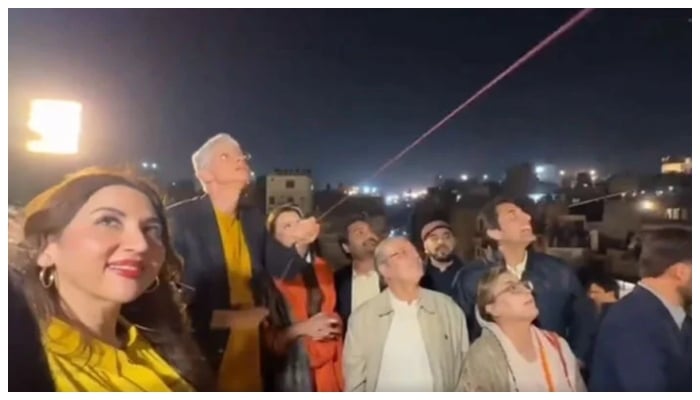
When the news arrived that Basant was returning to Lahore after nearly 20 years, the city I carried inside me began to stir. Time folded in on itself. I was eight again.
Memories long tucked away resurfaced. Entire households reorganised around the season: rooftops bursting with colour, laughter and movement; kites of every hue stacked in storerooms; voices and filmi music drifting across neighbourhoods. Women gathered on the rooftops, their laughter echoing, dressed in bright, carefully stitched shalwar kameez. In kitchens below, gajrella simmered for hours, and meat was prepared for naans and barbecue, tended by women who measured neither time nor effort.
Punjab’s tentative reopening of the skies to kite-flying has revived a familiar debate about safety, regulation and cultural tradition. What has remained largely absent, however, is how Basant once shaped women’s relationship to public space, visibility, and joy.
For women of a certain generation, Basant was one of the occasions when rooftops became socially permissible sites of visibility. While streets remained deeply gendered and unevenly accessible, rooftops – especially during Basant – briefly dissolved some of those boundaries. Often expected to observe strict norms, they found themselves cheering, flying kites, competing, choosing loud music and claiming space without transgressing respectability.
It mattered then; it matters now. In a society where women’s leisure is routinely scrutinised – expected to be modest, productive, or justified – Basant offered something radical: joy without purpose. Flying a kite was neither duty nor performance. It was play. And play, particularly for women, has always been political.
The conversation around Basant’s return has largely focused on men – motorcyclists, enforcement failures, public safety – all valid concerns. But women’s absence from rooftops, from neighbourhood festivals, was rarely acknowledged. For many women, especially those without access to parks or inclusive public spaces, Basant offered an informal right to the city. One did not need money, mobility, or structural conditions. A rooftop, a kite and the wind were enough.
In the years since the ban, women’s leisure has increasingly moved indoors – or online. Screens have become substitutes for shared physical space, offering connection without presence. Visibility on digital platforms is curated, surveilled and often punished. A woman laughing freely on a rooftop once drew little attention; the same joy expressed online today often invites scrutiny.
The cautious return of kite-flying therefore raises questions beyond safety protocols. Can Basant be imagined not merely as a nostalgic relic or a governance issue, but as an inclusive cultural practice worth reclaiming thoughtfully?
For Gen Z girls – raised on screens, algorithms and filtered visibility – the chance to experience Basant as a physical, collective gathering matters. In a time when women’s presence in public life is increasingly conditional, reclaiming such moments matters more than we admit.
A sky filled with colour is not a trivial memory. It is a reminder that joy can be collective, visible and inclusive.
The writer has a PhD in Sociology and is a researcher at the University of British Columbia & York University, Canada.