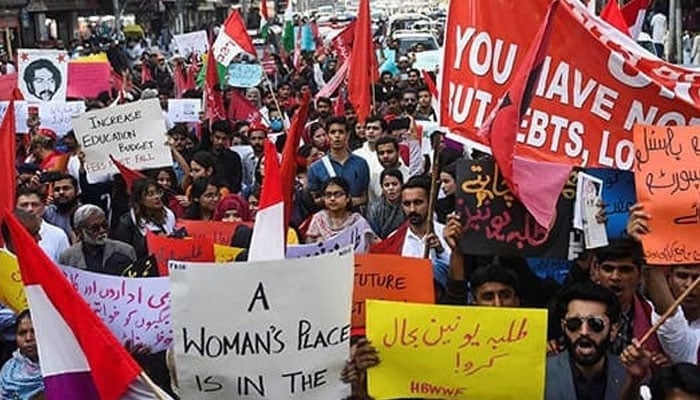
February 9 marks 42 years since Pakistan imposed a nationwide ban on student unions, a decision widely seen as a decisive blow to campus democracy whose consequences continue to shape student politics today.
The ban was enforced on February 9, 1984, by military ruler Gen Ziaul Haq through Martial Law Regulation 60, effectively excluding students from the democratic process. The move was officially justified as a measure to curb violence and restore discipline in educational institutions, but critics argue it was primarily aimed at suppressing dissent and denying young people an organised political voice.
Since then, successive civilian governments, including those led by the Pakistan Peoples Party (PPP), the Pakistan Muslim League-Nawaz and the Pakistan Tehreek-e-Insaf (PTI), have periodically promised to restore student unions and hold campus elections. None of them, however, has followed through.
In Sindh, where the PPP has remained in power for nearly 18 years, the provincial assembly did pass legislation to revive student unions, yet elections have not been held, rendering the law largely symbolic.
Then prime minister Yousaf Raza Gillani had pledged on the floor of the National Assembly to restore student unions within 100 days, alongside the reinstatement of the deposed judges. While the judiciary was restored, progress on student unions failed to materialise.
Similarly, Asif Ali Zardari, who is serving his second term as president, has been unable to translate political commitments into action on the issue. In Khyber Pakhtunkhwa, the PTI is now in its third consecutive term in office, yet despite repeated democratic claims, student union elections have not been held there either.
Political parties often cite the passage of the 18th constitutional amendment as restoring the spirit of the 1973 constitution. However, the constitution contains no explicit provision guaranteeing the revival of student unions, a gap that critics say reflects a broader reluctance to empower students as stakeholders in governance.
The issue has also surfaced at courts. Last week the constitutional bench of the Sindh High Court dismissed a petition seeking the restoration of student unions, imposing a fine of Rs10,000 on the petitioner.
During the hearing, the bench remarked that education is already in decline, and questioned the purpose and utility of student unions. The petitioner’s counsel argued that unions are meant to provide students representation in policymaking, but the court rejected the plea with costs.
Student organisations, human rights activists and educationists say that the immediate and long-term effects of the 1984 ban have been profound. They argue that the absence of elected student bodies has eliminated representative forums on campuses, deprived students of collective mechanisms to address grievances and disrupted the natural process of leadership development.
In the resulting vacuum, contend the critics, informal groupings, coercion and non-democratic power structures have flourished, and thus caused the academic environment to degrade further.
Political analysts describe the February 9, 1984, decision not as a routine administrative order but as a unilateral alteration of the social contract between the state and its youth. They argue that it has produced generations of students that have been excluded from participatory politics, dialogue and collective decision-making, a deficit that has echoed in national politics.
More than four decades on, demands for the restoration of student unions continue to resurface. Observers maintain that if democracy is to be strengthened at grassroots level, a regulated, representative and elected system of student politics must return to campuses, allowing dissent to be channelled through dialogue and representation rather than repression or violence.