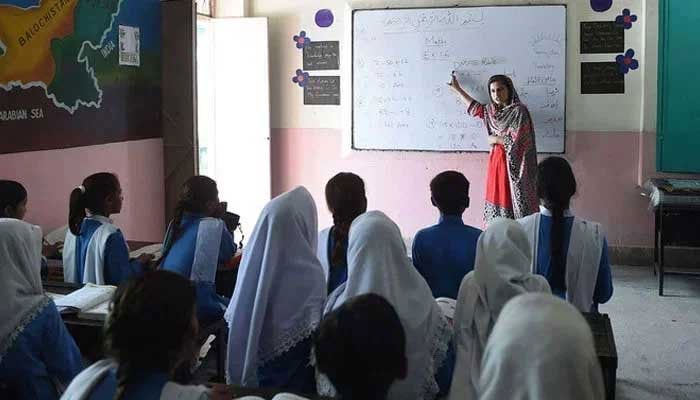
Artificial intelligence (AI) cannot replace teachers, but teachers need to improve their skills to be on a par with changing technology.
This was stated at a conference titled ‘Justuju: Rethink School Education with AI’ organised by the Shahwilayat Educational Trust at their School Campus 1 in Federal B Area. “Artificial Intelligence should be a thinking partner, not a thinking substitute, for students,” said Zafar Masud, president and CEO of the Bank of Punjab. He added that building cognitive depth was a slow work, and the use of AI should incrementally improve in teaching students, and must ideally be tailor-made to individual kids’ requirements to make it more effective and impactful.
He was speaking as the chief guest at the closing ceremony of ‘Justuju – Rethink School Education with AI’ organised on Saturday, February 7. Thought-provoking panel discussions took place on challenges and opportunities in using AI Learning Tools and Ethics and Boundaries in AI Use, with a demonstrative presentation, ‘From Chalk to AI: How Teachers Can Use AI to Teach Smarter’, on using various AI tools in school education.
Professor Farid F Panjwani, dean of the Institute for Educational Development at the Aga Khan University, stated in his keynote address that the context of using AI needed to be clearly comprehended especially in this day and age. “A better world is possible if we take the road less travelled: think of technology as a social practice, recognise that the social context shapes the impact of technology.”
Former senator and federal minister Javed Jabbar pointed out the disparities that existed in education, especially towards women who constituted 48 per cent of the population. Dr Kamran Ahsan said that children’s cognitive abilities must be augmented. He said students must ask questions and their curiosity must not be hampered to build the cognitive faculties of students.
Opportunities, he added, could become challenges if they were not addressed in time. He said AI was a concept of 1950s, but then there was no speed as there was today through the internet.
Dr Akhter Raza, FUUAST assistant professor, said teacher effectiveness was possible by using AI tools to improve performance and complete administrative tasks. Shahid Ashraf, deputy country director, Assessment Pakistan-CAIE, said teachers feared that they would be replaced by AI. He said AI could not replace the empathy shown by a teacher, but if teachers did not upgrade their skills, they might be left behind.
Journalist Munazza Siddiqui said that while AI was here to stay, we needed to find ways to coexist. She expressed fear that children might lose their ability to tell stories in the age of AI.
AKU-EB CEO Dr Naveed Yousuf said that students seemed to be outsourcing their thinking as they were not developing their reading skills. Jawwad Fareed Ahmed, CEO & Actuary AlChemy Tech Pvt. Ltd, said an instant gratification of a question with an answer by ChatGPT could not allow a child’s cognitive abilities to build efficiently. Small children should not be given tablets or smartphones before the age of eight, he said. A session on ethics in the use of AI session concluded that AI was merely another challenge posed by modernity.
A demonstration of AI tools was also conducted by educationists Dr Fatima Dar and Dr Mohsin Raza who emphasised that it was fine to make mistakes, but it was also important to learn from them.