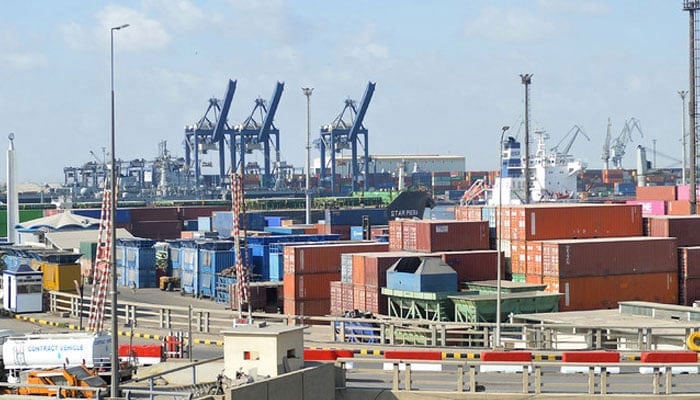
Trade unions and labour rights activists have strongly opposed a proposed plan to abolish the Karachi Dock Labour Board (KDLB), warning that the move would render around 2,600 dock workers jobless and dismantle a decades-old regulatory framework at the country’s busiest port.
The KDLB is a statutory and autonomous body responsible for registering and deploying dock workers under a rolling system. It also regulates stevedoring and shipping companies operating at the port. Under this mechanism, companies submit labour requisitions to the board whenever vessels berth at jetties, and workers are deployed on a rotational basis.
Wages are calculated on an incentive basis after eight-hour shifts and are transferred to workers’ bank accounts at the end of each month, including overtime where applicable.
The controversy escalated after the Pakistan International Container Terminal Limited (PICT) was sold to the Abu Dhabi Ports and renamed KGTL. Subsequently, berths No. 10 to 17 were handed over to AD Ports under the name KGTML. According to labour representatives, the agreement includes a clause calling for the abolition of the KDLB within 90 days. They also allege that operational control over several other berths has effectively created a monopoly, sharply increasing cargo handling costs.
Addressing protesters, Asad Iqbal Butt, chairperson of the Human Rights Commission of Pakistan (HRCP), said the move amounted to an attack on workers’ rights.
“A self-financed regulatory institution is being dismantled to serve corporate interests. This is not reform; it is dispossession,” he said.
Nasir Mansoor, secretary general of the National Trade Union Federation, warned that scrapping the board would destabilise labour relations at the port.
“The KDLB ensures transparency and job security. Abolishing it will push thousands of families into economic uncertainty,” he stated.
Meanwhile, Habibuddin Junaidi, Ppresident of the People’s Labour Bureau Sindh, alleged that only one private operator was behind the move.
“No port user has complained about the board. This is a profit-driven attempt to eliminate regulated labour,” he said.
In response, six registered trade unions of the KDLB have formed a joint alliance and launched a protest movement. A symbolic hunger strike began on December 29, 2025, at the Board’s head office on West Wharf Road and has since developed into a prolonged sit-in.
Hussain Badshah, chairperson of the KDLB Workers Union, said workers would continue their protest until their demands were met.
“We are fighting for our livelihoods, our pensions, and our legal rights. We will not accept decisions made without workers’ consent,” he said.
The alliance announced that a large demonstration will be held at 3pm on February 9, 2026, at the Karachi Press Club, calling on the government to halt the proposed abolition and protect dock workers’ rights.
Farhat Perveen, Shakil Yamin, Dr Tauseef Ahmed Khan, Zahra Khan, Tahir Hasan Khan and others spoke on the occasion.