For now, the worst appears to be over – not just for Iran, but for the region and beyond – despite recent skirmishes and rhetorical escalations. What we have just witnessed is the failure of a classical compellent diplomacy strategy, attempted once again by the US under President Donald Trump, at a moment of acute regional volatility.
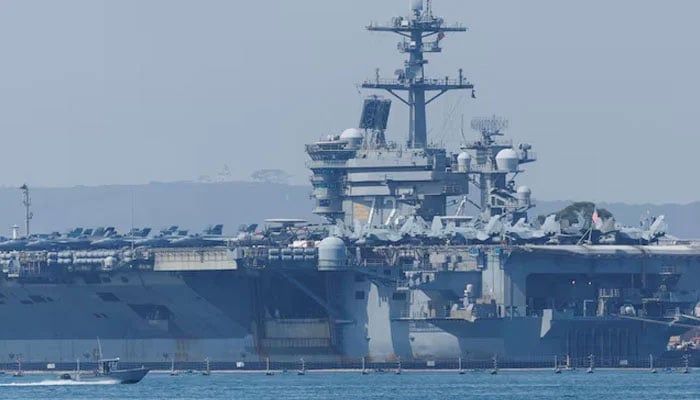
The centrepiece of this strategy was familiar: power projection designed to intimidate rather than persuade. The deployment of the USS Abraham Lincoln aircraft carrier strike group, the visible positioning of advanced US military assets in and around the Arabian Sea, and the use of America’s extensive airbase network across the region were intended to create an atmosphere of impending force. The assumption was that an overwhelming military presence would frighten Iran into conceding on two core US–Israeli objectives: regime destabilisation leading to internal upheaval, and the abandonment or enforced dismantling of Iran’s nuclear programme.
Neither objective was achieved. Washington appeared to believe that Iran’s severe economic stress, accumulated over years of sanctions, combined with political discontent among segments of the population, could be converted into an uprising, particularly if accompanied by an external shock. This expectation badly misread Iranian society. While Iran faces serious economic and governance challenges, it remains deeply conscious of external manipulation, especially when pressure is visibly coordinated between Israel, the US and a small circle of Western allies. The expectation of a popular revolt ignored a historical constant: external coercion rarely produces internal legitimacy crises in the way foreign planners imagine. In fact, it often does the opposite.
Equally unrealistic was the idea, reportedly explored in some Western and Israeli circles, of reinstalling a figure from Iran’s monarchical past. The suggestion that Reza Pahlavi, son of the last Shah Mohammad Reza Pahlavi, could be returned as a viable political alternative showed a striking detachment from regional political realities. Reza Pahlavi has negligible domestic support inside Iran, and his political relevance largely exists within the diaspora and media ecosystems outside the country.
This notion echoed earlier misadventures elsewhere. History shows that political transplants, especially exiles detached from lived realities, rarely succeed, particularly when imposed under the shadow of foreign power. This was not the first attempt in recent months to force a strategic break in Tehran. It was the second concerted push within less than a year, strongly driven by Israel and enabled by segments of the US administration, to achieve through pressure what diplomacy had not delivered. That effort included military escalation and direct attacks on Iranian-linked assets, followed by a more dramatic phase in June when US strategic bombers struck Iranian nuclear-related facilities.
The strikes did not achieve their intended outcome. Iran did not abandon its nuclear programme. Nor did it collapse into internal chaos. Instead, the episode hardened Iranian resolve, reinforced elite cohesion and exposed the limits of military coercion against a state that has spent decades preparing for precisely such scenarios.
This failure does not mean that the US, often prompted by Israeli strategic imperatives and lobbying pressure, will not try again. It does, however, explain why the immediate post-crisis outcome has shifted away from escalation and towards talk of direct engagement. Quiet preparations are now underway for renewed US–Iranian contacts, with initial meetings expected in Oman and possibly Turkey as a facilitating venue. Pakistan, too, has reportedly played a quiet supportive role in encouraging de-escalation and dialogue.
What is unfolding, therefore, is not merely crisis management but likely the beginning of a broader strategic revision across the region, shaped by the failure of force and the unintended consequences of Israel’s post-October trajectory. Iran is no longer widely perceived as the primary security threat by the majority of the GCC states. The Saudi–Iranian breakthrough has become a defining factor in how the Iran–US crisis is unfolding. After four decades, Iran is increasingly being seen not as an existential danger but as a necessary regional interlocutor.
Ironically, it is Israel’s conduct, particularly its ongoing genocide in Gaza and its expanding military footprint, that has reshaped threat perceptions. Israel’s aggressive posture and ideological ambitions have alarmed not only Iran but also key Arab states. This has placed Iran and much of the GCC in a shared strategic space. At the same time, the momentum behind Arab–Israeli normalisation has slowed dramatically. With few exceptions, enthusiasm among Gulf states for deepening ties with Israel has cooled since the Gaza catastrophe. Saudi Arabia’s position has been especially consequential. Riyadh has repeatedly reaffirmed that there will be no recognition of Israel without a credible Palestinian state, with East Jerusalem as its capital, a stance that has not softened despite intense pressure.
In this context, the Abraham Accords, which Washington projected as the foundation of a new Middle Eastern order, have effectively been set aside by Saudi Arabia. Without Riyadh, the accords lack the political weight. The Gaza genocide has not merely paused the process; it has exposed its fragility.
Alongside these shifts, a new regional security architecture is quietly taking shape. Still embryonic, it is unmistakably a work in progress. This architecture is being shaped by shared threat assessments. Israel’s expanding military actions, from Gaza to Lebanon, Syria, Yemen and beyond, with destabilising spillovers reaching Somalia and Sudan, have generated a growing consensus that unchecked Israeli militarism poses a systemic risk to regional stability. Pakistan has a role to play in this evolving framework. Its diplomatic reach, military credibility and long-standing ties across the Gulf position it as a stabilising actor at a moment when the region is rethinking old alignments. The broader concern driving this shift is the risk of deliberate destabilisation and fragmentation of societies and states, a pattern the region is now apprehensively witnessing.
What began as what many feared was an inevitable US-Israeli attack has instead evolved into a renewed, if cautious, process of dialogue on the nuclear issue and related regional questions. The unanswered question remains how far Israel has been pushed back and why this moment unfolded as it did. The answer lies in a convergence of factors. The regional response to the prospect of a wider war was not passive. Gulf states signalled, subtly but definitely, that they did not want to be dragged into another catastrophic conflict. Israel’s continued genocide in Gaza and its expanding military agenda eroded whatever residual sympathy or strategic indulgence it still enjoyed. Iran’s posture denied Washington the moral and political justification for escalation.
Equally important were the backchannels that never closed. Throughout the crisis, indirect communication between the United States and Iran continued. These channels, often dismissed publicly, once again proved that even at moments of apparent confrontation, diplomacy rarely disappears entirely.
For now, the guns have quieted. The carrier may remain, but the latest moment of coercive leverage appears to have passed. While peace is still far off, it is not war either. Instead, today’s Middle East is witnessing the beginning of a potentially significant shift.
The writer is a foreign policy & international security expert. X/Twitter: @nasimzehra Email: [email protected]