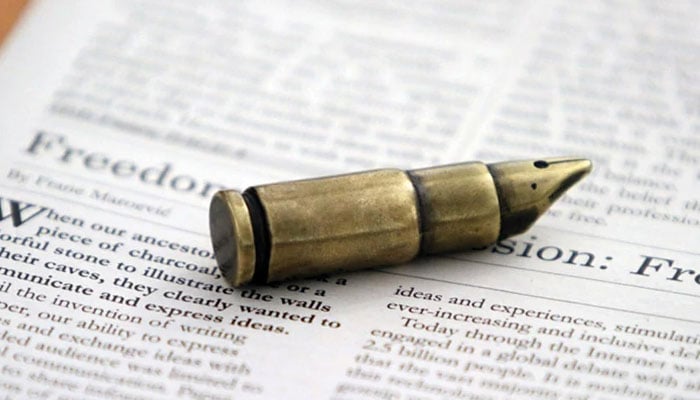
Whenever disputes arise over constitutional interpretation, jurists tend to divide along two dominant interpretive traditions: those who view the constitution as a living document, capable of evolving with changing political and social realities, and those who favour literalism and originalism, seeking meaning primarily through the intent of the framers and founders of the polity.
While I am persuaded that a synthesis of both approaches yields the most progressive outcomes, it is in the spirit of the latter that I write today. At a time when Pakistan’s minority ruling elite and majority opposition are starkly divided over the scope of freedom of speech – some insisting on drawing rigid red lines around criticism of the government, others arguing for a wider democratic breathing space – it is worth reminding the self-appointed custodians of the state of what Jinnah said in 1918 while addressing the Legislative Council in defence of press freedom: “I say, protect the innocent, protect those journalists who are doing their duty and who are serving both the public and the government by criticising the government freely, independently, honestly which is an education for any government".
That, apparently, was before criticism and dissent became a crime. The sentencing of Iman Mazari and Hadi to 17 years over a tweet criticising state policies is the inevitable end of the Peca Amendments Act, 2025. It is a painful vindication of every warning issued by lawyers, journalists and activists that it would not curb ‘fake news’ but criminalise dissent itself. The government insisted, with straight faces, that the amendments were about misinformation. But the intent has never been more apparent. And Peca has been used exactly as feared: as a blunt instrument to silence inconvenient voices. This is neither the first arrest nor will it be the last. It is simply the loudest warning shot yet.
Justice Athar Minallah saw this coming when he struck down similar Peca amendments introduced through the 2022 Ordinance. He warned of the chilling effect such laws would have on society. Chilling is too polite a word now. This is throttling. The message is unmistakable: look at Iman, look at Hadi, and learn to stay silent, to retreat inward, to practise self-censorship if you wish to remain free.
May I remind the sole arbiters of truth of the word ‘republic’ tucked into the grand title of the country? When citizens begin to fear that speaking out may land them behind bars, democracy erodes quietly. Sentence by sentence. Tweet by tweet. Democracy is not about casting votes every few years (rigged). It is the freedom to question, challenge and embarrass those in power. When the state decides what may be said, and punishes what displeases it, democracy ceases to exist in substance, even if it survives in name.
John Milton understood this centuries ago when he asked: “Let her and Falsehood grapple; who ever knew Truth put to the worse, in a free and open encounter?” Justice Holmes echoed the same principle when he argued that the best test of truth is its ability to prevail in the marketplace of ideas. That is precisely what is being feared today: open competition between truth and falsehood and, worse still, the independent judgment of the public.
Under the Peca amendments, public officials are elevated to the fragile status of private individuals, insulated from criticism under the guise of defamation. This flies in the face of a universally accepted democratic principle: public office invites public scrutiny. Those who wield power must tolerate discomfort. Embarrassing the government of the day is not a bug of democracy but rather a feature, a principle famously affirmed in New York Times Co v Sullivan.
The same ethos was articulated by Jinnah when addressing journalists: "If I go wrong or, for that matter, the League goes wrong in any direction or [in] its policy or programme, I want you to criticise it openly as its friend, in fact, as one whose heart is beating [in unison] with the Muslim nation".
Since Pakistan is not only a republic but also an Islamic state, guidance must equally be drawn from Islamic history and tradition. In that spirit, it is worth recalling the example of Caliph Umar (r.a), who was once publicly questioned by a woman about the source of an extra piece of cloth he was wearing. He did not resort to the use of coercive power. He listened, offered an explanation and allowed accountability to unfold in public. That is leadership rooted in transparency, and it is such leadership that commands trust and moral authority.
Nothing in our legal precedent or constitutional framework, whether viewed through original intent or a living constitutional lens, sanctions the criminalisation of dissent. Such repression finds no justification in democratic principles, which depend on open debate and public criticism, nor in Islamic tradition, which has long upheld accountability, consultation and the right to question authority.
Taken together, the very foundations of Pakistan reject any legal or moral basis for throttling free speech. If this is nevertheless the path we are now choosing, the question becomes unavoidable: what, then, are we descending into? And if our foundational principles are treated as disposable, what kind of future does that leave for the republic itself?
Now we have a state that responds to criticism with prison sentences and legislation designed to criminalise speech. At this rate, Pakistan’s 2026 is starting to look a lot like Orwell’s 1984, complete with a Ministry of Truth deciding what may be said, believed, or punished. And the most dangerous question of all remains unanswered: If the state becomes the sole arbiter of truth, who will ensure that the state itself is truthful? Because when dissent becomes a crime, silence becomes survival – and that is exactly how democracies die.
The writer is a student of law.