The White House said Thursday that President Donald Trump prefers diplomacy in handling Iran and will wait to see if a deal can emerge from high-stakes negotiations, but warned that military action remains an option.
Final preparations were underway for Friday's meeting in Oman amid heightened tensions as the US builds up forces in the Middle East, which Trump has called a massive “armada,” and regional players seek to avert what many fear could escalate into a wider war.
The talks were set to go ahead even though the two sides have had differences over the agenda, and that has increased doubts about the prospects for a deal. Trump has threatened to carry out strikes on Iran if an agreement cannot be reached.
The US previously said it wanted the discussions to include Iran's missile arsenal and other issues, while Tehran has insisted on focusing exclusively on its disputed nuclear program. It was unclear whether that disagreement had been resolved.
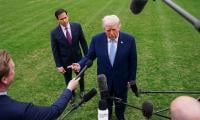
“The president’s diplomacy is always his first option when it comes to dealing with countries all around the world, whether it’s our allies or our adversaries,” White House press secretary Karoline Leavitt told reporters when asked about the coming talks.
She reiterated Trump’s position that “zero nuclear capability is something he's been very explicit about” in his demands for Iran.
"He wants to see if a deal can be struck," Leavitt said. “And while these negotiations are taking place, I would remind the Iranian regime that the president has many options at his disposal, aside from diplomacy, as the commander in chief of the most powerful military in the history of the world.”
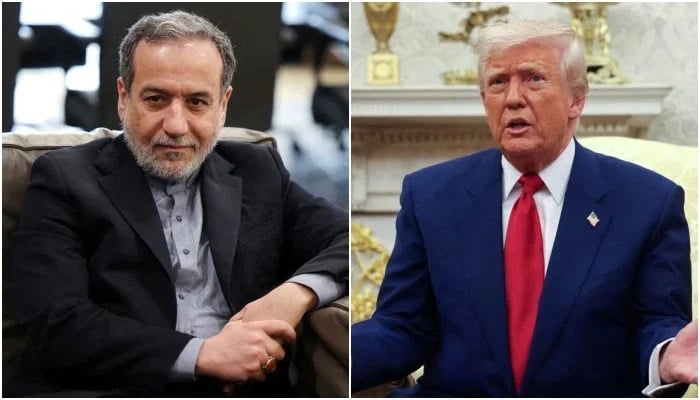
Iran's Foreign Minister Abbas Araqchi departed for Oman on Thursday. His spokesperson Esmail Baghaei said Tehran would engage "with authority and to reach a fair, mutually acceptable and dignified understanding on the nuclear issue."
"We hope the American side will also participate in this process with responsibility, realism and seriousness," Baghaei added.
Araqchi is expected to meet in Muscat with Steve Witkoff, Trump’s special envoy, and Jared Kushner, the president’s son-in-law and adviser.
On the eve of the talks, Iran's state-run Press TV said "one of the country's most advanced long-range ballistic missile(s),” the Khorramshahr 4, has been deployed at one of the Revolutionary Guards' underground missile sites. The missile has a range of 2,000 km (1,240 miles) and is capable of carrying a 1,500-kg (3,300-pound) warhead, it added.
The US has pressed Iran to accept a much more limited range for its missiles.
Trump's blunt warnings and Iran's vows of counter-strikes have spurred regional governments' efforts to calm the situation.
Turkish President Tayyip Erdogan said his government was working hard to prevent US-Iran tensions from tipping the Middle East into a new conflict. He has spent years cultivating a close relationship with Trump while expanding Ankara's diplomatic influence across the region.
Speaking to reporters on a return flight from a visit to Egypt, Erdogan added that talks at the level of the US and Iranian leadership would be helpful after lower-level nuclear negotiations due in Oman on Friday, according to a transcript of his comments shared by his office on Thursday.
Tensions ratcheted up this week amid uncertainty over the location and format for the talks, which will follow Tehran’s bloody crackdown on street protests last month.
Asked on Wednesday whether Iran's Supreme Leader Ayatollah Ali Khamenei should be worried, Trump told NBC News: "I would say he should be very worried. Yeah, he should be."
After Trump spoke, US and Iranian officials said the two sides had agreed to shift the talks' location to Muscat after initially accepting Istanbul.
At a press conference in Doha, German Chancellor Friedrich Merz said on Thursday that "great concern" had been expressed about potential escalation in the conflict with Iran during his meetings with officials in a visit to the Gulf region. He urged Iran to end what he called aggression and help bring stability to the region.
Gulf Arab states fear that Iran will carry out its threat to target US bases on their territory if the United States attacks the Islamic Republic.
China, meanwhile, said it supported Iran's legitimate right to the peaceful use of nuclear energy and opposed the "threat of force and sanction pressure."
Iran has said the talks must be confined to its long-running nuclear dispute with Western powers.
But US Secretary of State Marco Rubio said on Wednesday that talks would have to include the range of Iran’s ballistic missiles, its support for armed proxy groups around the Middle East and its treatment of its own people, besides nuclear issues. Iranian sources say the US is demanding Tehran limit the range of Iran's missiles to 500 km (310 miles).
Tehran's regional sway has been weakened by Israel's attacks on its proxies - from Hamas in Gaza to Hezbollah in Lebanon, the Houthis in Yemen and militias in Iraq - and by the ousting of Iran's close ally, former Syrian President Bashar al-Assad.
Iran says its nuclear activities are meant for peaceful, not military purposes, while the US and Israel have accused it of past efforts to develop nuclear weapons.
The US has sent thousands of troops to the Middle East, as well as an aircraft carrier, other warships, fighter jets, spy planes and air-refuelling tankers.
Trump has warned that "bad things" would probably happen if a deal could not be reached.