India’s evolving posture on the Indus Basin reflects a shift towards leveraging resources as statecraft, with infrastructure decisions doubling as strategic signals.
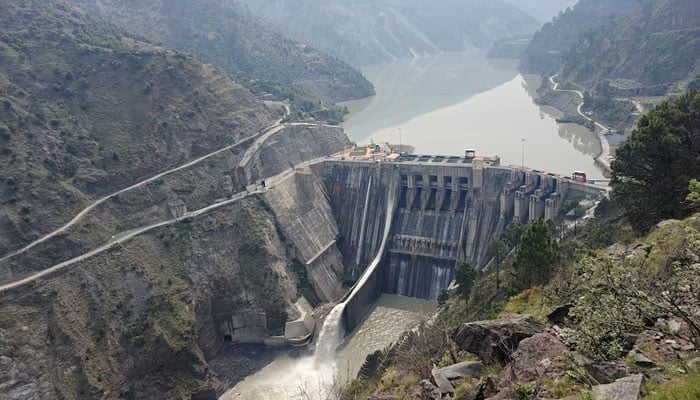
The approval of the 260MW Dulhasti Stage II hydropower project on the Chenab River is not an isolated development initiative but part of this changing calculus. Coming after India’s April 2025 decision to place the Indus Waters Treaty in abeyance, the project shows how water governance is being reframed as an instrument of pressure rather than cooperation.
Dulhasti Stage II, valued at about $395 million and developed by NHPC Limited, builds on the existing 390 MW Dulhasti Stage I facility commissioned in 2007. Indian authorities insist the project conforms to treaty provisions as a run-of-the-river scheme. Yet treaty compliance cannot be assessed project by project when upstream interventions accumulate into systemic control. Hydropower construction across the Chenab Basin, including Ratle, Pakal Dul, Bursar, Sawalkot, Kiru, Kwar and Kirthai I and II, reflects coordinated expansion rather than routine energy planning. The strategic context, not technical classification, is what gives Dulhasti Stage II its geopolitical weight.
For more than six decades, the Indus Waters Treaty served as a stabilising pillar between two adversarial states. Signed in 1960 under World Bank mediation, it survived wars, crises and diplomatic breakdowns because it insulated rivers from politics through binding legal mechanisms. The treaty allocated the eastern rivers to India and the western rivers to Pakistan, allowing India limited non-consumptive use under strict design constraints.
Crucially, the agreement contains no clause permitting unilateral suspension. India’s recent actions, including halting hydrological data sharing and questioning dispute-resolution forums, therefore represent not reinterpretation but the erosion of a framework built on predictability.
Legal institutions have reaffirmed this reality. The Permanent Court of Arbitration has confirmed that India remains obligated to allow uninterrupted flows of the western rivers for Pakistan’s unrestricted use. Pakistan’s continued engagement with Neutral Expert proceedings reflects adherence to established processes, while India’s selective compliance introduces a dangerous asymmetry into treaty governance. When one party upholds institutional mechanisms and the other bypasses them through faits accompli on the ground, cooperative management gives way to unilateralism masked as development.
The Chenab River occupies a central place in Pakistan’s agricultural and economic architecture. Flowing into Punjab, it supports irrigation networks that sustain wheat, rice and sugarcane production. Pakistan operates the world’s largest contiguous irrigation system, with more than 80 per cent of its agriculture dependent on Indus Basin waters. In such a system, disruptions in flow timing can be as destabilising as reductions in volume.
Dulhasti Stage II draws additional water from the Marusudar River through upstream linkages, altering river morphology and downstream hydrology. Environmental clearance documents acknowledge cumulative impacts extending beyond Indian territory.
This capacity to regulate timing transforms water into a subtle yet potent form of leverage. Unlike overt military escalation, resource coercion unfolds incrementally, eroding resilience without triggering immediate confrontation. Irregular flows reduce crop yields, destabilise rural livelihoods, inflate food prices and worsen malnutrition over time. For Pakistan, where millions depend directly on river-fed agriculture, prolonged uncertainty becomes a structural economic threat rather than a seasonal challenge.
Global risk assessments have begun to recognise this shift. Analysts warn that India’s suspension of treaty practices and withholding of hydrological data has introduced water as a strategic variable in an already volatile relationship. This development undermines the credibility of international water agreements at a time when climate stress is intensifying competition worldwide. Glacier retreat, erratic monsoons and rising demand are already testing transboundary water governance. Weakening one of the most durable water-sharing treaties risks normalising a future where legal commitments bend to political expediency.
Dulhasti Stage II, therefore, stands as a test case for the future of Indus governance. Proceeding without restored data sharing, institutional dialogue or meaningful international scrutiny risks embedding mistrust into the basin’s management architecture. Safeguarding the Indus Waters Treaty is no longer only a matter of bilateral diplomacy but of regional stability, food security and conflict prevention.
While upstream control may offer a short-term advantage, dismantling a framework that has prevented rivers from becoming weapons for over 60 years risks transforming shared lifelines into permanent fault lines across South Asia.
The writer is a freelance contributor and writes on issues concerning national and regional security. She can be reached at: [email protected]