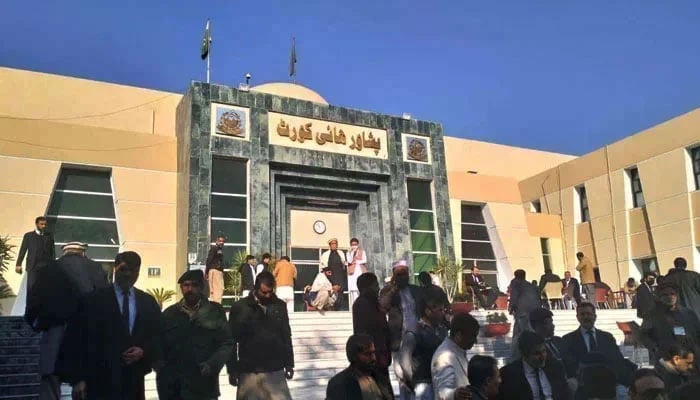
PESHAWAR: The Peshawar High Court (PHC) has ruled that private schools within Khyber Pakhtunkhwa were liable to extend social security benefits to their employees, including teachers.
The PHC issued its judgment in a case brought by the Private Education Network.PEN, on behalf of private schools in Khyber Pakhtunkhwa, had challenged a notification dated January 6, 2025 issued under the Khyber Pakhtunkhwa Employees Social Security Act, 2021 (KP-ESS Act, 2021) whereby private schools were deemed to be falling within the definition of the term “establishment” and liable to extend social security benefits to their staff, including teachers. The PHC had previously suspended the impugned notification.
Advocate Taif Khan representing PEN contended that private school were regulated under the Khyber Pakhtunkhwa Private Schools Regulatory Authority Act, 2017 (KP-PSRA Act, 2017) and as such, special law ought to prevail over general law. It was PEN’s stance that the KP-ESS Act, 2021 placed an onerous burden on private schools requiring “submission of various employee-related records, including attendance registers, salary details, overtime records, bank account particulars of employees”.
The Employees’ Social Security Institution (ESSI) represented by Gohar Durrani and the Private Schools Regulatory Authority (PSRA) represented by Barrister Asad-ul-Mulk took the stance that the scope and peripheral sphere of operation of the two statutes was altogether different, with the former concerned with social security for employees and the latter concerned with the regulation of private school insofar as the same related to registration, operation, norm & standards, fee, sibling discounts etc. They also took the plea that the KP-ESS Act, 2021 was beneficial legislation.
Barrister Asad-ul-Mulk clarified that the fund maintained by the PSRA under Section 13, 14 and 15 of the KP-PSRA Act, 2017 was not applied to provide social security benefits to employees of private schools, though it was applied for other lawful purposes.
In its judgment the PHC relied on a number of judgments issued by the Supreme Court albeit discussing the Employees’ Social Security Ordinance, 1965, a pari-materia law, but elaborating on the same principles and held “so far as the issue of functioning of some educational institutions on charitable basis is concerned, in our opinion, that will not place their case on any higher pedestal to exclude them from the applicability of such definitions as such character of charitable nature of an additional benefits offered/extended under the Ordinance of 1965, to their employees. As a matter of fact, the proverb ‘charity begins at home’ will be squarely applicable to their cases”.