The Indian COAS, in a recent press conference, has resorted to yet another round of sabre-rattling against Pakistan. The tired old and internationally discredited refrain about terrorism emanating from Pakistan was repeated ad nauseam, claiming 65 per cent of attacks inside Indian Occupied Kashmir had origins from Pakistani soil.
The irony in his statement was palpably visible as the world daily witnesses depredations of Indian terrorist proxies in Pakistan’s Khyber Pakhtunkhwa and Balochistan provinces. Laced with glib military jargon, suited more for an audience at a military institution, he kept his captive audience of Godi media in thrall with his verbal gobbledegook of battlefield awareness, force protection, OODA loop and control of air littoral etc.
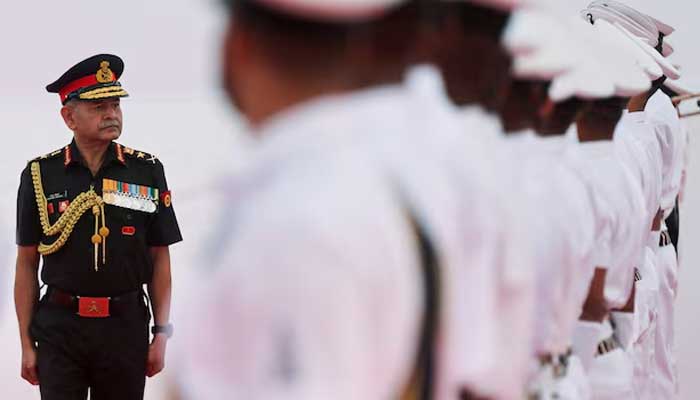
Had the voluble COAS displayed a frisson of resolve and expertise that he was so gamely touting in a press conference, bedecked in military regalia with a golden lanyard, during the four days of May standoff with Pakistan, India would not have been licking its wounds in the suffocating penumbra of a defeat-induced helplessness.
The press conference appeared to be directed at the domestic audience to placate the wounded pride of a nation drunk on Hindutva supremacism and to assuage the anguish of an army that had tasted defeat at the hands of a foe ten times smaller.
The murmurs of discontent arising out of the Indian army in the wake of the unpopular ‘Agnipath’ scheme may also have been the target. The Indian army has adopted a scheme of early retirement of soldiers ostensibly to reduce the pension costs, concealing the actual motive of saffronising a professional force through rapid turnover of young inductees, in order to consolidate the ideological chokehold of RSS over the Indian Army. The homilies, boasts, and projections smacked of a ‘professional parvenuism’ adopted with alacrity by the defeat-soused sensibilities of the Indian Army.
The boasts and claims about the Indian Army’s war performance and HODR (Humanitarian Operations and Disaster Relief) achievements need no analysis, as enough has already been written about the reversal suffered by the Indian military juggernaut in war as well as in peace in places like the north-east, Kashmir and the Red Corridor. What needs to be focused upon is the aspirational thrust of the Indian military leadership’s thinking.
The Indian COAS was apparently under pressure to demonstrate military intent to open an elusive space for conventional war, thereby justifying heavy military spending on a non-performing military instrument. In a Freudian slip, the Indian army chief indicated his fond desire – creating space for the conventional war under a nuclear overhang against Pakistan. In marked contrast, however, his tone and tenor toward the Chinese were timid and conciliatory.
Despite a volley of journalist queries related to Line of Actual Control (LOAC), Ladakh and Arunachal Pradesh, the Indian army chief remained unmoved, mentioning only the need for more border meetings, joint patrolling and de-escalation. The response differed when Pakistan and the eastern border were mentioned. Perhaps he was trying to justify the capital outlay of 80,000 crore plus before MOD bureaucrats, while raising the spectre of a Pakistani threat.
Operation Sindoor, as per him, was on “pause”, and the army was being reorganised and reequipped to achieve operational objectives that had eluded the Indian Army during the May standoff.
He made false claims about Pakistani casualties on LOC during the May standoff and made the false claims of keeping six bases of militants across LOC in AJ&K. Doctrinally he mentioned the need for 12-13 rapidly deployable Integrated Battle Groups (IBGs) along with their complementary Support Groups (for logistic self-sustenance of 72-96 hours), each commanded by a major general, to achieve spatial objectives through better mobility, enhanced firepower range and logistical suppleness, while remaining below the nuclear threshold of Pakistan. The first four IBGs are being created out of the two divisions of the Indian Army’s 17 Mountain Strike Corps. Later, out of 1, 2 and 21 Strike Corps, 8-9 IBGs would be created.
The reorganisation of the infantry battalions and brigades through inclusion of Ashni drone platoons, counter Unmanned Aerial System capabilities and EW detachments is aimed at facilitating the new doctrine of shallow territorial bites under the fire umbrella of own air and missile forces. The RUDRA brigades (intended scale 7-8) are being raised, comprising a combined-arms mix of armour, mechanised infantry, air defence, artillery, UAV & counter UAV sections and special forces. These combined arms capabilities have a clear spatial objective to make shallow penetrations.
Pakistan’s Rocket Force Command was cited as a concept worth emulation, suggesting enhanced ranges for Pinaka systems and conventional rockets. Pakistan was estimated to possess 5000 drones, and to counter this, over 10000 drones were planned in the first phase, with drone platoons integrated into infantry battalions and, later, into armoured regiments.
The integration of AI into information operations is also being planned, with Air Littoral and ground spaces covered through AI-supported decision support systems at the IBG, Corps, Army and Tri-Service levels, to shorten the Observe, Orient, Decide, and Act (OODA) Loop. The raising of 15 Bhairav (Light Commando Battalions) is also an intended objective to strengthen the tactical strike capability of IBGs and RUDRA brigades.
The explicit mention of a full spectrum of Non-Contact Kinetic, Contact Kinetic and Non-Kinetic Contact modes by General Upendra Dwivedi is a clear indication of India’s future intentions. The atomisation of the Strike Corps in combined arms brigade plus formations along with focus on rocket artillery, special operations and AI driven unmanned weapon systems like drone swarms indicates that India intends to fight the next round on ground, seeking some territorial objectives, while saturating our defensive responses through EW dominance and use of long range vectors like enhanced range Pinakas, conventional use missiles and armed drones/loitering munitions against our sensitive military and civilian installations.
Why the Indian Army is entertaining delusional notions of attaining territorial objectives through ground incursions, in a nuclearised environment that effectively constrains the space for conventional operations, is a question that can be best addressed to the Indian political leadership, whose religiously driven death wish imperils the lives of one fourth of humanity.
The writer is a security and defence analyst. He can be reached at: [email protected]