WASHINGTON: US President Donald Trump urged Iranians on Tuesday to keep protesting and said help was on the way, without giving details, as Iran’s clerical establishment pressed its crackdown against the biggest demonstrations in years.
“Iranian Patriots, KEEP PROTESTING — TAKE OVER YOUR INSTITUTIONS!!!...
HELP IS ON ITS WAY,” Trump said in a post on Truth Social, adding he had canceled all meetings with Iranian officials until the “senseless killing” of protesters stopped, a British wire service reported.
The unrest, sparked by dire economic conditions, has posed the biggest internal challenge to Iran’s rulers for at least three years and has come at a time of intensifying international pressure after Israeli and US strikes last year.
Following the US president’s post, Iranian security chief Ali Larijani said on social media platform ‘X’ that Trump and Israeli Prime Minister Benjamin Netanyahu were the “main killers” of the Iranian people.
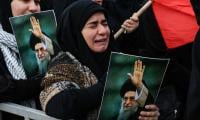
An Iranian official said about 2,000 people had been killed in the protests, the first time authorities have given an overall death toll from more than two weeks of nationwide unrest, though the official gave no breakdown.
US-based rights group HRANA said that of the 2,003 people whose deaths it had confirmed, 1,850 were protesters. It said 16,784 people had been detained, a sharp increase from the figure it gave on Monday.
On Monday evening, Trump announced 25 percent import tariffs on products from any country doing business with Iran -- a major oil exporter. Trump has also said more military action is among options he is weighing to punish Iran over the crackdown.
Tehran has not yet responded publicly to Trump’s announcement of the tariffs, but it was swiftly criticised by China. Iran, already under heavy US sanctions, exports much of its oil to China, with Turkey, Iraq, the United Arab Emirates and India among its other top trading partners.
Iran’s foreign minister Abbas Araqchi said on Monday he had continued to communicate with US special envoy Steve Witkoff during the protests and that Tehran was studying ideas proposed by Washington. Iranian authorities have accused the US and Israel of fomenting the unrest.
Russia on Tuesday condemned what it described as “subversive external interference” in Iran’s internal politics, saying any repeat of last year’s US strikes would have “disastrous consequences” for the Middle East and international security.
Despite the protests, the economic strains, and years of external pressure, there are as yet no signs of fracture in the security elite that could bring down the clerical system in power since a 1979 Islamic Revolution.
Britain, France, Germany and Italy all summoned Iranian ambassadors in protest over the crackdown. “The brutal actions of the Iranian regime against its own people are shocking,” the German Foreign Ministry said on ‘X’. Underscoring international uncertainty over what comes next in Iran, which has been one of the dominant powers across the Middle East for decades, German Chancellor Friedrich Merz said he believed the government would fall.
“I assume that we are now witnessing the final days and weeks of this regime,” he said, adding that if it had to maintain power through violence, “it is effectively at its end”.
He did not expand on whether this forecast was based on intelligence or other assessments.
Araqchi dismissed Merz’s criticisms, accusing Berlin of double standards and saying he had “obliterated any shred of credibility”.
The head of Iran’s judiciary has said specialised courts have been appointed to deal with protests.
Parliament member Mohammadreza Sabaghian, who represents an area in Yazd, in central Iran, said the government needed to resolve people’s dissatisfaction, otherwise “the same events will occur with greater intensity”.
Communications restrictions including an internet blackout have hampered the flow of information. The UN rights office said phone services had been restored but internet links with Iran remained patchy.
The Iranian Intelligence Ministry said it had confiscated electronic devices intended to be used in the protests, according to a statement carried by state media.
Sayyed Atollah Mohajerani, who served as Iran’s minister of culture from 1997-2000, said the US’s threats on Iran are nothing new. “From the beginning of our revolution [until] this time, we have had this experience many times, of America attacking Iran”, he tells Al Jazeera.
He dismissed charges of a brutal crackdown on protesters by the Iranian government, saying that things only turned violent after more than a week of civil unrest, blaming outside influence over armed groups inside Iran for the deaths that have occurred.
Meanwhile, TIME says despite the bellicose rhetoric, the Pentagon has not surged aircraft carriers or strike groups into the region. Gulf allies, still wary after Iranian missile strikes during last year’s brief war with Israel, have also shown little appetite for hosting American attacks on Iran. “This is another example of the United States inserting itself into something happening in the Middle East with no clear end game,” warns Jon Hoffman, a Middle East expert at the Cato Institute. “Is a single strike going to overthrow the regime? I don’t think so. And clearly that’s going to lead to further calls for more activity.”
“The most likely scenario that would push the US to become engaged militarily would be if it became irrefutably apparent that massive numbers of protesters were being killed by the regime,” says Mona Yacoubian, director of the Middle East Program at the Center for Strategic and International Studies (CSIS). Trump himself has framed lethal repression as a potential trigger for action, but Yacoubian cautioned that the lack of verifiable information makes such a determination difficult.
Absent that threshold, she said, Washington may see more value in continuing to weaken Tehran’s position short of war. “If the Trump Administration felt there was a way to sufficiently weaken the Iranian regime such that it is compelled to come to the table on US terms,” she said, “that might be another driver.”
What seems less likely, several experts said, is a full-throated American push for regime change. Yacoubian argued that military overthrow runs counter to how Trump approaches Iran. Given its position in the Middle East, she noted, Iran is a vastly more complex case than, say, Venezuela, and lacks a unified, organized opposition capable of governing. “An effort to decapitate the regime leads to some level of chaos. And I think the Trump Administration is wary of getting enmeshed in that level of chaos and unpredictability,” Yacoubian says. “Is the President seeking regime change?” asks Behnam Ben Taleblu, senior director of FDD’s Iran Program. “I would say, thus far, the President has not articulated what he’s seeking.” That absence weighs heavily on the military options under consideration. A limited strike—perhaps against an Islamic Revolutionary Guard Corps facility, an intelligence ministry building or a command center—could be designed to signal resolve without igniting a broader conflict. But such strikes risk rallying nationalist sentiment around the regime and foreclosing the possibility of defections within the security forces.
“By attacking those security elements themselves, it’s hard to see how that would push [the Iranian regime] toward dropping their weapons and joining the protesters,” Yacoubian said. “It would likely have the opposite effect.”
Any strikes would likely be carried out in a way that helps protesters rather than drive them back into their homes, Taleblu says.
Officials have also discussed less combative measures, such as cyber operations against Iranian military and government networks, covert action and efforts to restore internet access inside the country. Trump has publicly floated the idea of helping Iranians get online, even suggesting outreach to Elon Musk, whose Starlink service has been partially jammed by Iranian authorities.
“The greatest risk is an actual military strike on Iran,” Hoffman said, describing an administration pulled between hawks urging decisive action and officials wary of another Middle Eastern entanglement. “This is another example of the United States inserting itself into something with no clear endgame.”
For now, that ambivalence is reflected in Washington’s posture. Military assets have not surged toward Iran. Diplomatic channels remain open. And the menu of options remains just that: options. “Israel and the United States would rather see a collapsed, dysfunctional, ruined Iran than the current regime, because they view that as less threatening to their interests,” Hoffman says. Meanwhile, President Donald Trump said in his address in Michigan it’s a “good idea for Americans to leave Iran” as his administration considers action on the crackdown the Tehran regime has conducted on protesters.