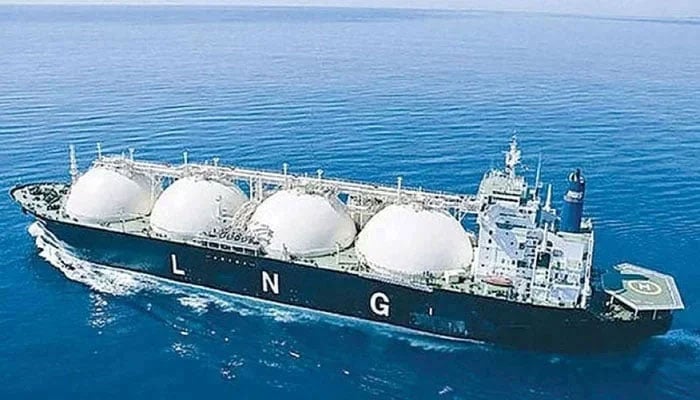
ISLAMABAD: After finalising the annual LNG delivery plan for 2026 with Qatar and ENI, the Power Division has informed the Petroleum Division that the power sector will be unable to utilise an additional nine LNG cargoes worth about $270 million.
This development has once again placed the Petroleum Division in a difficult position, as it may be left with no option but to divert these surplus cargoes to the domestic gas sector, potentially aggravating the country’s already rising circular debt.
Pakistan will import 89 LNG cargoes out of 124 in 2026 -- 88 from Qatar and 1 from ENI.
“The electricity demand outlook for 2026 has been revised downward, mainly due to increased solarisation and a lower projected GDP growth rate,” a senior official at the Petroleum Division told The News. “Last week, the Power Division formally conveyed that it would not be able to consume nine more RLNG cargoes in 2026, despite the fact that the annual delivery plan has already been finalised with Qatar and ENI.”
Under the agreed plan, 35 LNG cargoes, valued at over $1 billion, will be diverted to international market players. These diversions are expected to generate around Rs160 billion annually, which would help in retiring a portion of the gas circular debt.
Of the 35 cargoes, 24 will be diverted by Qatar and 11 by ENI. Pakistan LNG Limited (PLL) has a 15-year agreement with ENI—an Italian LNG trading company—under which ENI supplies one LNG cargo per month at 12.14 per cent of Brent.
Meanwhile, Pakistan’s gas circular debt has surged to Rs3,200 billion, largely due to a sharp increase in late payment surcharge, which alone stands at Rs1,450 billion, officials said. Of the remaining Rs1,750 billion, around Rs210 billion has accumulated due to income tax and GST, while the actual stock of circular debt is estimated at Rs1.5 trillion.
Previous governments led by PML-N and PTI had signed two long-term LNG supply agreements—one for 15 years at 13.37 per cent of Brent and another for 10 years at 10.2 per cent of Brent—on a take-or-pay basis with sovereign guarantees. Significant investments were also made in privately managed RLNG terminals, RLNG pipelines, and four RLNG-based power plants in Punjab.
However, the power sector is now increasingly reluctant to use RLNG for electricity generation, as RLNG-based power does not rank high on the economic merit order. Consequently, electricity produced from RLNG leads to an increase in the overall power tariff basket.