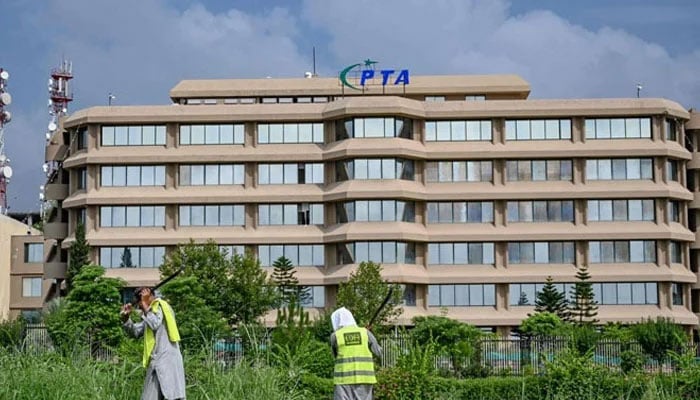
ISLAMABAD: Pakistan Telecommunication Authority (PTA) on Friday night issued an information memorandum (IM) for the auction of Next Generation Mobile Services (NGMS)/5G technology in Pakistan.
According to an IM issued by PTA, the NGMS/5G auction will offer 597.2 MHz of spectrum below 6 GHz. This includes additional spectrum in two existing IMT bands (1800 and 2100 MHz) and newly available spectrum in four additional IMT bands (700, 2300, 2600 and 3500 MHz) that have not previously been allocated to cellular mobile operators in Pakistan.
The duration of the licence shall be fifteen (15) years from the Licence Effective Date of the licence. Cellular Mobile Licence(s) are renewable on terms & conditions applicable under GoP policy applicable at the time of renewal.
As a pre-condition for participation in the NGMS/5G auction, operators are required to agree to participate in a future replanning/rationalisation/refarming of each frequency band, including existing spectrum holdings and newly assigned spectrum in NGMS/5G Auction, if this is required by PTA and FAB on spectrum management grounds, irrespective whether they have acquired spectrum in that particular band in this NGMS/5G or otherwise.
The purpose of this obligation is to facilitate future configuration of the 900 MHz, 1800 MHz, 2100 MHz and other bands for IMT services and ensure that any future spectrum sold in any frequency band can be efficiently integrated with spectrum sold in this auction and prior allocations. Any future reconfiguration would follow industry consultation, and prioritise contiguity and creation of 5G compatible blocks, while also minimising frequency position shifts (if possible).
Spectrum caps impose limits on the amount of spectrum in specific bands or across bands that a bidder can buy as 4 caps are imposed in the NGMS/5G Auction for the purposes of precluding certain auction outcomes with significant asymmetries in spectrum holdings between MNOs that could give rise downstream competition concerns now or in the future.
The following caps will apply to each qualified bidder in the auction: (1) 348.5 MHz for all IMT spectrum holdings (including existing spectrum and spectrum acquired in the auction). This corresponds to 40 percent of total spectrum available post auction;
(2) 55 MHz for all low band IMT spectrum holdings, i.e. 700 MHz + 850 MHz + 900 MHz bands (including existing spectrum and spectrum acquired in the auction);
(3) 140 MHz (14 lots) in 2600 MHz band; and (4) 200 MHz (20 lots) in the 3500 MHz band. iii) Based on their current spectrum holdings, the existing MNOs would be subject to caps on their individual demand in the auction.
In addition, new entrant having no existing IMT spectrum will not be allowed to bid for spectrum in the 1800 MHz band; iv) Considering acquisition of Telenor by PTCL, either of the three i.e. PTCL, Ufone & Telenor is allowed to participate in this award process and MergeCo cap will be applicable; and in Spectrum Auction either by Ufone or Telenor.
v) These caps are set sufficiently high that they will allow for competition for and variation between operators in spectrum acquisition. They are also sufficiently tight that they will preclude any single MNO from realising a very large lead in holdings of total spectrum or low-band spectrum, or in spectrum suitable for deploying 4G or 5G capacity.
Licensees must meet phase-specific obligations including site deployments, geographic coverage targets, and fibre-to-the-site (FTTS) ratio milestones. Existing Cellular Mobile Operators who participate and win spectrum in this auction, will have their ongoing rollout along with associated QoS obligations replaced with new obligations along with associated financial instruments.
These obligations are set out in four different phases Phase 1: (2026-2028) (a) During the first phase of implementation, the focus is on deployment of advanced mobile technology in key urban centres, high-demand locations and address coverage gaps;
(b) The rollout obligations are as follows: (i) Deployment of advanced mobile technology with minimum of 1,000 sites per year – at least 20 percent must be completely new sites at new locations (i.e. at least 200 new sites per year); (ii) 4G sites to be proportionately distributed in urban and rural areas in each province; (iii) 5G coverage must be made available in federal and provincial capitals i.e. Islamabad/Rawalpindi, Karachi, Lahore, Peshawar and Quetta. For existing CMOs at least 10 percent equivalent of existing 4G/LTE sites in each city to be rolled out for provision of 5G services each year in federal and provincial capitals; (iv) FTTS ratio to be increased to 20 percent of total sites including new sites, with a focus on ensuring robust backhaul connectivity for high demand urban areas; and (v) For New Entrants Only: Deployment of minimum 200 sites per year (at least 20 percent FTTS and 20 percent 5G sites).
Phase 2: (2028-2030) (a) Building on the initial deployment in Phase 1, this phase extends coverage to additional cities, population centres and critical service locations: (i) Deployment of advanced mobile technology at 1,000 sites per year – at least 20 percent must be completely new sites at new locations (i.e., at least 200 new sites per year); (ii) 4G sites to be proportionately distributed in urban and rural areas in each province; (iii) 5G services to be made available in 10 additional cities (at least 2 additional cities from each province, i.e. Punjab, Sindh, KP and Balochistan) with at least 10 percent equivalent of existing 4G/LTE sites (in each of 10 cities) alongside further enhancement of phase 1 cities 5G roll out each year; (iv) 5G service provision in important locations including universities, technology parks, industrial zones, major transit hubs covering motorways, highways, airports, train stations, hospitals and bus terminals to be prioritised; (v) FTTS ratio to be increased to achieve 25 percent of total sites of each MNO including new sites, supported by enhanced fibre deployment to support growing bandwidth demands; and (vi) For New Entrants Only: Deployment of minimum 200 sites per year (at least 20 percent FTTS and 20 percent 5G sites). (3) Phase 3: (2030 - 2032) (a) This phase is focused on expanding coverage and establishing foundational connectivity to support less populated areas.
New Entrants will only be permitted to bid for spectrum in the 700 MHz, 2100 MHz, 2300 MHz, 2600 MHz and 3500 MHz bands. Accordingly, at start of auction, a new entrant will have 340 eligibility points, sufficient to bid for at most 340 MHz. Existing MNOs may be restricted to bid on a smaller aggregate amount of MHz in the main auction owing to the spectrum cap on total holdings.
b) The amount of pre-bid deposit is US$15 million that is a pre-requisite for an application to be considered for evaluation before qualification stage. Therefore, an application must be accompanied by a supporting pre-bid deposit. The purpose of the pre-bid deposit is to demonstrate the applicant’s commitment to the process and its financial viability to support its bids.