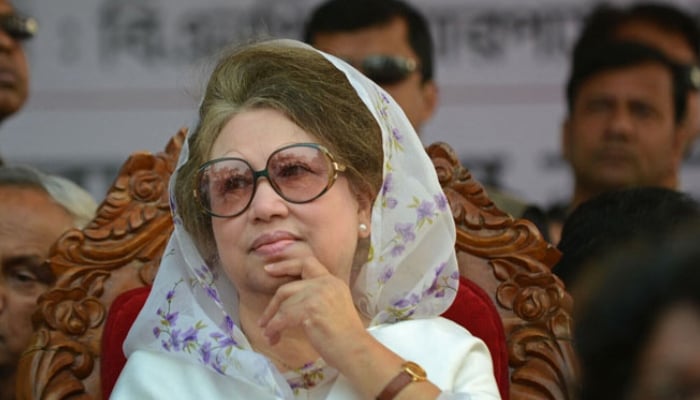
The passing of Begum Khaleda Zia, an uncompromising icon of democracy and sovereignty in Bangladesh politics, has cast a deep pall of grief over the Bangladeshi nation.
Her life reads as a luminous chronicle of political struggle. Widowed at a relatively young age after the assassination of her husband, President Ziaur Rahman, in 1981, Khaleda Zia refused to retreat into private mourning. Instead, she stepped onto the streets, emerging as a central force in the movement to restore democracy and national sovereignty. Her leadership proved decisive during the mass uprising against the autocratic rule of Hussain Muhammad Ershad.
Sheikh Hasina, daughter of Bangladesh’s founding president Sheikh Mujibur Rahman, himself assassinated in 1975, returned to the country after six years in exile in India. In the early years, she accommodated Ershad’s regime before later joining the anti-Ershad movement. Over time, however, and with India’s patronage, Hasina’s politics gravitated towards constructing a cultural and ideological sphere closely aligned with external interests. On questions of cultural identity and territorial sovereignty, Khaleda Zia thus emerged as the people’s most unequivocal refuge.
Following Ershad’s fall, Khaleda Zia became prime minister through a popular mandate in 1991, with the Bangladesh Nationalist Party (BNP) assuming responsibility for governance. Recognising that women constitute half of Bangladesh’s population, she initiated landmark reforms in girls’ education, introducing free schooling up to Grade Eight and stipends that helped craft a brighter future for millions of girls. It was also during her tenure that the vision for the garments industry was first articulated, laying the foundation for a sector that would later become a regional model and significantly expand women’s participation in the workforce.
Backed by India, Sheikh Hasina was encouraged to advance a political narrative rooted in dynastic entitlement; the belief that Bangladesh was, in effect, her father’s inheritance. This view fueled persistent campaigns against Khaleda Zia’s leadership. Ironically, the modern and fashion-conscious Khaleda known for her chiffon saris, was repeatedly branded an ‘Islamist’, even as Hasina herself entered political alliances with Jamaat-e-Islami to counter Khaleda’s influence.
The Islamophobia embedded within India’s Hindutva-driven political imagination ensured that Khaleda Zia remained a constant target. Through coordinated cultural and media campaigns, she was defamed in the run-up to the Awami League’s rise to power in 1996. When Hasina assumed office, a long-standing ambition to subsume Bangladesh within India’s strategic shadow appeared fulfilled. Media outlets and cultural organisations aligned with this orientation multiplied, rebranding Hindutva preferences as ‘progressivism’.
Yet in 2001, sovereignty-conscious citizens delivered Khaleda Zia a resounding electoral victory. Despite Sheikh Hasina’s own record of alliances with the Jamaat in 1986 and again from 1991 to 1996, and her overt use of religious symbolism during the 1996 election campaign when she returned from Hajj with a black headband portraying herself as a servant of Islam, Hasina’s cultural wing erupted in outrage when the Jamaat later joined Khaleda’s electoral coalition. The Indian media played a central role in recasting Khaleda as an extremist Islamist, even though she herself consistently refrained from religious display and remained steadfast in her personal lifestyle choices.
India’s late politician Pranab Mukherjee, in his autobiography ‘Coalition Years’, detailed how an understanding with Bangladesh’s army-backed interim administration in 2007–08 facilitated Sheikh Hasina’s return to power. Upon assuming office in 2009, Hasina moved swiftly to marginalise Khaleda Zia and the BNP. That same year witnessed the Pilkhana massacre, which claimed the lives of numerous promising army officers, an event later linked by investigative reports to Indian involvement.
As India’s influence penetrated Bangladesh’s military and intelligence institutions, Khaleda Zia was systematically sidelined. Through three one-sided elections in 2014, 2018 and 2024, Hasina consolidated a de facto one-party state. Khaleda was evicted from her residence; state agencies, compliant media and cultural fronts unleashed relentless defamation; her late husband, a decorated freedom fighter, was recast as a ‘Pakistani agent’, and the legacy of the Liberation War was monopolised as dynastic property. Khaleda herself was imprisoned on fabricated charges.
In a joint India-Hasina project of repression, political opponents were labelled Islamist terrorists and subjected to enforced disappearances, extrajudicial killings, torture and detention in secret interrogation facilities known as Aina-ghar. But even under this suffocating fascist order, where the state itself seemed transformed into a laboratory of oppression, Khaleda Zia remained defiant. “Bangladesh is my only home”, she declared, issuing a rallying cry that would later resonate across generations: Take Back Bangladesh.
That call resonated during the July Revolution of 2024, when students and citizens rose against discrimination and authoritarianism. Through extraordinary courage and blood sacrifice, Bangladesh’s youth dismantled the architecture of fascism and forced Sheikh Hasina and her accomplices in crimes against humanity to flee to India. After years of illness and repression, Khaleda Zia was finally seen smiling in freedom, standing alongside the revolutionary youth. On Armed Forces Day, a new generation gathered around her, the Mother of Sovereignty, to pledge allegiance to a democratic Bangladesh grounded in an authentic cultural identity.
The struggle, however, did not end there. The recent assassination of Osman Hadi, a leader of the anti-aggression cultural movement, underscored the enduring reach of external interference. Planned from across the border, his killing was met with celebration among Hindutva supporters online, while Indian media again branded him an extremist Islamist. In response, youth-led protests have reignited at Hadi Square (Shahbagh) in the heart of Dhaka, demanding an end to hegemony and distortion.
It is at this critical juncture that Khaleda Zia’s voice has fallen silent. The Mother of Bangladesh’s sovereignty is no more. Yet her death is not a signal for retreat. The most authentic tribute to her life and legacy lies in advancing democracy, restoring sovereignty and safeguarding a cultural identity that belongs unmistakably to the people of Bangladesh.
The writer is the editor-in-Chief of E-SouthAsia. He can be reached at: [email protected]