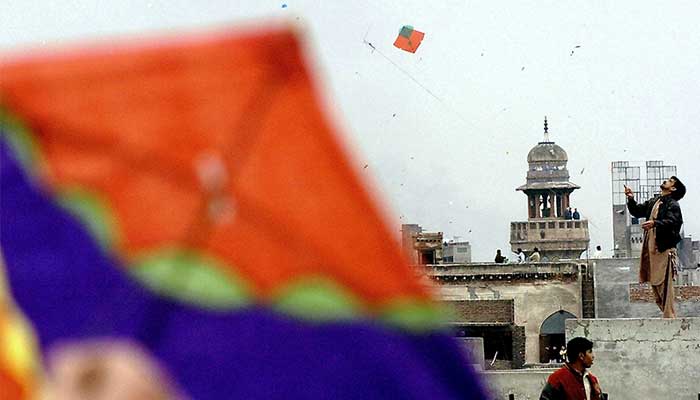
As the wait begins for Basant to be celebrated in Lahore for the first time since it was banned in 2007, people watch and wait with both excitement and tension. There is hope that there will be no catastrophic injuries and there will be a willingness to follow the guidelines worked out by the Punjab government.
For many, the Punjab Kite Flying Ordinance 2025, which restores colour to Lahore's skies, is critical. Basant has been at the heart of Lahori culture and lifestyle for centuries, with kites spotted in miniature paintings during the Mughal era. The ban in 2007 came not only as a result of the fatalities and accidents on the roads, but also due to a religiously led campaign equating Basant with a different religion. This, of course, is simply a lie. Basant is essentially a Punjabi celebration, marked by people from all faiths and all walks of life.
Its loss has meant a snatching away of something which stands at the heart of our culture. Kites have indeed caused accidents. But then cars and other road vehicles also cause much worse damage virtually each day in all parts of the country. Everyone knows that the answer is to regulate the use of these vehicles, not ban them. The same applies to kites. The SOPs put in place by the Punjab government restrict the kind of string that can be used to fly kites, placing a ban on spool-fed string and instead limiting use only to the ‘pinna’, and setting in place rules for the size of the kites which can be flown. There is, of course, already controversy. Experts argue that the size of a kite does not affect its capacity to pull a long taut string, and that even small kites flown with the now-illegal glass-covered ‘manjha’ can be equally dangerous. This, however, is a debate that will be sorted out only in the times to come.
At present, we have a situation where an entire generation has grown up without ever flying a kite or feeling the pull of the ‘dor’ in their hands. They have never seen the skies of Lahore covered with splashes of colour from kites or the colourful displays in shops selling them. For them, this would be a first-time experience. But for many, the excitement is inherited from the memories of parents, for whom kite-flying was a way of life.
The propaganda against kites has, in some ways, tampered with a few spirits, but for the vast part, Lahore has strongly welcomed the return of kites from February 6-8, and there is an immense response to the event, even in the hearts of children who have yet to experience their first kite. The importance of kites for Lahoris was illustrated recently by a journalist who described how, while in Karachi, he rushed to a kite shop, bought kites for his young sons, and then attempted to teach them the intricacies of flying them at a beach in Karachi. He knew the magic that came with kite-flying and wished to pass it on to his children. There are literally millions who want the same thing.
But Basant represents a little more than that. It is an integral part of our heritage and our culture. Snatching it away means ending a tradition that has existed for many hundreds of years, and leaving a generation bereft of the wonder of Basant and all that comes with it. This today includes night flying, with white kites lit up by flood lights placed on rooftops and, of course food, which is vital to Lahore and its people. The yellow colour of the dresses worn mainly by young girls and women on Basant will also return, or so we hope.
We can only wish that the years without the kites have not taken away from the people of Lahore the intrinsic values of Basant and the equality it brings, with kites flown by people of all income groups and all religions. Of course, the rich can afford bigger, better kites. But even then, a small ‘guddi’ can cut the strings of the largest ‘patang’ in the sky. This and the simple budget of a sky filled with so much colour that it defeats the wonder of a rainbow lie at the heart of Basant.
There are, however, some questions to be asked. What will happen if the rules put in place do not prevent the accidents that accompany Basant in an already overcrowded city? We hope that this will lead to other measures being taken so that Basant is a safe event, and not a time to be feared. We also wonder how the next generation will learn how to fly kites when no kites are flown throughout the year and are allowed only from February 6 to 8. Three days are not enough to master the skills and nuances that are involved in expert kite flying. These were learned traditionally over the days of the entire year, and notably the winter season, when it became possible to be out in the open for longer periods of time.
These questions will need to be answered one by one and piece by piece. What is essential is that Basant be restored to Lahoris. It is the one festival on the calendar that is essentially secular in spirit and meaning. It must return to a city that desperately needs joy and also needs the crores of rupees that Basant brought, along with the tourism it generated, year after year, earning a place on more than one list of the world’s biggest events. It has to return for the sake of Lahore, and indeed for the sake of its economy as well as for the generations which have not seen kite-filled skies.
The writer is a freelance columnist and former newspaper editor. She can be reached at: [email protected]