I was working on my computer in that strange, in-between hour – somewhere between the night of December 15 and the first hour of December 16, 2025 – when something felt off.
Outside my apartment, the crows suddenly started cawing like they knew something I didn’t. Loud, restless, unsettled. It broke the stillness of the night in a way that made my stomach tighten. A line from an old Sindhi saying floated up in my mind: “Raataan rarray kangrri, deenhaan rarray siyar, ya eendo zilzilo, ya siru wanjau saalar.” [If crows cry at night or jackals howl during the day, either an earthquake is coming – or the ruler will fall].
I was still half-smiling at the memory when the jolt hit. Folk wisdom can never be wrong.
The tremor – 5.2 on the Richter scale – shook the apartment hard enough to make the windows rattle. My daughter and son ran towards me, wide-eyed, asking what was happening. For a few seconds, it felt like the whole city held its breath. The quake passed quickly, but it left behind that familiar Karachi feeling: fear mixed with resignation, and the quiet knowledge that we live on ground that never truly sleeps.
Later, geologists tried to reassure us. They said the recent string of small tremors might be the earth releasing pent-up stress bit by bit – maybe even lowering the chances of a big one. But the keyword was ‘might’. Karachi’s geology doesn’t give easy comfort.
This city sits at the messy meeting point of three tectonic plates – the Arabian, Indian and Eurasian. Beneath us runs a web of active, unpredictable and uncharted fault lines. The Landhi Fault cuts under the industrial east. The Rann of Kutch fault system lies to the northeast. To the west lies the Makran subduction zone, one of the most dangerous seismic regions in South Asia. And to the north, another fault slices through Dadu.
Seismologists keep reminding us that the Makran zone, which triggered the massive 8.1 earthquake and tsunami in 1945, hasn’t released its built-up pressure in decades. Some estimate a slip deficit of up to nine metres – enough to unleash a quake well above magnitude 8.
History backs them up. This region has been shaken apart more times than we like to remember. In 893 AD, Debal – the ancient port near today’s Karachi – was destroyed by a powerful quake. In 1668, a 7.6 quake devastated Auranga Port near Shah Bundar, reportedly sinking tens of thousands of homes. In 1819, the earth rose to form the 90-km-long Allah Bund, drowning entire villages. The 1945 Makran quake sent 12-metre-high tsunami waves crashing along the coast, killing thousands. Even the 2001 Bhuj earthquake, far away in India, cracked buildings across Karachi.
And yet, despite all this, Karachi remains frighteningly unprepared.
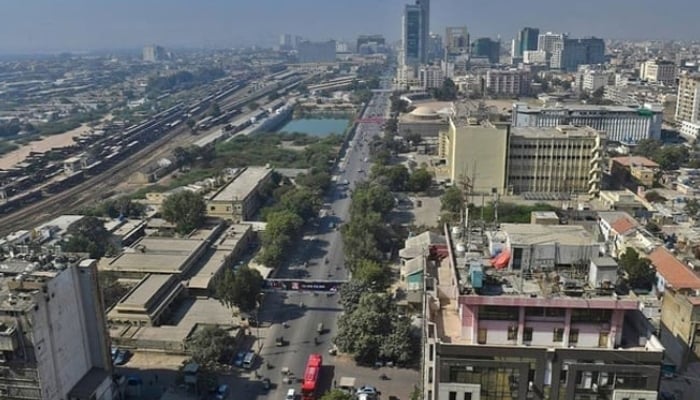
Decades of chaotic expansion have wiped out the city’s natural buffers. Creeks, lagoons and mangroves – once shock absorbers for both floods and seismic shifts – have been filled, blocked or poisoned. Gizri Creek is now a housing colony. Obhayo Lagoon, cut off by the Mai Kolachi Bridge, has turned into the stagnant, polluted waters of Boat Basin.
Meanwhile, high-rises keep sprouting across reclaimed and unstable coastal land, often with little enforcement of seismic safety codes. In DHA, Clifton, Korangi – places built on soft, shifting soil – the risk of liquefaction during a strong quake is very real. Even the ports that keep Pakistan’s economy alive sit uncomfortably close to active fault lines, with no serious emergency planning in sight.
Cities like Los Angeles and Tokyo have spent decades preparing for the worst – early-warning systems, strict building codes, public drills. Karachi, by contrast, keeps gambling with geology. Our preparedness is mostly talk, mostly afterthought, mostly cosmetic.
There’s still time to change that – but maybe not much.
The tremors of December 2025 weren’t just random shakes. They were reminders. Whether they mean the earth is slowly releasing pressure or quietly gearing up for something bigger, the message is the same: silence is not safety.
In a city where history lies buried beneath our feet, and where the earth itself remembers, ignoring these warnings is dangerous.
The writer is an expert on climate change and sustainable development and the founder of the Clifton Urban Forest. He tweets/posts @masoodlohar and can be reached at: [email protected]