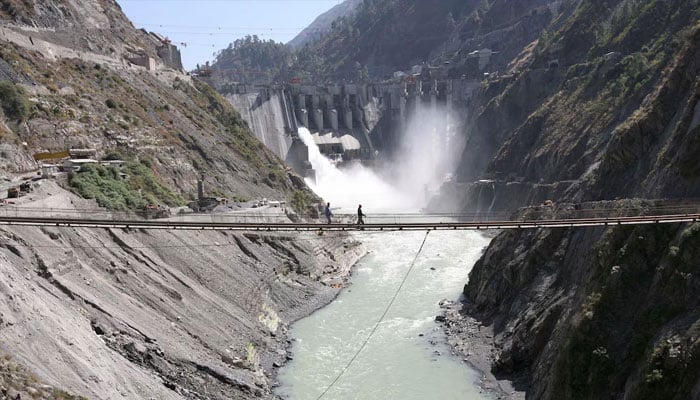
ISLAMABAD: In a flagrant violation of the Indus Waters Treaty (IWT), India has finally given approval to the Dulhasti Stage-II hydropower project on Chenab River in the Indian Illegally Occupied Jammu and Kashmir (IIOJ&K).
Th project would cost 3,277.45 crore Indian rupees and work could be started on the disputed hydropower project early next year. The project will be developed by a public sector Indian company NHPC Limited and is expected to cost Rs3,277.45 crore.
Sources told The News here Saturday that Dulhasti Stage-II project will generate up to 260 megawatts of electricity.
The project could be detrimental from defence and strategic point of view for Pakistan. Chenab River falls within Pakistan’s territory and Dulhasti Stage-II construction would negate IWT which India has declared as suspended by defying international agreements.
Dulhasti Stage-II will utilise the existing infrastructure of Dulhasti Stage-I project. Notably, the 390 MW Dulhasti Stage-I is a run-of-the-river scheme that was commissioned in 2007. The project will utilise the existing dam, reservoir and power intake of Stage-I.
In this phase, water will be drawn from the Marusudar River, which will be brought to the Dulhasti Dam through the Pakal Dul project. The objective is to ensure additional power generation by making maximum use of available water resources. However, while granting environmental clearance, the authorities concerned clarified that this change in water flow could affect the natural form and ecology of the river.
Approximately 25-kilometer stretch of the Marusudar River downstream of the Pakal Dul project will undergo significant hydrological changes after the project becomes operational. The waters of Chenab River Basin have been shared between Pakistan and India under the 1960 IWT, but the Dulhasti Stage-II project has been transgressing the provisions of the treaty.
New Delhi had announced the suspension of the treaty on April 23, 2025. Under the IWT, Pakistan has control over the waters of the Indus, Jhelum, and Chenab rivers, while the Ravi, Beas and Sutlej rivers were under India’s control.
Following the illegal suspension of the treaty, India has decided to fast-track several disputed hydroelectric projects in the Indus Basin. These projects include Sawalkot, Ratle, Bursar, Pakal Dul, Kwar, Kiru, and Kirthai-1 and 2. Dulhasti Stage-II is considered part of this strategy.