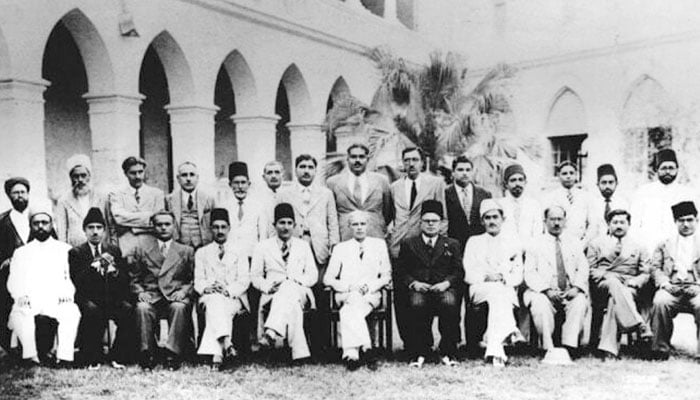
Muhammad Ali Jinnah’s journey from a Western-educated barrister to the Quaid-i-Azam (Great Leader) represents one of the most remarkable political transformations of the twentieth century. He evolved from a staunch advocate of Hindu-Muslim unity within a united India into the chief architect of Pakistan, driven by the conviction that Muslims required a separate homeland to safeguard their political rights, identity, and future. This transfrmation culminated in his leadership of the All-India Muslim League and the creation of Pakistan in 1947.
Born on 25 December 1876 in Karachi, Muhammad Ali Jinnah was the son of merchant Jinnahbhai Poonja and Mithibai. He received his early education at home before enrolling at Sindh Madrasatul Islam in Karachi. He later joined the Christian Missionary Society High School, where he passed his matriculation examination. Jinnah then travelled to England to study law and, after qualifying as a barrister, returned to British India to practise at the Bombay High Court.
As a child, Quaid-i-Azam Muhammad Ali Jinnah displayed an unusual sense of discipline and purpose. Studies came first, and he carried a quiet confidence that set him apart from his peers.
Once, while returning from Sindh Madrasatul Islam, he noticed a group of boys playing marbles in a dusty street of old Karachi. Recognising one of them, Nanji Jaffar, the tall, lean boy paused and advised him to stop playing in the dirt, suggesting cricket instead-a cleaner, more refined game.
At a time when cricket was far from popular, Jinnah’s preference reflected his lifelong values. His love for cleanliness, order, and discipline, evident even in youth, remained defining traits throughout his life and leadership.
During his stay in London, Jinnah was deeply influenced by the liberal political philosophy of William E. Gladstone, who became British prime minister for the fourth time in 1892-the same year Jinnah arrived in England. He also took a keen interest in Indian political affairs and student activism. When Dadabhai Naoroji, a prominent Parsi leader and nationalist, contested elections for the British Parliament, Jinnah actively campaigned for him alongside other Indian students. Their efforts bore fruit when Naoroji became the first Indian member of the House of Commons.
Upon returning to Karachi in 1896, Jinnah discovered that his father’s business had suffered significant losses, forcing him to rely solely on his own efforts. He chose to establish his legal practice in Bombay, a task that required years of perseverance before he earned recognition as a leading lawyer.
Jinnah’s legal brilliance came to national attention during the landmark 1908 “Caucus Case.” As a young advocate, he successfully challenged a European-dominated clique-known as the “caucus”-that sought to prevent Sir Pherozeshah Mehta from securing a seat on the municipal council. The caucus promoted its own candidate, Suleman Abdul Waheed, who held municipal contracts. Representing Mehta, Jinnah argued that Waheed was legally disqualified due to a conflict of interest. The Chief Judge accepted Jinnah’s arguments, disqualified Waheed, and declared Mehta elected. The verdict not only thwarted the caucus’s designs but also firmly established Jinnah’s reputation as a formidable legal mind.
Muhammad Ali Jinnah married Emibai in 1892. Following her early death, he married Rattanbai Petit in 1918, who later embraced Islam and was known as Maryam Jinnah.
Jinnah’s interest in national politics deepened early in his career. He formally started his political career by attending the 20th annual session of the Indian National Congress in Bombay in December 1904. At the time, he was among those Congress members who strongly believed in Hindu-Muslim unity as the basis for achieving self-government. He later joined the All-India Muslim League, where he emerged as a powerful advocate for Muslim political rights and eventually as the undisputed leader of the Pakistan Movement.
Despite his tireless efforts, Jinnah grew disillusioned with Indian politics in the early 1930s and moved to England, intending to settle there permanently. Recognising the gravity of the situation, Mirza Bashiruddin Mahmud Ahmad sought to persuade him to return so that he could resume leadership of the Muslim cause. He instructed Maulvi Abdur Rahim Dard, then Imam of the London Mosque, to approach Jinnah.
Maulvi Abdur Rahim Dard held several meetings with Jinnah and eventually convinced him to re-engage with Indian politics. On Dard’s invitation, Jinnah attended an Eid-ul-Adha gathering at the Fazl Mosque in London in April 1933, where he delivered a speech on India’s political future. The address attracted widespread attention and was covered by prominent British and Indian newspapers, including The Statesman, Madras Mail, The Hindu, and The Sunday Times.
The Pakistan Times later reported:
“It was Mr Liaquat Ali Khan and Maulana Abdur Rahim Dard, an Imam of the London Mosque, who persuaded Mr M. A. Jinnah to change his mind and return home to play his role in national politics. Consequently, Mr Jinnah returned to India in 1934 and was elected unopposed to the Central Assembly.”
(Pakistan Times, 11 September 1981, Quaid-i-Azam Anniversary Supplement)
With renewed determination, Quaid-i-Azam resumed his struggle for the political emancipation of Indian Muslims, receiving consistent support from Mirza Bashiruddin Mahmud Ahmad at critical junctures.
Jinnah’s relentless efforts ultimately led to the creation of Pakistan in 1947. He was acclaimed as the Quaid-i-Azam and became the country’s first Governor-General. Revered as the founder of the nation, he worked tirelessly to establish the new state, frame its policies, and address the humanitarian crisis caused by the mass migration of millions. He also appointed Chaudhry Muhammad Zafrulla Khan as Pakistan’s first foreign minister.
On August 11, 1947, in his historic address to the first Constituent Assembly of Pakistan, Quaid-i-Azam declared:
“Life, property, and religious beliefs must be fully protected by the state... My guiding principle will be justice, fair play, and complete impartiality in the discharge of my duties.”
Thus, Muhammad Ali Jinnah’s journey from a curious and disciplined child to the revered Quaid-i-Azam was marked by immense struggle, intellectual rigour, and political evolution. His transformation-from a promising barrister to the founding father of Pakistan-was driven by unwavering discipline, sharp intellect, and a profound vision for the dignity and future of his people.
-The writer is doing her M.Phil from History department of Karachi University