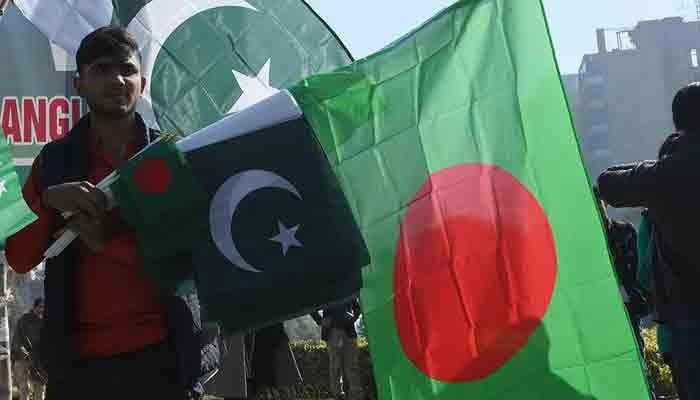
Relations between Pakistan and Bangladesh have been improving since the ouster of former prime minister Sheikh Hasina Wajid in August 2024.
The thaw in bilateral ties, however, doesn’t render irrelevant the question of the events leading to the creation of Bangladesh on December 16, 1971. Before that, the territory of Bangladesh formed part of the federation of Pakistan and was known as East Pakistan.
In a nation where making sweeping generalisations is a stock-in-trade of both politicians and the intelligentsia, it’s convenient as well as alluring to point the accusing finger at one person – Yahya, Bhutto, Mujib or even General Niazi – for the country’s dismemberment. In fact, the separation of East Pakistan was the culmination of a long process spanning two decades and cannot be attributed to the ambition or stubbornness of a single general, politician or political party.
The federation of Pakistan had two remarkable features, which played a no small role in its eventual dismemberment. One was the absence of geographical contiguity between its two wings, which were more than a thousand miles apart, separated by India. Thus, from the very outset, India was in a position to undermine the territorial integrity of its smaller neighbour.
Although in 1947 the Indian National Congress (INC) reluctantly acquiesced in the creation of Pakistan, the partition of India on the basis of religion ran counter to the Indian nationalism espoused by the party. Therefore, post-independence India’s leadership wasn’t expected to let go of any opportunity to break up Pakistan, not least to send out the narrative that Muslim nationalism didn’t rest on secure foundations. Not surprisingly, after the creation of Bangladesh, the then Indian prime minister Indira Gandhi swankily stated that they had consigned the Two-Nation Theory to the Indian Ocean.
Two, culturally and economically, the two wings represented a marked contrast: Whereas West Pakistan was ethnically diverse, East Pakistan was ethnically homogeneous, which made it easier to make a common cause against a common ‘adversary’. Whereas West Pakistan was essentially a feudal society, East Pakistan had only a vestige of feudalism. The East Pakistanis were politically more conscious than the West Pakistanis. West Pakistan was economically more prosperous and advanced than East Pakistan, posing a challenge for policymakers to invest more funds in the region, where the return on scarce capital was likely to be lower. Finally, population-wise, the eastern wing was larger than the western wing, accounting for nearly 54 per cent of the country’s total population.
In the interest of the integrity of the federation, it was imperative that the federating units were given full autonomy, adequate representation in the state apparatus and an equitable share in economic development, and that its various ethnic nationalities were welded together. The former necessitated holding regular elections and transferring power to the elected representatives of the people.
As for welding various ethnic groups, the country needed a strong and stable political party, much like the Congress in India, with a nationwide base. However, both those requirements remained unfulfilled.
Most of the frontline leaders of the Muslim League hailed from Muslim minority provinces, which after Partition were included in India. Therefore, they lacked a popular base in Pakistan. Apprehensive of their defeat, those leaders were averse to seeking a popular mandate. Hence, it took more than 23 years to hold the first nationwide elections in Pakistan.
It isn’t that the eastern wing had little representation in the upper echelons of power. Khwaja Nazimuddin, the second governor-general and also the second prime minister of Pakistan, hailed from East Pakistan. Iskandar Mirza, the last governor-general and the first president of Pakistan, who promulgated the country’s first nationwide martial law in 1958, was ethnically a Bengali. Likewise, both Mohammad Ali Bogra (PM from April 1953 to August 1955), and Huseyn Suhrawardy (PM from September 1956 to October 1957), were from East Pakistan.
That said, politicians’ legitimacy rests on popular mandate. Since none of the aforementioned leaders had won a popular mandate, their legitimacy as genuine representatives of East Pakistanis remained doubtful.
Since political and economic power go hand in hand, a lack of an adequate share of political power also hampered the economic development of the eastern wing, giving rise to acute deprivation and discontent among its people.
East Pakistan’s discontent with the ruling elite was reflected in the 1954 provincial assembly elections in which the United Front, an anti-Muslim League alliance, made a clean sweep and formed government in the province. However, within two months of its formation, the Front government was sacked and governor's rule was clamped on the province.
Amid all the confusion and uncertainty, the government announced general elections in 1959. But the elections, which were to be held on the basis of adult franchise, would have transferred power from West Pakistan to East Pakistan, as population-wise the former was smaller than the latter. But in October 1958, president Iskandar Mirza abrogated the constitution, declared martial law and asked army chief General Ayub to take over.
During Ayub’s ten-year rule, things went from bad to worse. The made-for-Ayub 1962 constitution reduced provincial autonomy to a minimum, denied representative government and concentrated powers in the office of the president. The powers, which were effectively exercised by a West Pakistan-dominated civil service elite, further alienated East Pakistanis.
Political deprivation was accompanied by economic deprivation. When Ayub assumed power, the per capita income of the two wings differed by 30 per cent; by the time the general was forced to step down, the gap had more than doubled to 61 per cent.
The growing alienation of East Pakistanis was articulated in the famous six points of Mujibur Rehman. Enunciated in 1966, these points, inter alia, called for separate military and currency for both regions with a very weak centre. Although those points also demanded a federal form of government, there is little doubt that, if fully implemented, they would have vitiated the federal character of the constitution and created a confederation.
It was on the basis of the six points that the AL contested, and surprisingly swept, the first-ever general elections in Pakistan held in 1970. In East Pakistan, the AL won 151 out of 153 seats for the National Assembly. However, the AL failed to win a single seat in the western wing. Conversely, in West Pakistan, the Pakistan People’s Party (PPP) headed by Zulfikar Ali Bhutto, emerged as the single largest party. However, the PPP could not win a single seat in the eastern wing. It was obvious that neither party had an across-the-country base – a capital condition for holding a federation together.
The total number of National Assembly seats was 300, which meant that the AL was in a position to form the government on its own. But since the party had achieved electoral success on the basis of the six points, the people who mattered were reluctant to transfer power to it. Though during his meetings with President Yahya, Mujib had assured him that once in the assembly he would try to tone down his six points so as to preserve the federation, the government was doubtful whether he could be trusted.
Bhutto sought to have the six-point issue resolved before the National Assembly convened. At any rate, democratic conventions required the president to invite Mujib to form the government. But no such conventions existed in Pakistan.
The military government’s delay in transferring power to the AL caused grave unrest in East Pakistan. In desperation, the central government launched a military action to quell the uprising. The operation, it is widely believed, was miscalculated. The military action and the subsequent military intervention by India led to the dismemberment of Pakistan.
The writer is an Islamabad-based columnist. He tweets/posts @hussainhzaidi and can be reached at: [email protected]